

If you have ever written an IA research question that felt “ambitious,” you know the quiet thrill: it sounds like a real academic problem. It feels grown-up. It feels like you are aiming high.
Then you start writing.
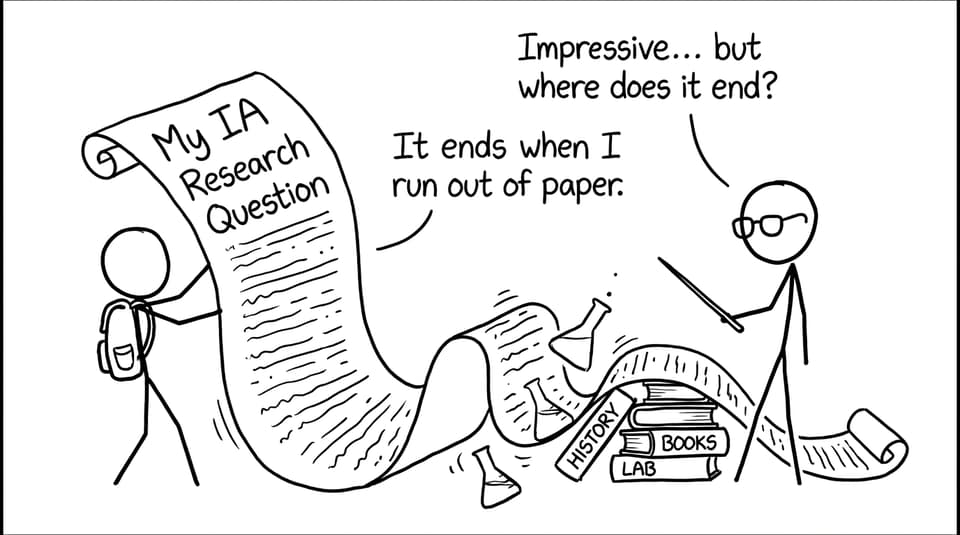
Suddenly your IA becomes a crowded room. Every paragraph invites another paragraph. Every source opens three more doors. And the question that once felt powerful starts to feel… foggy.
Most IA research questions are too broad for a simple reason: students confuse scope with quality. In IB, marks come from precision.
The quick checklist for a focused IA question
Before you commit, run your IA research question through this filter:
-
Can you answer it in one clear claim (not a summary)?
-
Does it focus on one relationship (cause/effect, comparison, impact, trend)?
-
Are the variables, timeframe, and context tightly limited?
-
Can you realistically collect or analyse enough evidence within IB constraints?
-
Will the question naturally lead to evaluation, not just description?
If you want a structured walkthrough for tightening focus, use RevisionDojo’s Coursework Guide alongside your planning.
Broad IA questions create shallow analysis
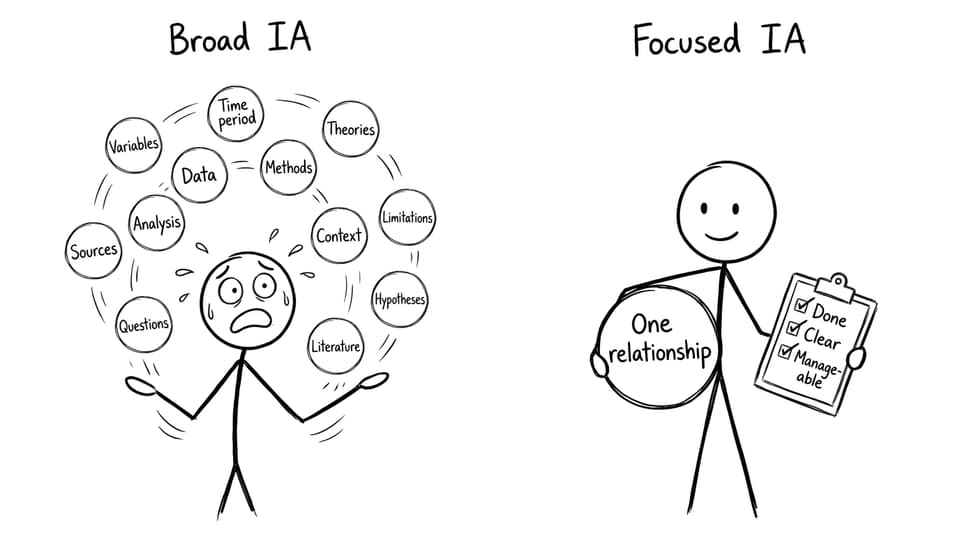
A broad IA question forces you to spread your thinking across too much territory. The result is often “coverage”: a bit of everything, but nothing with teeth.
In practice, a broad IA leads to:
-
Many claims with minimal evidence
-
Paragraphs that explain rather than analyse
-
Conclusions that sound reasonable but feel generic
Examiners are not looking for the student who mentions the most ideas. They reward the student who can show a clear chain of reasoning and defend it.
For a deeper framework, see How to Write a Strong IA Research Question and compare it to your current draft.
Students mistake complexity for width
A high-scoring IA can absolutely be complex. But complexity in IB is usually built from depth, not breadth.
A broad IA question often tries to do too many of these at once:
-
multiple variables
-
multiple case studies
-
long time periods
-
several concepts or theories
The irony is that narrowing your IA can make it feel more “advanced,” because you finally have room to do what IB rewards: interpret patterns, justify choices, and evaluate limitations with specificity.
A useful read here is The Difference Between a Good IA Question and a High-Scoring One. It explains why some questions cap marks even when the writing is solid.
Broad IA questions weaken evaluation (and that caps marks)
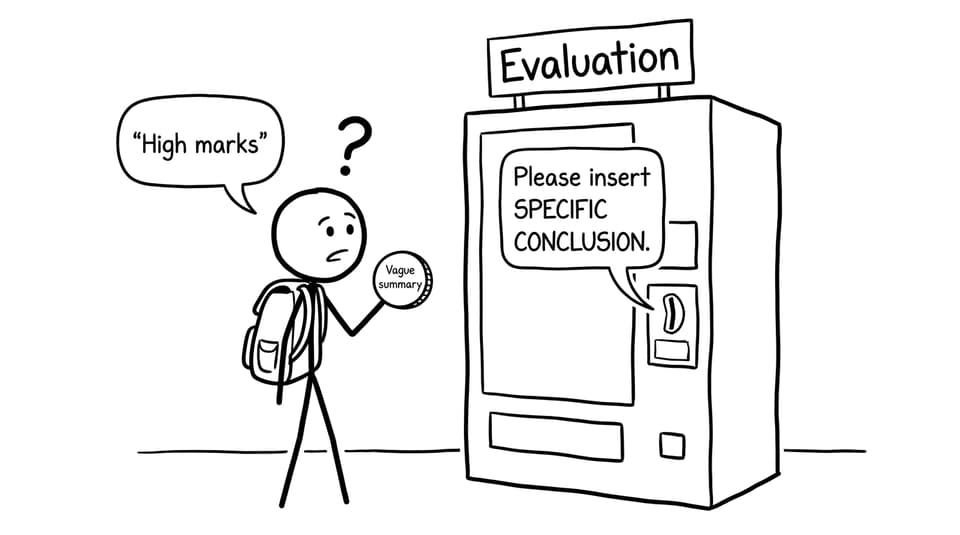
Evaluation needs something concrete to judge.
When your IA question is too broad, your evaluation becomes:
-
vague (“more data would be helpful”)
-
descriptive (“the results show many factors”)
-
hard to justify (“it depends” without a clear argument)
A focused IA gives you a smaller target, which makes your judgment sharper. Your limitations become specific. Your improvements become realistic. Your conclusion becomes a defendable answer.
If you are unsure whether your question is setting you up for weak evaluation, use How to Tell If Your IB IA Research Question Is Weak as a diagnostic.
Why broad IA questions feel “safer” (but aren’t)
Most students choose a broad IA because it feels protective:
-
“If one angle fails, I can pivot.”
-
“If I keep it general, I won’t get stuck.”
-
“If it sounds big, it sounds impressive.”
But broad scope usually creates more rewrites, not fewer. You end up collecting material you cannot use, then cutting it, then rebuilding structure around a question that keeps shifting.
A calmer approach is to narrow early and iterate within a small space. That is where RevisionDojo’s tools help: the AI Chat can challenge your assumptions, the Grading tools can flag “description vs evaluation,” and the Coursework Library can show what focused exemplars look like.
To explore the wider set of IA resources, start at RevisionDojo’s IA Guides hub.
How to narrow a broad IA question in 10 minutes
Take your current IA question and apply one of these “tighteners”:
-
Limit the context: one location, one text, one population, one dataset.
-
Reduce variables: pick one main independent variable and one dependent variable.
-
Add a boundary: a specific time window, condition, or comparison group.
-
Switch the verb: replace “explore” with “to what extent,” “how significant,” or “how does X affect Y.”
Then test it with targeted practice: use RevisionDojo’s Questionbank to strengthen exam-style thinking while you refine your coursework writing. That cross-training matters: the same precision that earns marks in papers is the precision that makes a strong IA.
If you want a topic-first approach, How to Choose the Perfect IA Topic for IB Students pairs well with this narrowing process.
Closing: the best IA questions feel slightly “too specific”
A broad IA question promises freedom, but it often delivers stress. A focused IA question looks modest on paper, yet it gives you room to think like the IB rewards: analyse, justify, evaluate.
If you want to lock that focus in early, use RevisionDojo’s Coursework Guide and the IA Guides, then lean on RevisionDojo’s Study Notes, Flashcards, Questionbank, AI Chat, Grading tools, Predicted Papers, Mock Exams, Coursework Library, and Tutors to keep both coursework and exam prep moving in the same direction.
Your IA does not need to be bigger. It needs to be sharper.