

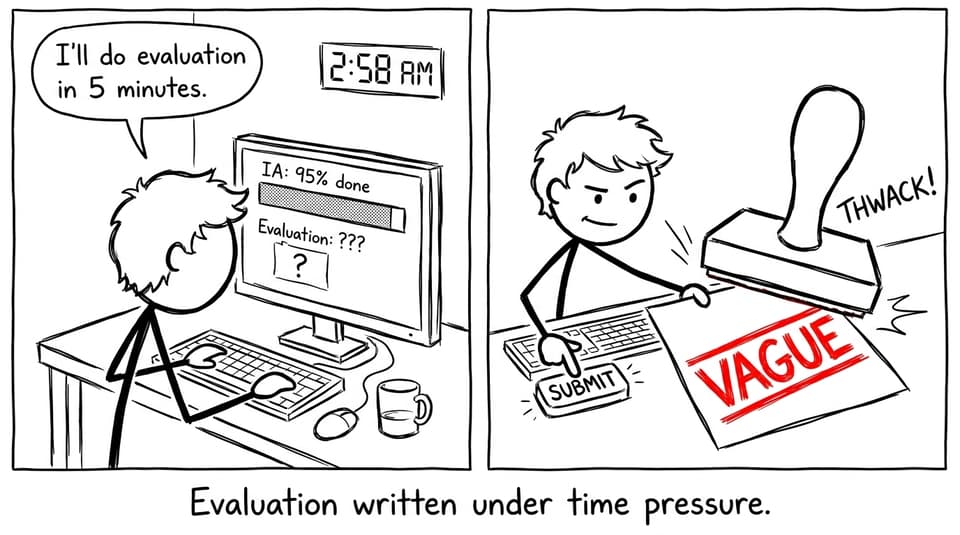
If your IA evaluation feels like the last five minutes of a long run, you’re not alone. Most students reach the end of their investigation, glance at the rubric, and write the academic version of “stuff happened.” Then they wonder why the marks don’t move.
The quiet truth is that the IA evaluation isn’t a confession booth. It’s where you prove you can think like a careful researcher: you connect flaws to evidence, explain impact on results, and propose fixes that would actually change the quality of the investigation.
A quick checklist for a strong IA evaluation
Before you rewrite anything, check whether your IA evaluation does these five things:
-
Names the most important limitation (not every possible one)
-
Explains the impact on your data, trend, or conclusion
-
Uses evidence (a data point, anomaly, uncertainty, method detail)
-
Proposes a specific improvement that is realistic
-
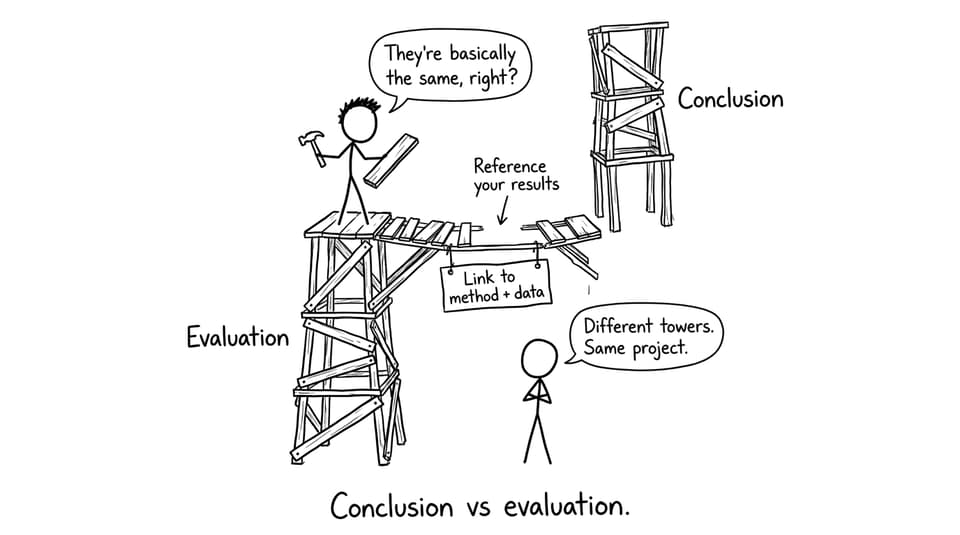
Separates evaluation from your conclusion (different job, different paragraph)
If you want an examiner-focused model, start with How to Write Evaluation That Actually Earns IA Marks.
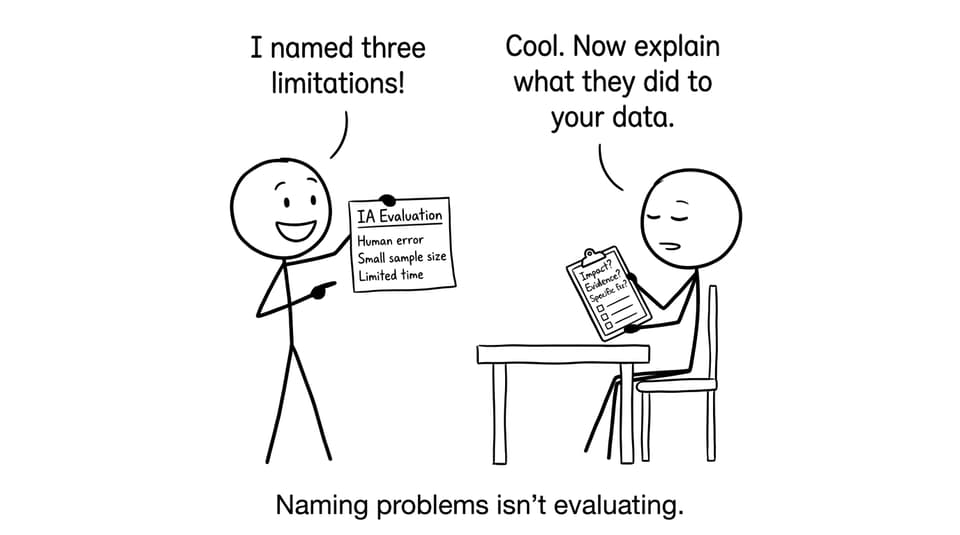
The #1 reason IA evaluation is weak: it’s generic
Many IA evaluations read like they were pre-written and pasted in:
-
“Human error occurred.”
-
“Small sample size.”
-
“Time constraints.”
The issue isn’t that these can’t be true. The issue is that they don’t mean anything until you show what they did to your results.
Try this upgrade:
-
Weak: “Small sample size reduced reliability.”
-
Strong: “With only 10 trials, the mean shifted by 0.4 when I removed one outlier, suggesting the trend is sensitive to single anomalous readings. This lowers confidence in the conclusion.”
That’s what turns an IA evaluation into analysis.
For more structure, How to Write a Compelling IA Evaluation Section breaks this down step-by-step.
The second reason IA evaluation is weak: it’s disconnected from your own work
Examiners reward evaluation that is anchored to what you actually did in the IA. That means referring back to your method, your data processing choices, and specific patterns in the results.
A useful test: if you could swap your evaluation with a friend’s and it still “fits,” it’s probably not specific enough.
To calibrate what examiners look for across subjects, read What IB Examiners Look for in a Strong IA and Comparing IA Expectations Across Different IB Subjects.
The third reason IA evaluation is weak: “critical” gets misread as “self-destructive”
Some students think a top-band IA evaluation means tearing the project apart. But being critical is about judgment, not drama.
Balanced evaluation sounds like:
-
“This control worked well because…”
-
“This limitation matters because it biases results in this direction…”
-
“This improvement is realistic within school constraints and would reduce uncertainty by…”
If you’re unsure what “good judgment” looks like, browse IB IA Guides for rubric-aligned expectations.
The fourth reason IA evaluation is weak: improvements are vague
“Do more trials” and “control variables better” are placeholders, not improvements.
A high-quality IA evaluation explains:
-
exactly what you would change (equipment, design, sampling, measurement)
-
how you would implement it
-
why it improves validity or reliability
Example:
-
Vague: “Use more precise equipment.”
-
Specific: “Replace the ruler with a digital caliper (±0.01 mm) and take three measurements per trial, averaging them to reduce random error.”
IA evaluation should not steal time from exam prep
It’s easy to let coursework swallow revision season. A calmer strategy is to keep two lanes open: improve your IA while protecting exam memory.
RevisionDojo is built for that rhythm: use Study Notes to stay anchored to the syllabus, Flashcards for daily recall, and Questionbank sets to keep exam technique sharp. When you return to your IA draft, use AI Chat to ask, “What is the impact of this limitation on my conclusion?” and refine one paragraph at a time. If you want fast criterion-by-criterion feedback, the Grading tools and Mock Exams help you spot gaps early, while Tutors can pressure-test whether your evaluation claims are defensible.
For a timing strategy, see Which IA Should You Start First? A Calm IB Strategy.
A stronger IA evaluation is a skill, not a confession
Most IA evaluations are weak because they name problems without proving impact, and propose improvements without showing how they would change results. Fix those two habits and your evaluation stops being a rushed add-on and becomes the section that signals maturity.
If you want the cleanest next step, use the RevisionDojo Coursework Guide and the Coursework Guide hub to see how examiners interpret evaluation. Then iterate: tighten one limitation, add one impact sentence, and rewrite one improvement so it’s specific enough to execute. That’s how an IA evaluation starts earning marks instead of leaking them.