


If you have ever tried to revise the whole IB in one sitting, you know the feeling: your desk gets busier, your mind gets quieter, and somehow the hours disappear without leaving much behind.
The problem usually is not effort. It is direction.
Mastering one subject at a time works because the IB is less like reading a book and more like training a skill. You do not get better by touching everything once. You get better by staying with one thing long enough to notice what you do not understand, fix it, and prove the fix under exam-style pressure.
The one-subject rule (and why IB students resist it)
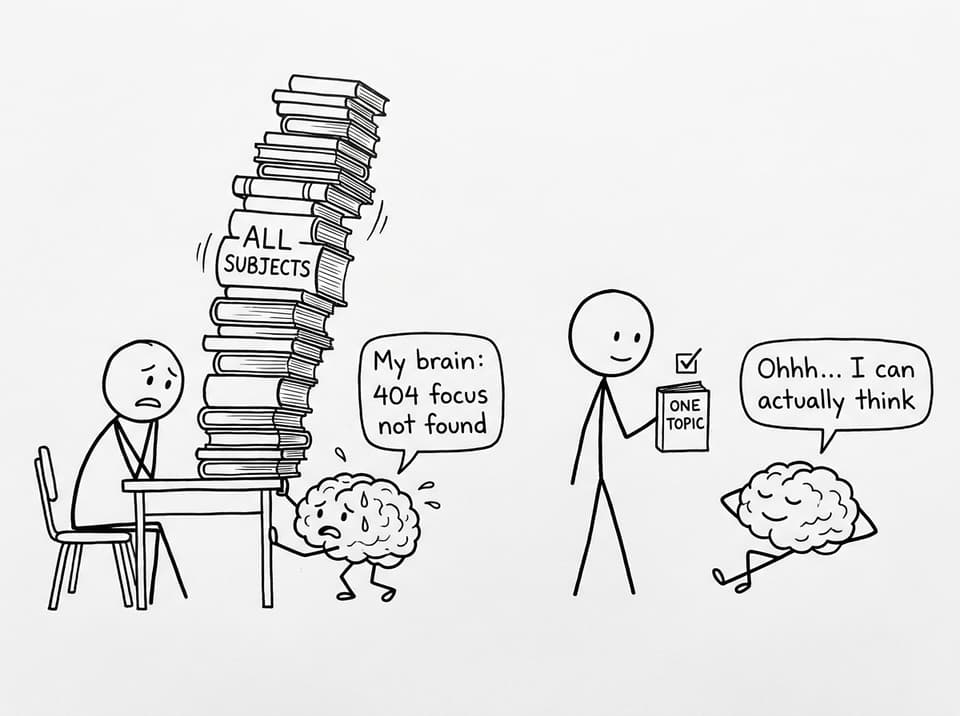
IB students often plan revision like a motivational poster: a little Biology, a little History, a little Math, then a quick look at Chemistry “so it does not get neglected.” It looks balanced. It feels responsible.
But it usually creates shallow reps.
When you switch subjects too frequently, you pay a hidden tax: context switching. In IB terms, it is the time spent remembering the method, the vocabulary, the command terms, and the marking logic for that subject. That tax is small once. It is huge when you pay it ten times a day.
Focusing on one subject at a time reduces that tax and increases depth. You start seeing patterns: the exact phrasing that repeats, the steps you always skip, the definitions you “kind of” know until a question asks for precision.
To make that focus practical, build your sessions around targeted questions, not vague reading. A great starting point is RevisionDojo’s guides on question practice, like IB Question Bank: Thousands of Practice Questions and IB Question Bank | How to Use It Effectively.
A simple IB checklist for single-subject mastery
Use this mini checklist to turn “I revised” into “I improved”:
-
Pick one IB subject for today (only one).
-
Pick one topic inside that subject.
-
Do a short topic test (10-25 minutes).
-
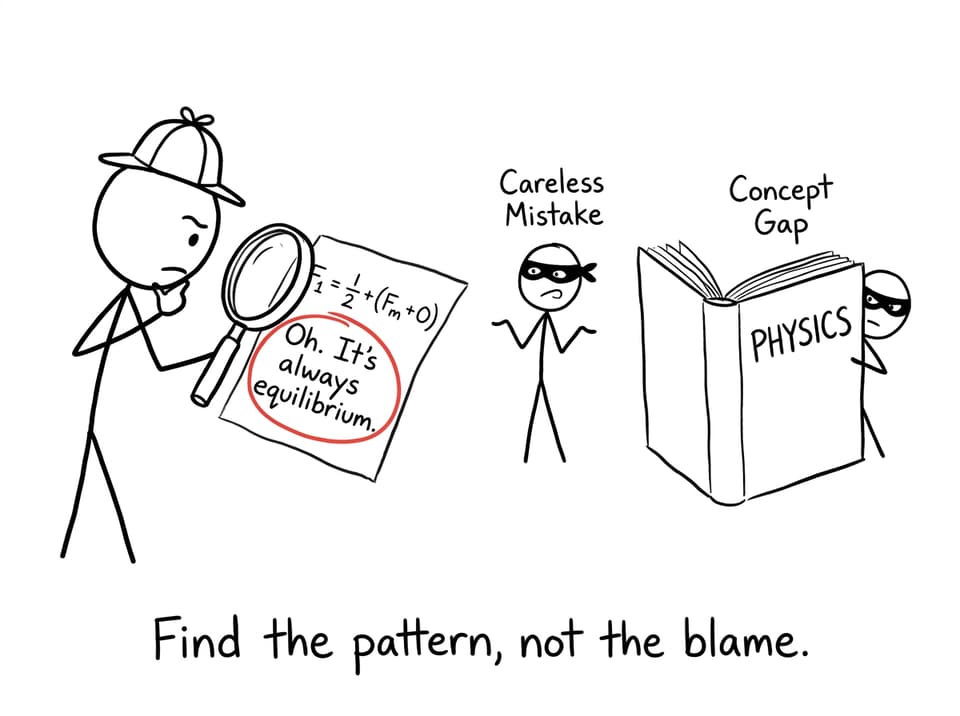
Review mistakes and label them (concept gap, command term, careless error, timing).
-
Fix with a tiny resource loop: notes → flashcards → retest.
-
End by saving a “next set” for tomorrow.
If you need a bigger structure around this, keep a tab open for How to Study for IB Exams: Step-by-Step Guide.
Why topic tests beat full-paper panic (early on)
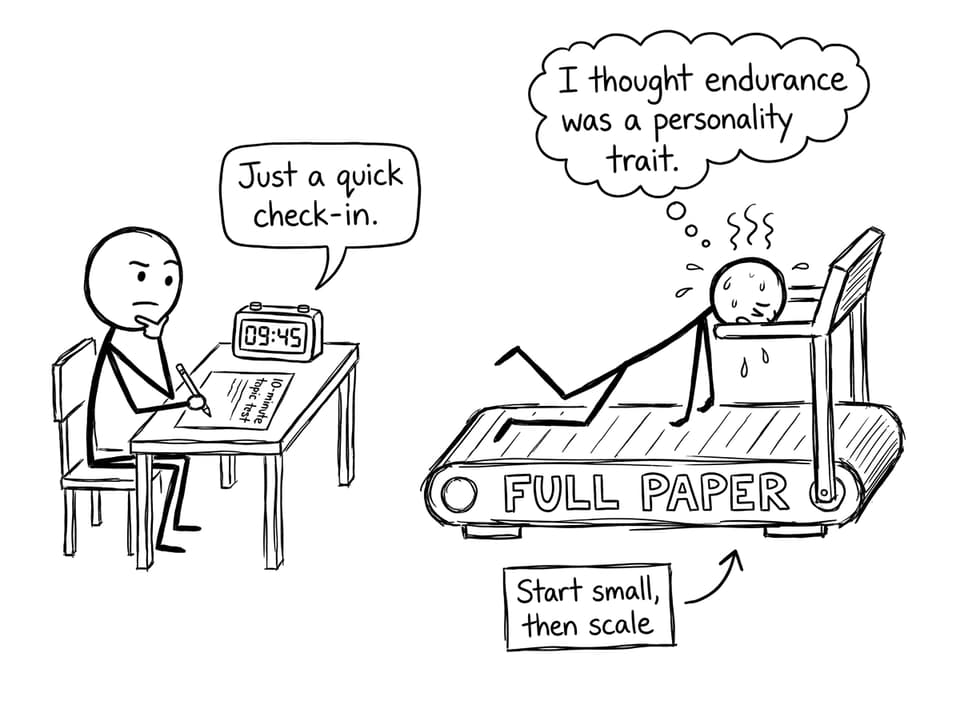
Full papers matter in IB prep, but they are a terrible starting point if your foundation is shaky. They blur the diagnosis.
A low score on a full paper can mean anything:
-
you forgot a definition,
-
you misunderstood a single core process,
-
you misread command terms,
-
you ran out of time,
-
or you simply met too many weak areas at once.
Topic tests remove the fog. When you isolate one unit (say, equilibrium or photosynthesis), your mistakes become specific enough to fix.
RevisionDojo is built around this kind of specificity: the Questionbank lets you drill by topic, and the AI Chat can explain why an answer earns marks in IB language. When you want to expand into timed practice, you can step up with Mock Exams and Predicted Papers, then use Grading tools to see what your writing is missing.
For scheduling timed practice without burning out, see IB Mock Exam Schedule: How Often Should You Practice?.
The compounding effect: one IB subject mastered makes the rest easier
This is the part students rarely notice until late: deep focus creates momentum.
When you stick with one IB subject for a block of days, you start building a mental “workspace.” Methods come faster. Vocabulary stops feeling foreign. You begin recognising question types instead of reacting to them.
And once one subject is stable, your confidence becomes evidence-based. That matters because IB stress is often uncertainty pretending to be laziness.
A good weekly rhythm is:
-
3-4 focused sessions on one subject (topic tests + review)
-
1 timed mixed session (mini mock or paper section)
-
1 lighter recall session using flashcards
If your mocks have gone badly and you need a reset, the calmest path back is narrower practice with feedback. Use Failed Mock Exams? You Can Still Pass IB as a guide.
How to run a “one-subject” RevisionDojo session
Here is a practical loop many IB students can repeat without friction:
Choose one topic and one question type
Example: Biology genetics short response, or Economics data response.
Do 15-30 minutes in the Questionbank
Keep it narrow. Your goal is not variety. Your goal is clean reps.
If you revise Math this way, the guide How to Use the Questionbank for Targeted Math Revision shows a strong routine.
Review with mark-minded feedback
Use RevisionDojo’s AI Chat and Grading tools to understand what the IB rewards. Then write one “error rule” per mistake.
Turn repeated mistakes into Flashcards
This is where one-subject focus becomes durable. Flashcards are not extra work; they are how you stop paying the same mistake twice.
Step up to Mock Exams when the topic is stable
When you can score consistently on topic tests, add timed practice. For tactics, use IB Mock Exam Tips: Expert Strategies for Better Performance.
Conclusion: the quiet power of mastering one subject at a time
The IB rewards depth under pressure. That is why mastering one subject at a time works: it turns revision from a blur into a feedback loop.
If you want a simple next step, pick one IB subject for today, open RevisionDojo, and run the loop: Study Notes → Questionbank → Flashcards → AI Chat → retest. Then, when you are ready, build confidence with Mock Exams and Predicted Papers, and sharpen your writing with Grading tools, the Coursework Library, and support from Tutors.
One subject. One topic. One honest review.
That is how IB revision starts feeling manageable again.