


A week into exam season, it’s easy to feel like you’re living inside a spreadsheet.
One column is your IB predicted. Another is your “dream university” entry requirement. Somewhere in the margins: a quiet fear that a single number might decide everything.
But here’s the calmer truth: top universities don’t love the IB because it’s dramatic. They love it because it’s useful. It behaves like evidence. It shows not only what you know, but how reliably you can perform across time, subjects, and assessment styles.
And when universities are choosing among thousands of brilliant students, “useful evidence” is the real academic edge.
Quick overview: what top universities read into an IB score
When an admissions officer sees an IB score (or predicted score), they often infer five things:
-
Rigor: you trained in a curriculum known for difficulty and depth
-
Consistency: you sustained performance across two years, not one lucky test
-
Breadth + depth: you can handle specialization without becoming narrow
-
Core academic habits: research, argument, reflection, and deadlines
-
Comparability: they can benchmark you against applicants worldwide
If you want to turn that into marks, you need a practice loop that produces evidence, not vibes. That’s exactly what RevisionDojo is built for: Study Notes for clarity, Flashcards for daily recall, the Questionbank for exam-style practice, AI Chat when you’re stuck, and Grading tools to understand how marks are actually awarded.
Why IB matters in competitive admissions: the “comparison problem”
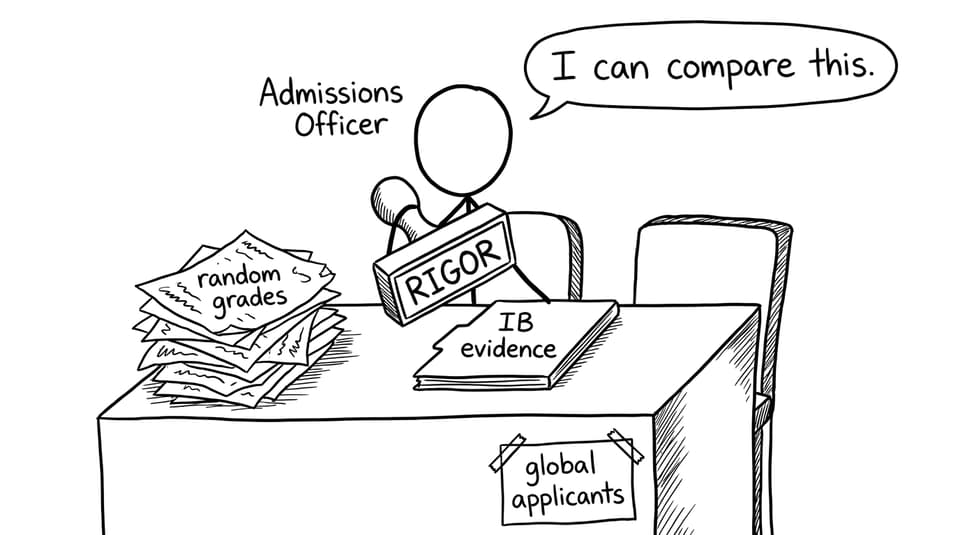
Top universities face a quiet logistical problem: they receive applicants from different schools, grading systems, and course standards. A 92 in one country can be wildly different from a 92 in another. Even within the same city, grading can drift.
The IB helps solve that.
Because it’s internationally recognized and structured, it gives admissions teams a shared language. The value isn’t that the IB is “better” than other pathways. The value is that it’s interpretable at scale.
That’s also why predicted performance matters in many systems: universities aren’t just selecting for talent; they’re selecting for the likelihood you’ll meet conditions, thrive, and persist.
If you’re trying to understand how predictions function emotionally (and how to respond if yours feels low), this is a useful read: IB Predicted Grades Don’t Define You (Here’s What Does).
The academic edge: what IB reveals that grades alone often miss
IB shows rigor without needing a footnote
Many applicants claim they took “the hardest classes available.” In the IB, that claim is built into the framework: Higher Level vs Standard Level, external assessments, internal assessments, and structured mark schemes.
For selective universities, rigor is a proxy for future workload tolerance. They’re not asking, “Are you smart?” They’re asking, “Will you keep showing up when it’s difficult?” The IB is two years of that question, answered repeatedly.
IB proves you can do breadth and still go deep
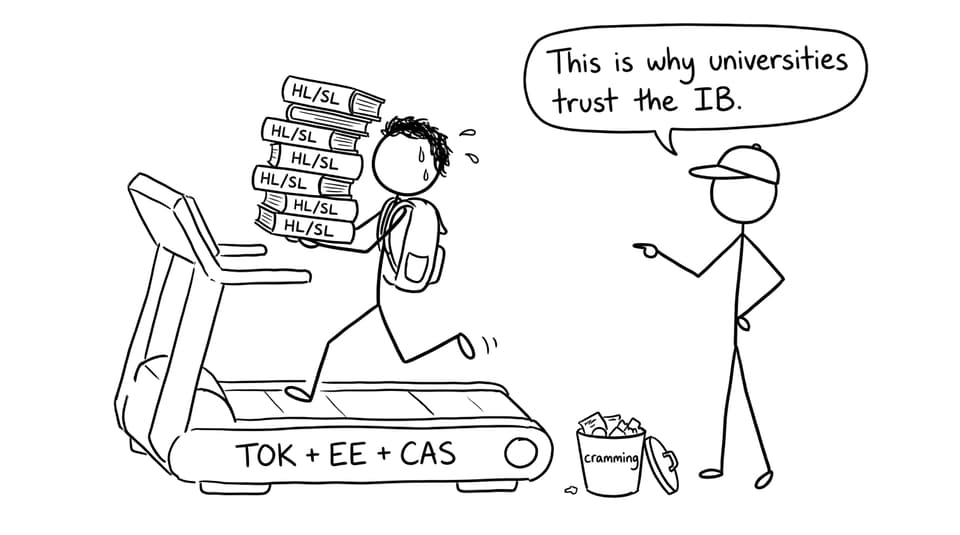
The IB forces a kind of academic adulthood: you can’t hide in only your strengths. You study languages, humanities, sciences, and math. You write. You analyze. You calculate. You revise.
That breadth matters because most top universities are multidisciplinary ecosystems. Even in highly specialized degrees, you’re still expected to read widely, argue clearly, and learn quickly.
A strong IB profile is a signal that you can switch modes: from lab thinking to essay thinking to problem-solving, without collapsing.
IB trains core skills universities depend on
The standout advantage isn’t the content. It’s the habits.
-
The Extended Essay teaches research structure, academic integrity, and long-form writing.
-
Theory of Knowledge trains you to examine claims, not just repeat them.
-
CAS shows you can sustain commitments and manage time around academic pressure.
In other words, the IB tests the skills universities are tired of teaching from scratch.
If you’re building a study routine that matches those demands, start here: How to Study for IB Exams: Step-by-Step Guide.
How top universities actually use IB scores
Predicted scores shape offers (especially in the UK and beyond)
In systems that rely on conditional offers, predicted IB scores help universities decide whether to extend an offer and what conditions to attach (for example, a total score plus specific Higher Level requirements).
Predicted scores aren’t a prophecy. They’re a planning tool for universities. Your job is to treat them as a training baseline and build evidence that you can improve.
RevisionDojo supports that with a simple, repeatable loop: drill weaknesses in the Questionbank, patch gaps using Study Notes, lock in recall with Flashcards, and use AI Chat plus Grading tools to align your responses with markscheme logic.
Universities convert IB into their own internal comparisons
Some universities translate IB scores into local equivalents like GPA bands, entry tariffs, or credit/placement decisions. The exact conversion varies, but the intent is consistent: create a workable comparison across applicant pools.
That’s why it’s worth tracking where you currently sit relative to your targets. A practical tool for this is the IB Grade Calculator, which helps you estimate outcomes from practice marks using grade boundaries.
Higher Level choices can matter more than the total
Total points matter, but so does subject relevance.
If you’re applying for a degree that expects math depth, or strong writing, or lab experience, universities may look closely at your HLs and your performance in those areas.
This is one reason timed practice matters: HL questions often punish “almost right” thinking. You need fluency under time pressure, not just understanding.
For stamina-building practice, RevisionDojo’s IB Predicted Papers are designed to simulate exam conditions and decision-making, while Mock Exams (inside the platform) help you rehearse pacing and mark allocation.
What you can do now: an IB prep checklist that also helps admissions
Here’s a short checklist that improves your IB score and quietly strengthens your university readiness at the same time:
-
Know your target requirements (total + HL specifics)
-
Run weekly timed practice (one paper or section, then proper review)
-
Keep a mistake log (patterns, not just questions)
-
Turn weak points into Flashcards (small, daily, ruthless)
-
Use markscheme language in your writing and explanations
-
Protect sleep because recall is biology, not motivation
If you need the exam-season pacing plan, keep this open: IB Exam Week-by-Week Survival Guide.
Where RevisionDojo fits: turning IB effort into measurable gains
A big reason students plateau in the IB is that they work hard in a way that produces little feedback.
RevisionDojo is designed to fix that.
-
The Questionbank gives you high-volume, exam-style practice with fast feedback loops.
-
Study Notes help you relearn only what you need, aligned to what gets tested.
-
Flashcards keep recall alive when your schedule gets messy.
-
AI Chat helps you get unstuck quickly without losing an hour to confusion.
-
Grading tools teach you the difference between “good” and “marked as good.”
-
Predicted Papers and Mock Exams help you rehearse the pressure.
-
The Coursework Library lowers stress around IA/EE/TOK expectations.
-
Tutors are there when you need human diagnosis, not generic advice.
If you want a full study-system view, this pairs well with today’s topic: How to Prepare for IB Final Exams Efficiently: 10 Proven Strategies.
Closing: the real reason an IB score opens doors
Top universities don’t chase the IB because it’s fashionable. They use it because it compresses something messy, potential, into something readable.
Your job, as an IB student preparing for exams, is to make that readability work for you. Train in a way that produces proof: timed attempts, clear feedback, fewer repeated mistakes, and steady improvement.
If you want one place to run that entire loop, start here: RevisionDojo for IB. Use the Questionbank to target weak topics, Study Notes to rebuild fast, Flashcards to keep recall sharp, and Predicted Papers plus Mock Exams to rehearse the real pressure.
The score is a number. The edge is the system you build to earn it.