



A marker once described reading an IA like following a hiking trail in fog. You might start on a clear path, with a promising research question and a confident introduction. Then, somewhere around page six, the trail splits. You keep walking anyway. You add an extra theory paragraph, a fascinating statistic, a second mini-topic “just in case.”
And by the time you reach the conclusion, the marker isn’t asking “Is this smart?” They’re asking, “What is this actually trying to prove?”
That’s why unclear focus is one of the fastest ways for an IA to lose marks. Not because you lacked effort. But because focus is assessed constantly, and drift quietly caps your score.
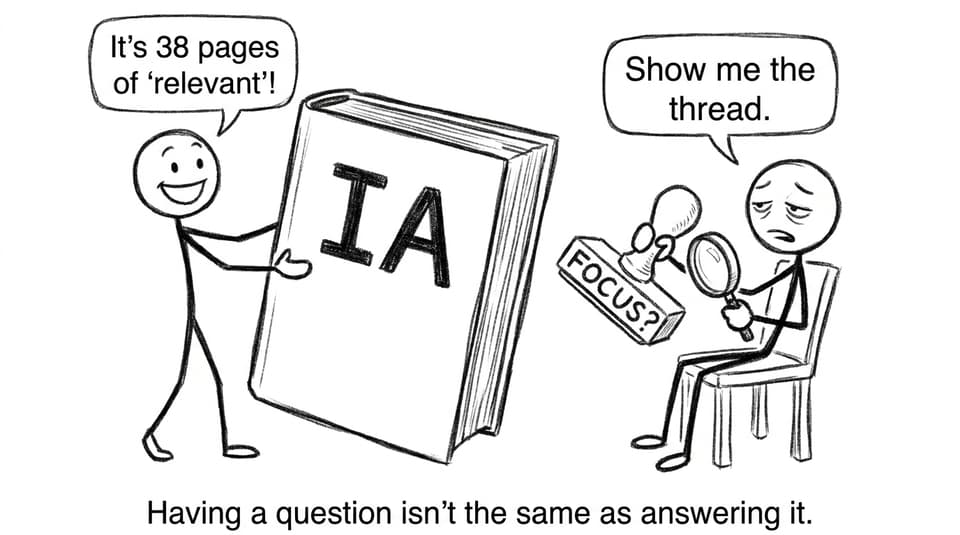
The focus checklist markers apply to every IA
Markers don’t only check your research question once. They keep testing your IA as they read:
-
Is this section directly answering the research question?
-
Does this paragraph move the investigation forward?
-
Are methods, evidence, and analysis still aligned?
-
Does the conclusion match what the body actually did?
If you want a rubric-first view of what this feels like from the other side of the desk, use What IB Examiners Actually Look For in an IA as a reference point while you draft.
How an IA loses marks: drift creates “technically good” irrelevance
When focus weakens, you start writing paragraphs that are correct but unnecessary. In an IA, that shows up as:
-
Background that could fit any topic
-
Extra concepts that don’t change your argument
-
Data or quotes you never use to make a judgment
-
A mini-essay that answers a different question than your own
Markers then have to hunt for relevance, and when they have to hunt, they stop rewarding.
A practical fix: after each paragraph, add one sentence that explicitly connects back to the research question. If you can’t write that sentence, the paragraph probably doesn’t earn marks.
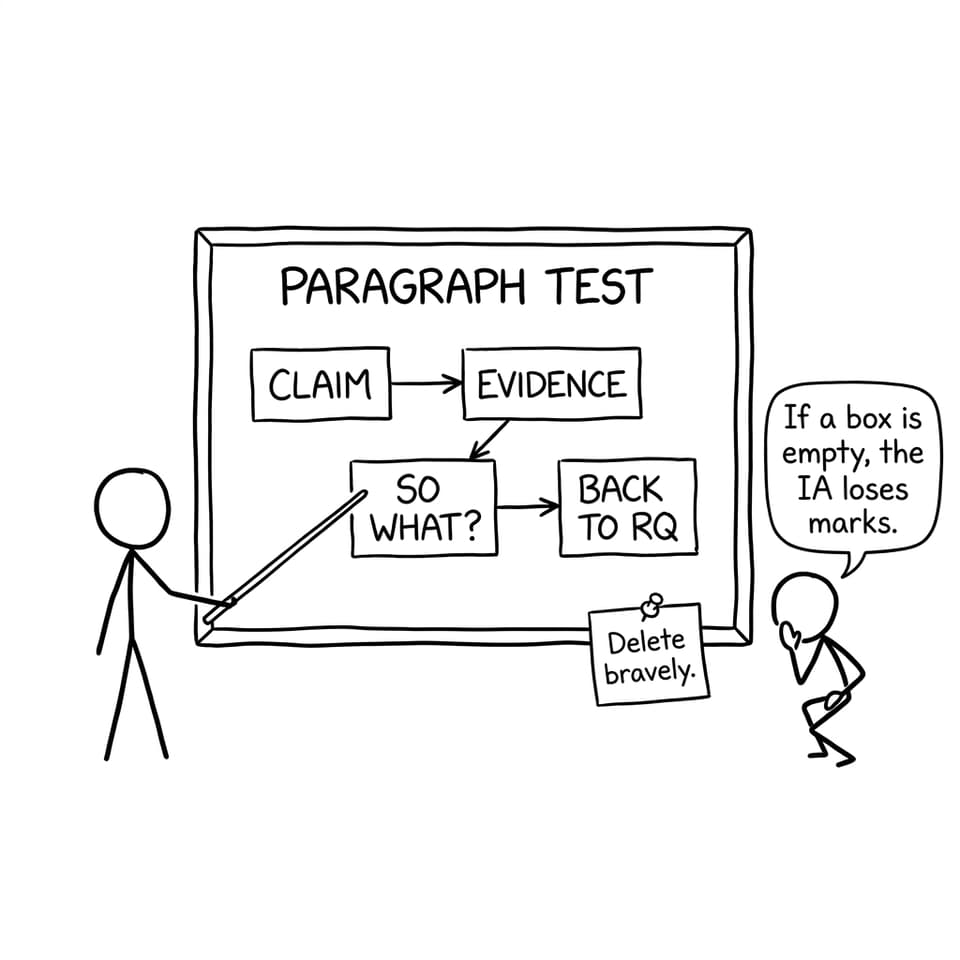
Unclear focus makes analysis shallow (even when you work hard)
Strong analysis requires a stable target. If your IA is unsure what it is testing, comparing, or arguing, your analysis becomes:
-
General instead of specific
-
Descriptive instead of interpretive
-
A list of points rather than a line of reasoning
This is why students sometimes feel like they “did analysis,” but their marks say otherwise. They analysed something, but not consistently the right thing.
One useful move is to tighten the research question before you tighten the writing. This guide helps: Refine Your IA Research Question for Clarity and Focus.
Evaluation suffers first when your IA focus is shaky
Evaluation is where focus problems become obvious. If the core investigation isn’t clear, evaluation turns vague:
-
Limitations become generic (“small sample size” with no impact explained)
-
Improvements feel copied from templates
-
Judgments sound cautious because they are unanchored
A focused IA evaluates specific trade-offs: this method, with this constraint, changed confidence in this conclusion. If you want a second perspective on why broad scope breaks evaluation, read Why Most IA Research Questions Are Too Broad.
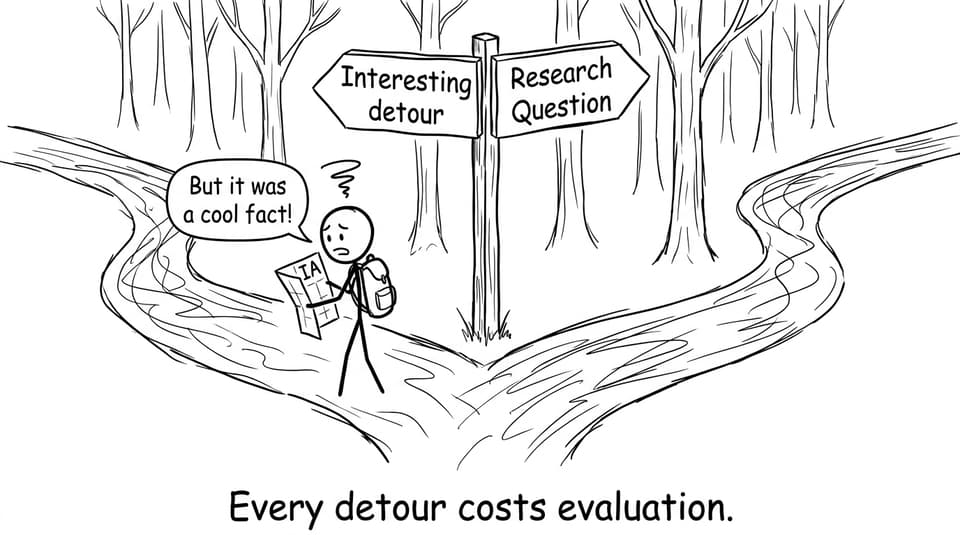
How to keep IA focus sharp without making it “too narrow”
Students hear “focus” and think “tiny topic.” In reality, focus is control.
A controlled IA lets you:
-
Choose evidence you can actually use
-
Build deeper analysis because the variables stay stable
-
Write evaluation that is precise instead of performative
If you want a framework that keeps your coursework bounded from the start, follow the coursework system. And if you want an all-in-one way to run feedback loops, RevisionDojo’s IB IA Guides plus its Grading tools and Coursework Library make it easier to see whether every section earns marks.
A simple RevisionDojo workflow for a more focused IA
Focus improves fastest when you stop relying on vibes and start relying on checks:
-
Use the Coursework Library to compare your structure to strong exemplars.
-
Use AI Chat to ask: “Which criterion is this paragraph serving, and what is missing?”
-
Use Grading tools to catch drift early, before it spreads.
-
Keep your exam prep steady alongside coursework using the Questionbank, Study Notes, and Flashcards.
If your exams are close, build a stable routine with RevisionDojo App: The Smarter Way to Prep for IB Exams and protect your time with systems, not panic.
Closing: make your IA feel like one story, not five
A high-scoring IA doesn’t feel bigger than it is. It feels deliberate. Each part earns its place. Each paragraph points back to the same question. And the conclusion feels inevitable because the body actually built it.
If you want that kind of control, use RevisionDojo as your base camp: IA Guides for structure, a Coursework Library for models, Grading tools and AI Chat for fast feedback, plus Study Notes, Flashcards, Questionbank, Mock Exams, Predicted Papers, and Tutors to keep exams moving too.
When your IA focus is clear, marks stop leaking in the dark.


