


An IB examiner once described a great IA like a well-lit hallway: you walk in, you instantly know where you are, and every door is labeled.
Most students try to build a chandelier instead. They spend hours polishing sentences, adding academic vocabulary, and stretching paragraphs until they sound impressive. But when the lights are dim and the doors are missing, no one cares how expensive the chandelier was.
In an IA, clear structure is what makes your thinking visible. It is also what makes marking easy. And in a system built on criteria, “easy to mark” often translates to “easier to reward.”
A quick IA structure checklist (steal this)
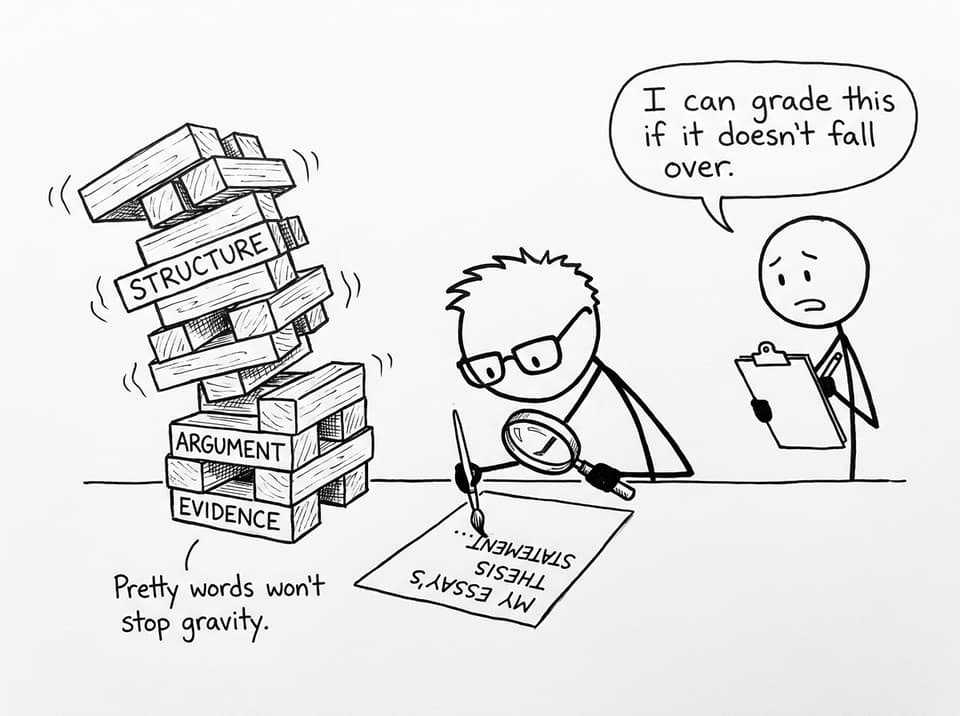
Before you upgrade your writing style, upgrade your map. A strong IA usually has:
-
A research question you can repeat in one breath
-
Headings that match what the criteria reward (not what looks nice)
-
One purpose per paragraph (no “everything everywhere all at once”)
-
Clear separation between description, analysis, and evaluation
-
A conclusion that directly answers the question you asked
If you want a subject-by-subject overview of what “structure” looks like across the Diploma, start with IB IA Guides: Internal Assessment Structure, Rubrics & More.
Why examiners reward structure in an IA
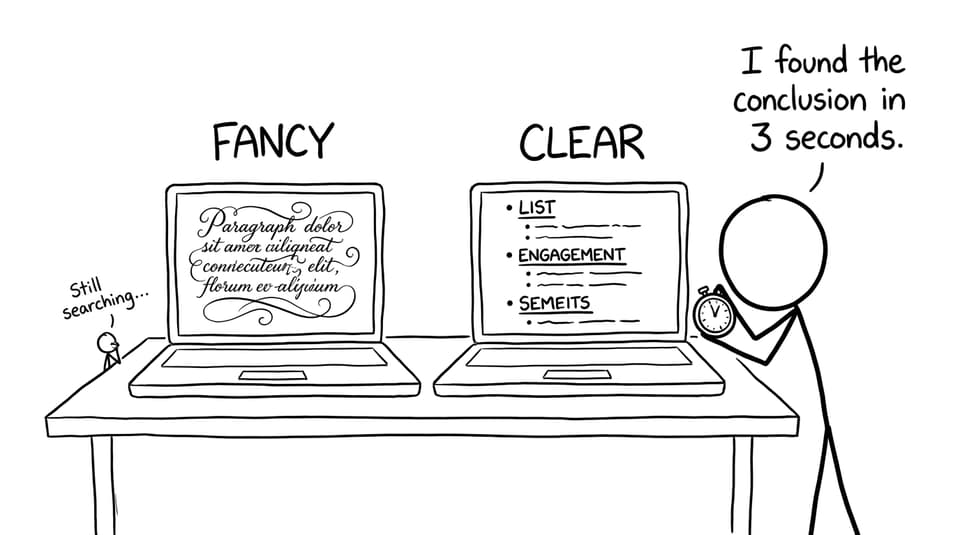
Examiners are not reading your IA like a novel. They are scanning for proof: Where did you meet the criteria?
That is why a clearly organized IA tends to score better than a beautifully written one that hides the good parts. If you bury your best analysis inside a long paragraph with no signposting, you create a scavenger hunt. Scavenger hunts do not earn marks.
To see the mindset from the marker’s side, read What IB Examiners Look for in a Strong IA. Then compare it to your draft headings. That comparison is often uncomfortable. It is also extremely productive.
Structure makes analysis and evaluation easier to spot
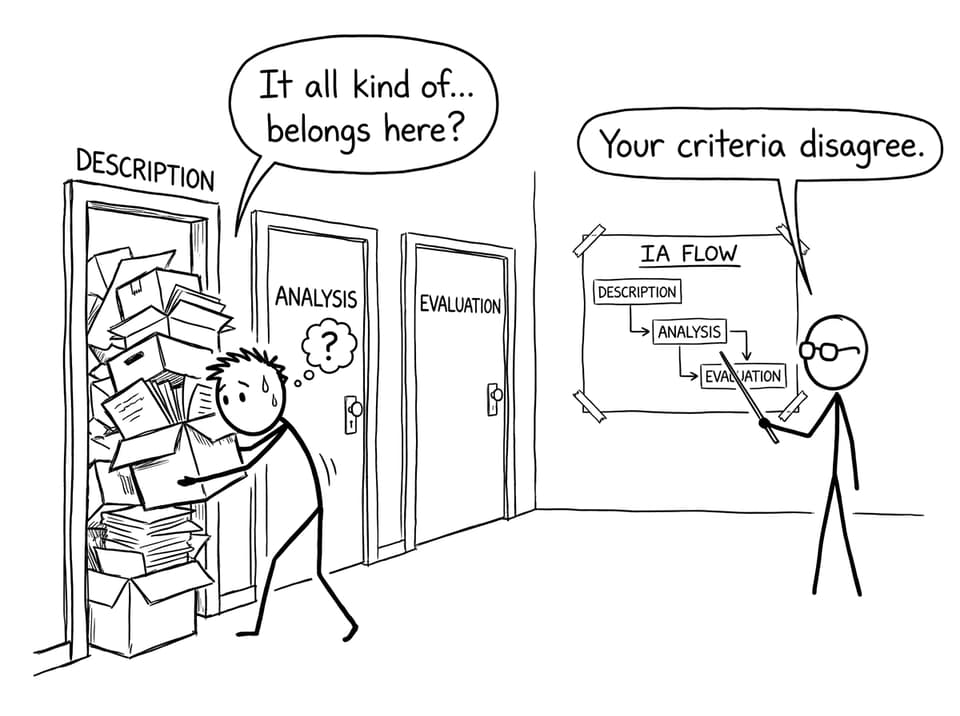
Many IAs lose marks in the middle, not the beginning. The student has a decent question and decent data, but the writing turns into a blur: background, results, explanation, evaluation, all mixed together.
A clean IA structure fixes that by giving each skill its own space:
-
Description tells the reader what happened.
-
Analysis tells the reader what it means.
-
Evaluation tells the reader what to trust, what to doubt, and what you would improve.
If you’re not sure what “real analysis” looks like, use What Real Analysis Looks Like in an IB IA as a calibration tool. And for evaluation specifically, The Role of Evaluation in a Top-Level IA is a fast way to see what high-band reflection sounds like.
Fancy writing can hide weak thinking (and waste revision time)
Here’s the trap: style is easier to “improve” than reasoning. You can swap words, lengthen sentences, and sound more academic in an afternoon. Building a strong chain of logic takes longer, and it feels riskier.
But the IB does not award marks for sounding sophisticated. Your IA earns marks for being controlled: clear question, relevant evidence, explained reasoning, honest evaluation.
If you feel like you’re working hard but your draft is not improving, this is usually why. The effort is real, but it is not aimed at the parts that move criteria. Why Working Hard on Your IB IA Doesn't Always Mean a High Grade explains that mismatch in a way most students recognize instantly.
How RevisionDojo helps you build an IA that’s easy to reward
A good structure is not talent. It is a system.
RevisionDojo is built to make that system simpler:
-
Use the Coursework Library and IB Coursework Guides to model clear sections.
-
Draft with AI Chat when you need help turning messy ideas into clean headings.
-
Check your reasoning with Grading tools so you know what to fix before you add more words.
-
Keep exam momentum with Study Notes, Flashcards, and the Questionbank while coursework is happening.
-
When you need timed realism, use Mock Exams and Predicted Papers to protect exam performance.
-
If you want fast, human feedback on structure, RevisionDojo Tutors can help you see what your draft is actually doing.
For a practical starting point, the step-by-step framework here is worth bookmarking: Coursework Guide.
Conclusion: give your IA a map, not a costume
A fancy writing style can decorate an IA, but it cannot rescue one. Clear structure does the real work: it guides the examiner, highlights your analysis, and makes evaluation easy to reward.
If you want a calmer way to build that structure, use RevisionDojo’s coursework resources, graders, and AI Chat to turn your draft into something that reads like a well-lit hallway. Then return to exam prep with Study Notes, Flashcards, and the Questionbank knowing your IA is doing what it should: earning marks without drama.


