In IB History, the Industrial Revolution can feel like a blur of smoke, machines, and unfamiliar names. But the students who score highly don’t memorize a museum tour of inventions. They learn one calmer idea: the Industrial Revolution is what happens when a society figures out how to turn energy, capital, and technology into mass production--and then has to live with the consequences.
That single shift (from hand production to mechanized factory production) helps you explain everything the syllabus wants: economic transformation, new social classes, urban growth, and political ideologies that tried to make sense of it all.
If you want the full topic pathway for IB History, keep the hub open while you revise: IB History Resources.
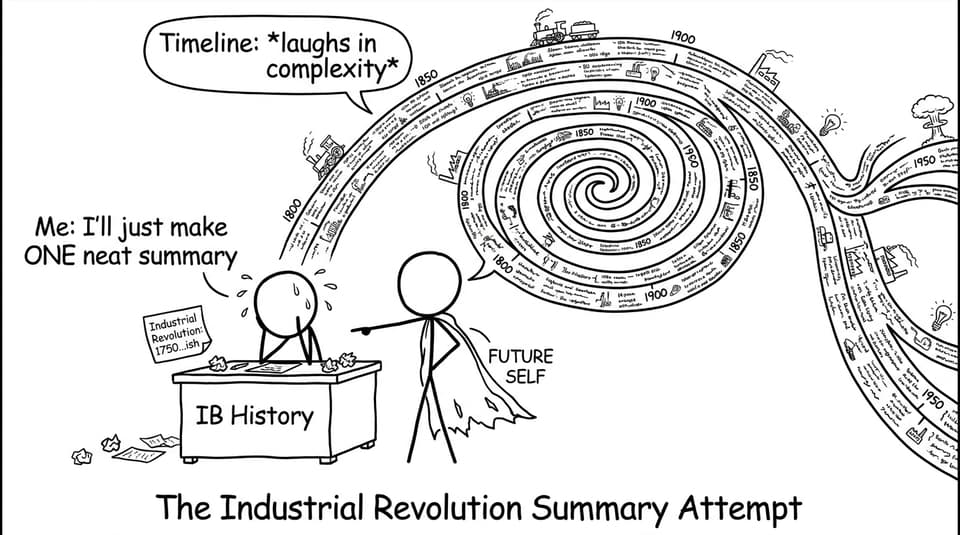
An IB History sticky note meets a wild timeline
What was the Industrial Revolution? (IB History definition)
In IB History, the Industrial Revolution refers to the rapid transformation in manufacturing, transportation, and technology that began in Britain in the late 18th century (around 1750) and spread across Europe and North America during the 19th century, later shaping global industrial development.
Your exam answers should show that it wasn’t just “more factories.” It was a new system:
Mechanization replaced many forms of skilled hand labor.
Consequences: urbanization, class change, reform, ideology, environment.
Judgement: weigh positives vs negatives (and for whom).
If you need targeted practice on writing these arguments, RevisionDojo’s IB History Paper 2 Topic Page pairs Study Notes and Flashcards with exam-style drills.
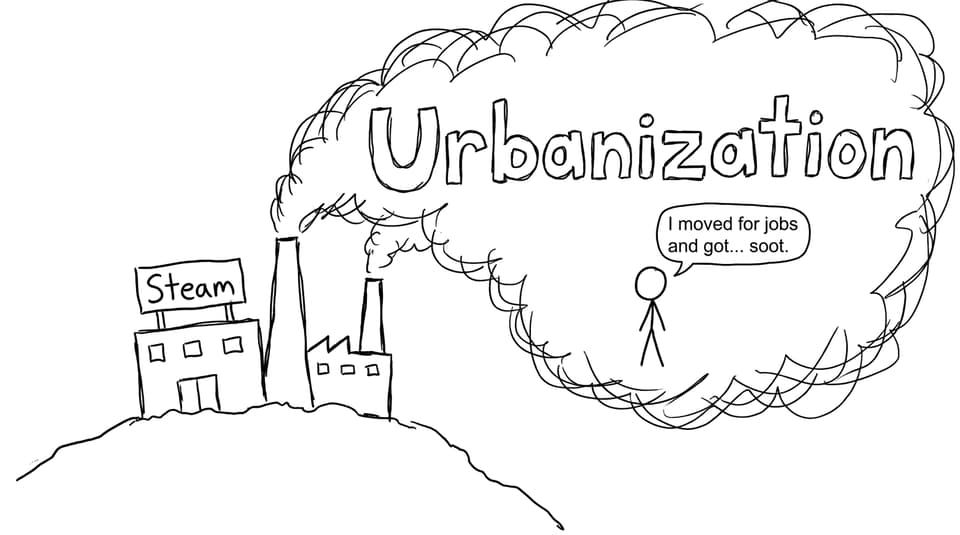
Steam turns into urbanization (and soot)
Why did it start in Britain? (IB History causes)
A strong IB History answer avoids a single-factor explanation. Britain industrialized first because multiple conditions stacked together:
Resources and geography
Coal and iron were accessible, and transport links (rivers, ports, later canals and railways) supported expanding trade.
Capital and markets
Profits from trade and expanding markets gave investors reasons to fund new machines and factories. Colonial connections also mattered for raw materials and consumers.
Agriculture and population
Changes in farming increased food production, supported population growth, and pushed some rural workers toward wage labor in towns.
Political stability and institutions
Relative stability, property rights, and patent culture encouraged entrepreneurship and experimentation.
When you get stuck turning this into an argument, use AI Chat inside RevisionDojo to test thesis statements and counterarguments, then validate them with practice questions from the IB History Paper 2 Questionbank.
Key features you must know (IB History essentials)
In IB History, these are the high-yield features that repeatedly appear in essay prompts and markschemes:
Technological change (not just a list)
Steam power (James Watt’s improvements) scaled production and transport.
Textile machinery (like the Spinning Jenny and power loom) made output faster and cheaper.
Improvements in iron smelting and coal mining supported heavier industry.
Urbanization and new social patterns
Industrial cities grew rapidly (Manchester is the classic example), drawing people into dense housing and new rhythms of factory time.
New class relationships
A clearer divide emerged between industrial owners and wage workers. The pressure of long hours, low pay, and unsafe conditions fueled unionization and reform movements.
Consequences: how to score with evaluation (IB History)
In IB History, consequences are where you can prove maturity. Aim to evaluate trade-offs:
Economic: productivity rose dramatically; new industries formed; global trade expanded.
Social: urban crowding, public health crises, and child labor existed alongside new opportunities and wages.
Political and ideological: reform movements grew; socialist and Marxist critiques gained traction.
Environmental: coal-powered industry intensified air and water pollution and accelerated long-term environmental change.
A good Paper 2 conclusion might sound like: industrialization raised national output, but redistributed suffering and opportunity unevenly--so “progress” depended on class, region, and time period.
Paper 2 referee demands nuance
How to revise Industrial Revolution content efficiently
Use a loop that fits real life:
Read RevisionDojo Study Notes to clarify the narrative.
Use Flashcards to lock definitions (industrialization, urbanization, proletariat, laissez-faire).
Drill arguments using the Questionbank and get feedback with Grading tools.
Run timed practice with Mock Exams and Predicted Papers to build stamina.
The Industrial Revolution is big, but your IB History grade doesn’t depend on knowing everything. It depends on controlling a few powerful explanations: why Britain first, what mechanization changed, and how economic growth produced social and political tension.
If you want that control quickly, build your revision loop inside RevisionDojo: Study Notes for clarity, Flashcards for recall, Questionbank for exam practice, AI Chat for instant help, Grading tools for mark-focused feedback, and timed Mock Exams plus Predicted Papers to make exam day feel familiar. Start here: IB History Resources.
James read Economics at the London School of Economics and worked as a government policy analyst before teaching. His focus is IB Economics Paper 1, 2, and 3, embedding the evaluation and real-world examples the mark scheme rewards into every answer.