
When your IA is due soon, panic feels productive (it isn’t)
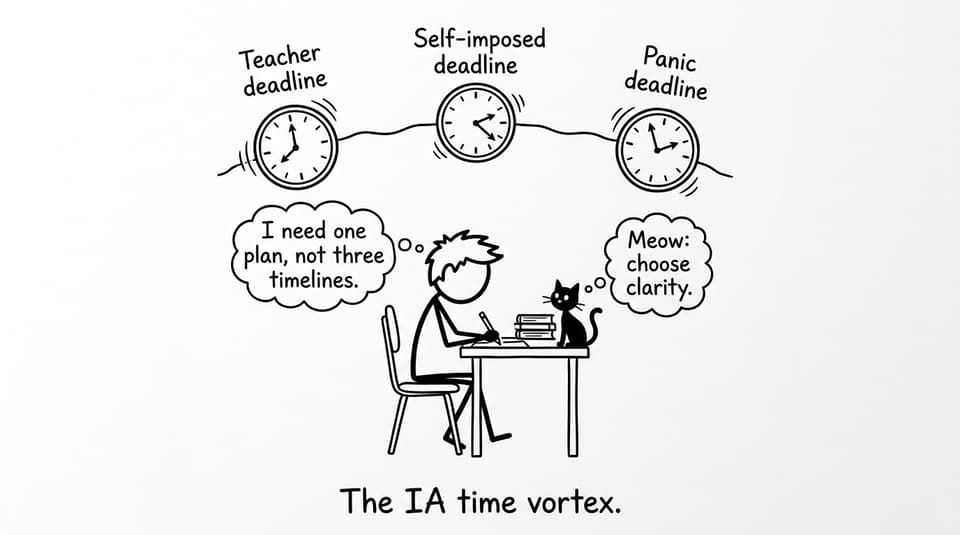
The night before an IA is due has a special kind of noise. Your tabs multiply. Your word count becomes a scoreboard. You convince yourself that rewriting the whole thing at 1:17 a.m. is “finally taking it seriously.”
But panic doesn’t usually improve an IA. It scrambles your judgment. It nudges you toward low-impact work (formatting, extra background, new data you can’t explain) and away from the high-impact work (clear analysis, explicit evaluation, a conclusion that actually answers your research question).
If your IA is due soon and you’re spiralling, you don’t need motivation. You need a small, ruthless plan.
The 30-minute IA triage checklist
Before you touch a single paragraph, run this checklist. It’s designed to stabilise your IA fast.
-
Write your research question at the top of your document.
-
Under it, add: “So what?” in one sentence (your main takeaway).
-
Skim every section and ask: does it move the reader toward answering the question?
-
Circle the 2 sections that usually carry marks: analysis and evaluation/conclusion.
-
Make a “do not touch” list: methods you can’t redo, data you can’t verify, new content you can’t defend.
If you want models to compare against, open one exemplar and borrow structure, not wording: Coursework Exemplars Library.
What to do (and not do) in the final stretch of an IA
Do: make the logic visible
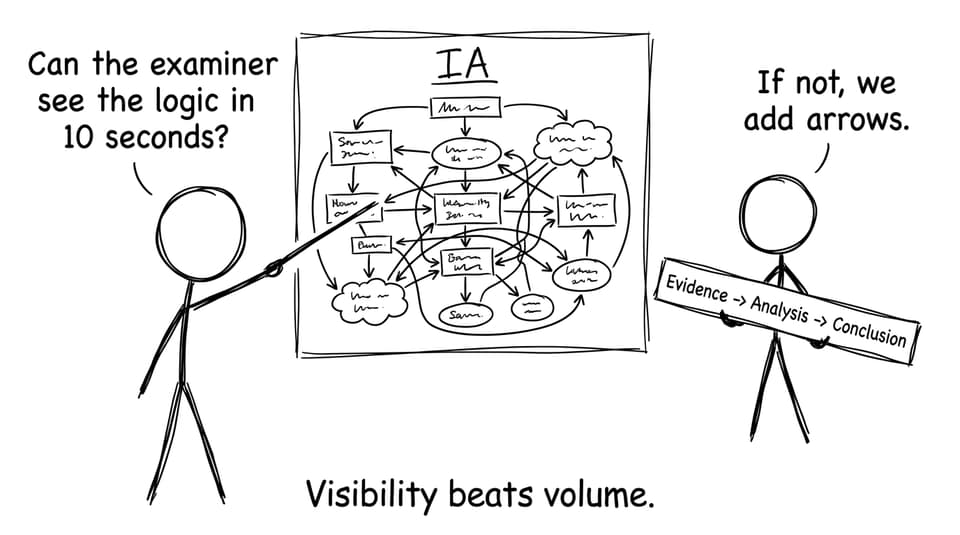
Examiners reward what they can see quickly. In an IA, clarity is a mark-protection strategy.
High-impact edits:
-
Add topic sentences that state the point of the paragraph.
-
After each table/graph, add 2-3 lines explaining what it shows and why it matters.
-
Use short linking phrases: “This suggests…”, “Therefore…”, “However…”, “This limitation means…”.
If your panic is coming from uncertainty about structure or criteria, anchor yourself with IB IA Guides and the broader Coursework Guides.
Don’t: expand the IA just to feel safe
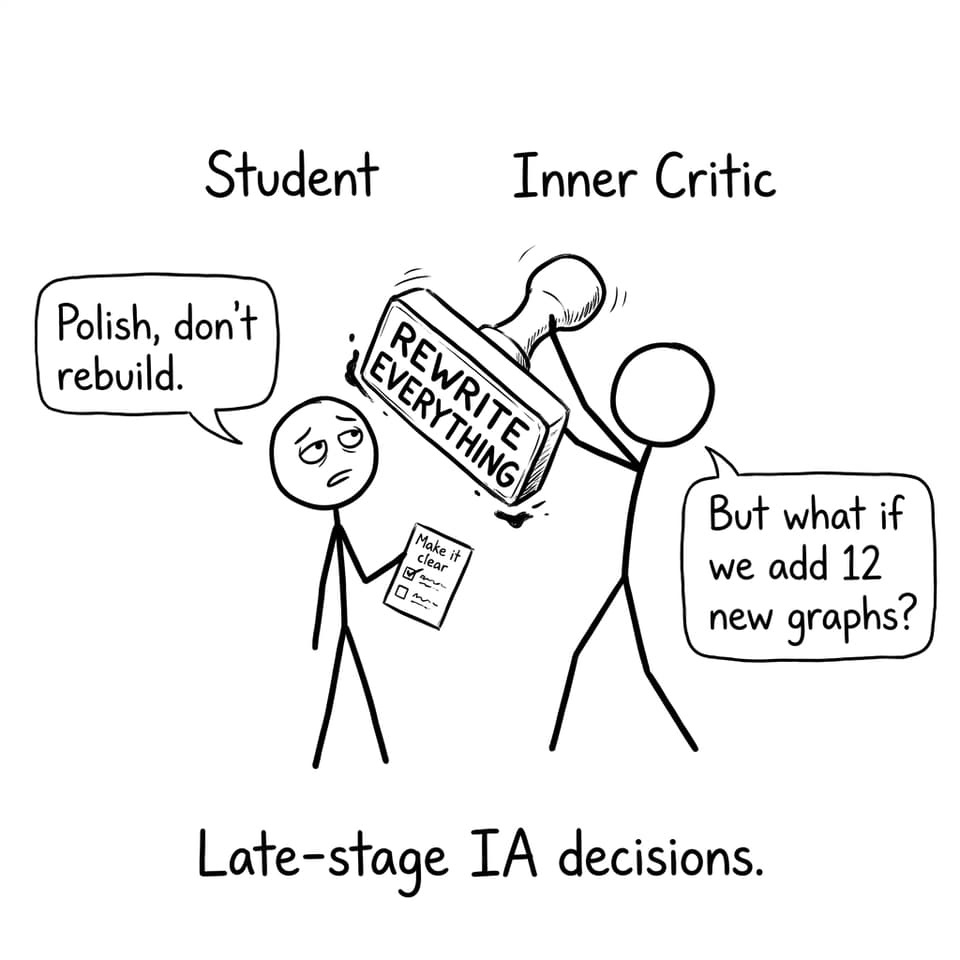
Adding new content late is the most common panic move. It feels like effort, but it often creates:
-
imbalance (huge background, thin analysis)
-
contradictions you don’t notice under stress
-
claims you can’t support with evidence
Refinement beats expansion. Your IA doesn’t need to be bigger. It needs to be easier to follow.
Do: upgrade your evaluation and conclusion first
If you only have limited time, spend it where your judgement shows.
A strong IA evaluation:
-
names real limitations (not generic “human error”)
-
explains impact on reliability/validity
-
proposes realistic improvements
A strong conclusion:
-
directly answers the research question
-
references your actual results
-
acknowledges uncertainty without collapsing into excuses
For fast, rubric-aligned feedback, run your draft through the IB Coursework Grader. Then fix the top 3 issues it flags, and stop.
Do: borrow calm from tools, not from willpower
When your IA deadline is close, decision fatigue is the enemy. Offload the thinking where you can:
-
Use AI Chat to clarify what a criterion is asking in plain language (then write in your own words).
-
Use the Coursework Library to see what “good” looks like in your subject.
-
If you need human reassurance, use Tutors for a targeted 20-minute check on the weakest section.
And keep your exam prep moving in the background with RevisionDojo’s Questionbank, Study Notes, Flashcards, Mock Exams, and Predicted Papers (especially once the IA is submitted). A good starting hub is RevisionDojo for IB.
Finish your IA like a strategist
A near-deadline IA is not a test of who can panic the hardest. It’s a test of who can protect clarity under pressure. Make your logic visible. Resist last-minute expansion. Stabilise evaluation and conclusion. Then submit.
When you’re ready to turn stress into a repeatable system, RevisionDojo is built for the full IB loop: Questionbank, Study Notes, Flashcards, AI Chat, Grading tools, Predicted Papers, Mock Exams, a Coursework Library, and Tutors. Start with the Coursework Guides and move forward with a plan you can trust.