
Studying at an IB school feels a bit like being handed a map that keeps unfolding. Every time you think you can see the whole route, another section opens: an essay deadline, a lab write-up, a TOK prompt that makes your brain itch, a CAS reflection you forgot existed.
The strange part is that this pressure can be… clarifying. The IB doesn’t just test what you know. It tests how you live: how you plan, how you recover, how you keep going when motivation disappears. If you’re an IB student preparing for exams, that’s good news, because student life is basically exam training in disguise.
What daily life at an IB school actually looks like
Most IB days aren’t dramatic. They’re crowded.
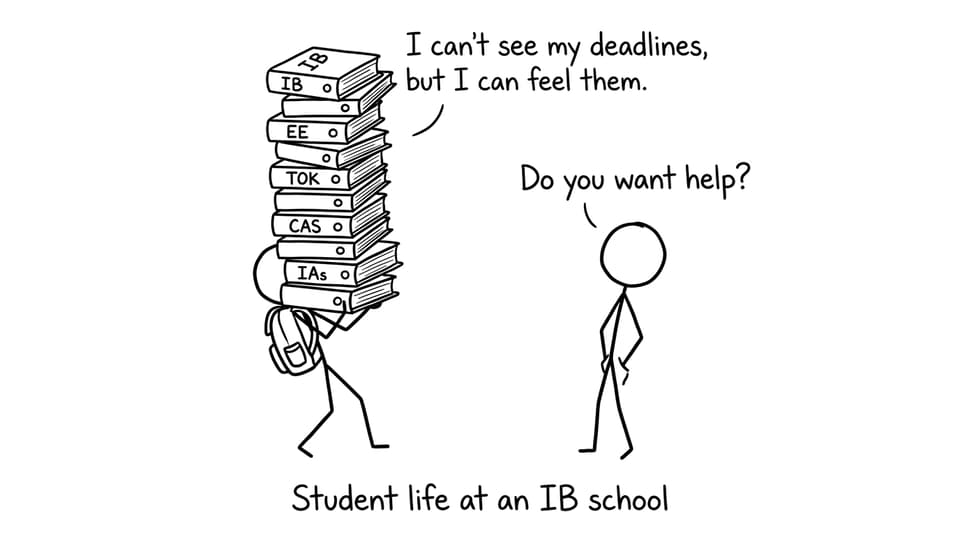
You’ll usually bounce between HL classes that demand depth (analysis, evaluation, writing) and SL classes that still expect consistency. Then the “invisible subjects” show up: EE research, TOK drafts, CAS planning, Internal Assessments (IAs), plus revision that you swear you’ll start “properly” next week.
In practical terms, IB student life often looks like:
-
One or two heavy thinking classes (HL) that drain your brain early
-
Short gaps that you intend to use well (and sometimes do)
-
Homework that isn’t hard because it’s confusing, but because it’s relentless
-
A constant low hum of deadlines, even on good weeks
If you want to feel less scattered, it helps to anchor your routine with one home base. Many students use RevisionDojo for IB as that hub, because it connects practice, feedback, and planning in one place.
IB student survival checklist (print this mentally)
When the IB gets loud, return to a boring checklist:
-
Choose the next exam skill (not “revise the whole subject”)
-
Patch understanding quickly with Study Notes
-
Lock recall with Flashcards (small, daily)
-
Convert knowledge into marks with targeted question practice
-
Do timed exam training weekly
-
Protect sleep like it’s part of your grade (because it is)
For a fuller routine, bookmark How to Study for IB Exams: Step-by-Step Guide.

The academic load: why the IB feels heavier than it “should”
The IB workload isn’t just “more.” It’s more parallel.
In many school systems, your grade mostly comes from final tests. In the IB, your grade comes from final exams and IAs and core requirements. That means you’re rarely focused on one thing at a time, and your stress spikes when deadlines overlap.
Two realities help:
Internal Assessments are not side quests
In the IB, IAs are part of the main story. Treating them as “later” work usually creates a panic month. If you want clearer structure, use the IB Internal Assessment Guides as a rubric-first roadmap.
The core (EE, TOK, CAS) rewards calm consistency
The IB core is where students lose time through uncertainty. A simple fix is to stop guessing and use a reference point: IB Extended Essay Guides for EE structure, and IB Theory of Knowledge Resources for TOK expectations.
If you’re blending TOK thinking into writing, How to Integrate TOK Thinking into Your IA is a practical bridge.
What makes IB revision different (and why exams feel personal)
The IB has a particular kind of cruelty: it rewards precision.
You can “know” a topic and still drop marks because you misread a command term, used the wrong structure, or ran out of time. That’s why top IB students treat revision like training, not like reading.
A clean loop looks like this:
-
Learn the concept (fast)
-
Practice exam-style questions (targeted)
-
Get feedback (immediate)
-
Fix one pattern (specific)
-
Retest (within 48 hours)
RevisionDojo is built around that loop: Study Notes, Flashcards, Questionbank, AI Chat, Grading tools, plus Predicted Papers and Mock Exams when you’re ready to simulate pressure.
Start with the Questionbank and use IB Question Bank | How to Use It Effectively to avoid random practice.
Then keep daily recall simple with IB Flashcards with Spaced Repetition (SRS) and the Flashcards feature.
Social life in an IB school: yes, but it’s scheduled
You can have a social life in the IB, but it works best when it’s treated like something you protect, not something you “earn.”
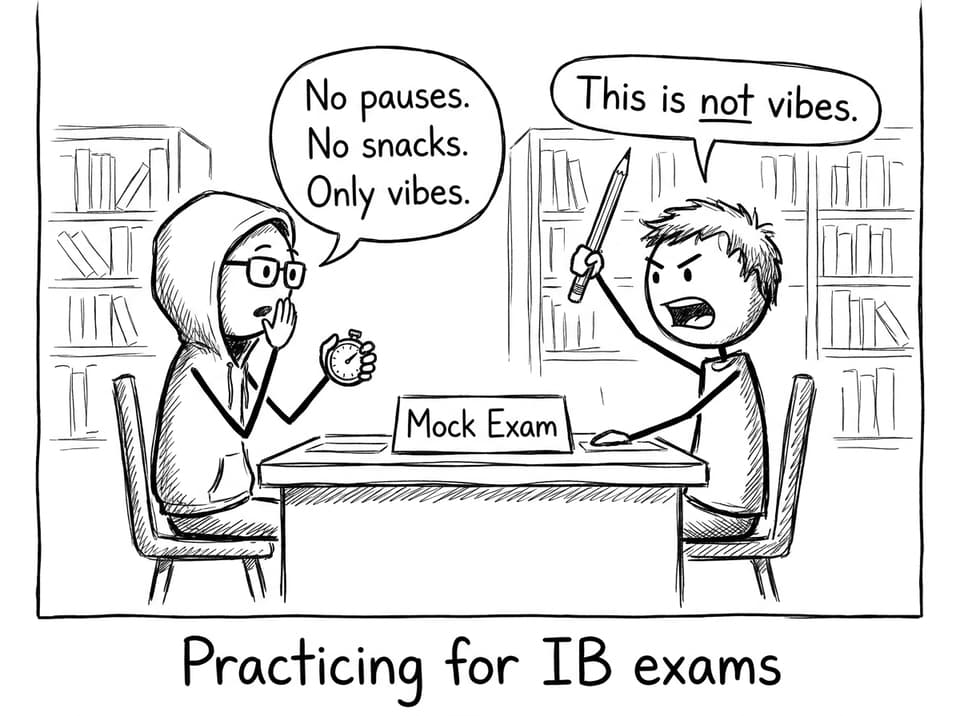
Group study can actually help, especially when it’s structured. One person times. One person marks. One person tracks errors. That’s how social time becomes exam time without feeling bleak.
If you’re struggling with balance, What Are Healthy Study Habits for Balancing IB and Life? is the most useful reset I’ve seen.
Conclusion: the IB is hard, but it’s not a mystery
If you’re asking what it’s like to study at an IB school, the honest answer is: intense, structured, occasionally exhausting, and surprisingly meaningful when you stop trying to “power through” and start building a repeatable routine.
The students who thrive in the IB aren’t the ones who never struggle. They’re the ones who struggle, then set up a system that makes improvement inevitable: Flashcards for recall, a Questionbank for marks, Grading tools for clarity, Predicted Papers and Mock Exams for realism, and Tutors when you need a human to spot what you can’t.
If you want that system in one place, start with RevisionDojo and make your next IB study session boring, timed, and effective.