

In the time it takes you to open your calculator, a multinational company can shift inventory across borders, change prices in three currencies, and reroute an entire supply chain around a single disruption. That quiet ability to move quickly, globally, and with options is the real reason MNCs feel “too big to ignore.”
For IB Business Management, MNC power is not a vague idea. It’s a set of advantages you can define, apply to a case study, and evaluate with stakeholder impacts. Once you learn to spot those advantages, Paper 1 and Paper 2 responses become less about memorising and more about explaining how global business actually works.
A quick exam checklist for IB Business Management
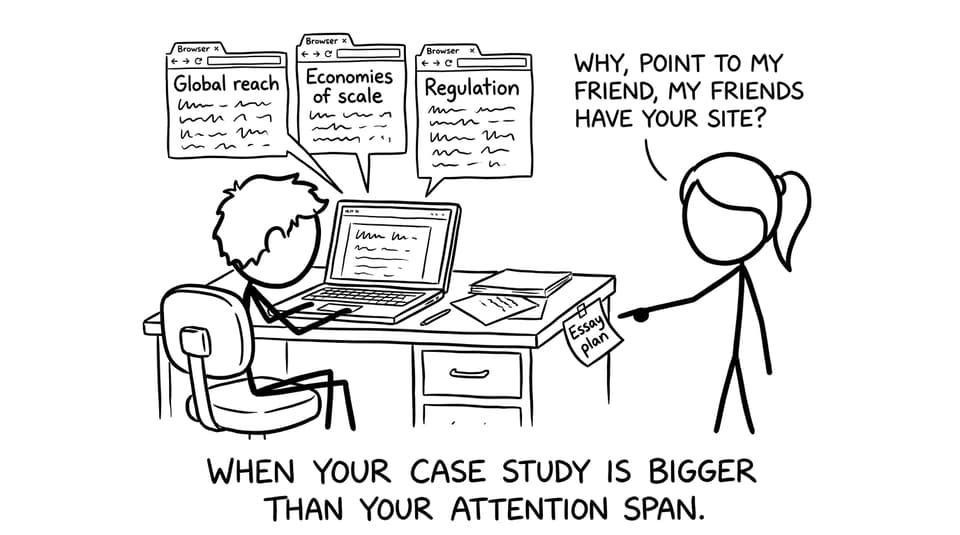
When a question asks why MNCs are powerful, build your answer around:
-
Global reach (market access and risk spreading)
-
Control of resources (finance, talent, technology)
-
Economies of scale (lower unit costs, stronger pricing power)
-
Bargaining power (suppliers, distributors, even labour)
-
Influence over regulation (tax incentives, standards, lobbying)
-
Brand dominance (trust, loyalty, barriers to entry)
For syllabus-aligned definitions and examples, anchor your revision in 1.6 Multinational Companies and the deeper 1.6 MNC notes.
Global reach: power through options
In IB Business Management, global reach is often the first mark. But the higher marks come from explaining what reach does: it creates options.
An MNC sells into multiple markets, so a downturn in one region can be balanced by stability in another. It can also adapt products and marketing to local cultures while still keeping the core brand consistent. This is why some MNCs can keep revenue steady even when a single country faces inflation, political uncertainty, or weaker consumer confidence.
If you want applied practice, use the 1.6 MNC Questionbank and force yourself to write one paragraph that links “global reach” to a specific case detail and stakeholder outcome.
Economies of scale: power through lower costs
Size is not automatically power. Size becomes power when it reduces unit costs.
MNCs often achieve economies of scale in production, purchasing, logistics, and marketing. Lower average costs can allow lower prices (raising market share) or higher margins (raising retained profit for growth). In exam terms, connect this to finance: stronger cash flow can fund R&D, expansion, and acquisitions.
To tighten your cost language, revise 3.3 Costs and Revenues and practise weaving in terms like fixed costs, contribution, and margin without turning your answer into a purely numerical one.
Control over resources: money, technology, and people
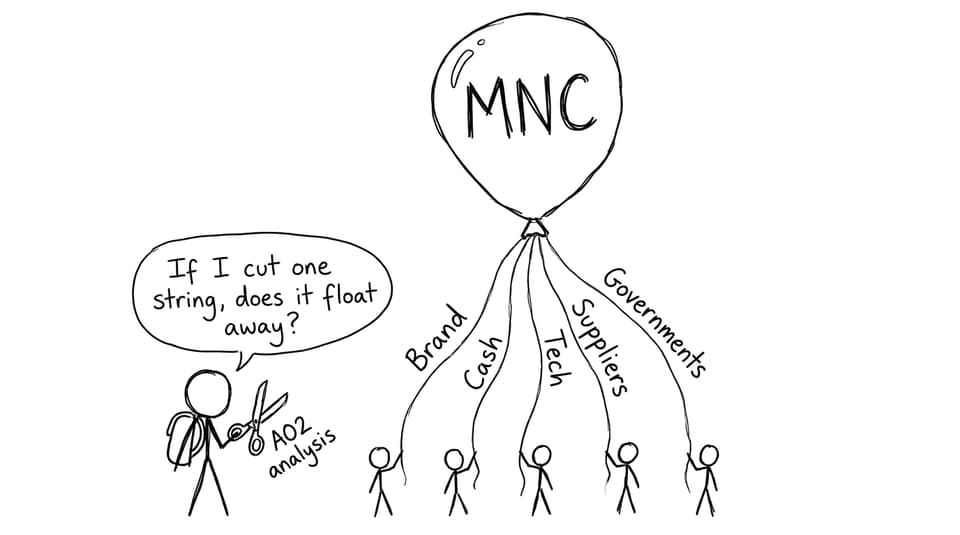
A powerful MNC can do three things quickly: invest, innovate, and hire.
Because MNCs typically have deeper financial resources, they can fund large-scale facilities, global marketing campaigns, and long-term R&D projects that smaller firms can’t justify. They can also buy capabilities instead of building them, acquiring competitors, suppliers, or new technologies.
This matters in IB Business Management because it creates a feedback loop: resources increase competitiveness, which increases profit, which increases resources.
RevisionDojo helps you train this loop into exam-ready analysis using the IB Business Management subject hub, where you can switch between Study Notes, Flashcards, and targeted practice sets.
Influence over governments and rules: negotiated power
MNCs don’t control governments, but they can influence the environment they operate in.
Large investments create jobs and tax revenue, which can give MNCs bargaining power when negotiating location decisions, incentives, or regulatory requirements. In evaluation, be careful: influence varies by country and depends on governance quality, political stability, and public pressure.
A strong way to evaluate in IB Business Management is to compare outcomes for stakeholders. A host government may gain employment and infrastructure, while local SMEs may face tougher competition. For angles you can reuse in essays, see IB Business Management: MNCs and Local Economies.
Brand dominance: power you can’t see on a balance sheet
Brands are a shortcut for trust.
A globally recognised brand can enter new markets more easily because consumers already know what to expect. That reduces the perceived risk of purchase. Strong brands also create barriers to entry: competitors must spend heavily just to be noticed.
In IB Business Management, brand power is a great evaluation lever: it can support premium pricing and customer loyalty, but it can also amplify reputational risk if ethical issues appear in the supply chain.
How to turn this into marks with RevisionDojo
If MNC questions feel repetitive, that’s good news: you can drill them.
Use RevisionDojo’s Questionbank to practise application under time pressure, then ask RevisionDojo’s AI Chat to challenge your assumptions (for example: “When would economies of scale fail?”). Convert key advantages into Flashcards, and use Grading tools to refine chains of analysis until your evaluation sounds deliberate, not rushed. When you want full exam realism, build Mock Exams and use Predicted Papers to test whether your MNC points hold up in unfamiliar prompts.
Conclusion: the IB Business Management takeaway
MNCs are powerful because they combine reach, scale, resources, and brand into something that looks like momentum. Each advantage reinforces the next, which is why MNC dominance can persist even when competitors are smart and hardworking.
If you’re revising IB Business Management, don’t just memorise the list. Practise turning one MNC advantage into application, then analysis, then evaluation. Start with 1.6 Multinational Companies, drill with the MNC Questionbank, and use RevisionDojo’s Study Notes, Flashcards, AI Chat, Grading tools, Predicted Papers, Mock Exams, Coursework Library, and Tutors to make your arguments feel inevitable under exam pressure.