
The question every beginner asks (quietly, at first)
In the first weeks of IB German Ab Initio, your German can feel like a suitcase packed in the dark. You know you brought something useful. You just can’t find it when you need it. Then someone asks the big question: What level of German will I actually achieve by the end?
It’s the right question, especially inside IB Languages, where expectations can swing between “I’ll be fluent by May” and “I hope I can survive a menu.” The honest answer sits in the middle: IB German Ab Initio is designed to take true beginners to a practical, exam-ready level of communication. It won’t make you advanced. But it can make you capable, confident, and surprisingly functional in everyday situations.
Quick checklist: what you’ll be able to do by the end
If you want the one-screen version before we go deeper, here it is. By the end of German Ab Initio, most students can:
-
Handle predictable everyday interactions: greetings, shopping, transport, school life
-
Speak in short, structured bursts (not elegant, but understandable)
-
Understand the gist of clear, slow audio on familiar themes
-
Read short texts for key details (ads, emails, schedules, simple articles)
-
Write organised texts in common formats (email, blog entry, diary-style reflection)
-
Use theme vocabulary from the Ab Initio syllabus with basic accuracy
That’s the practical promise of IB Languages at ab initio level: usable communication, not sophistication.
Where German Ab Initio sits on the CEFR scale
The global reference point for language levels is the CEFR (Common European Framework of Reference for Languages): A1, A2, B1, B2, C1, C2.
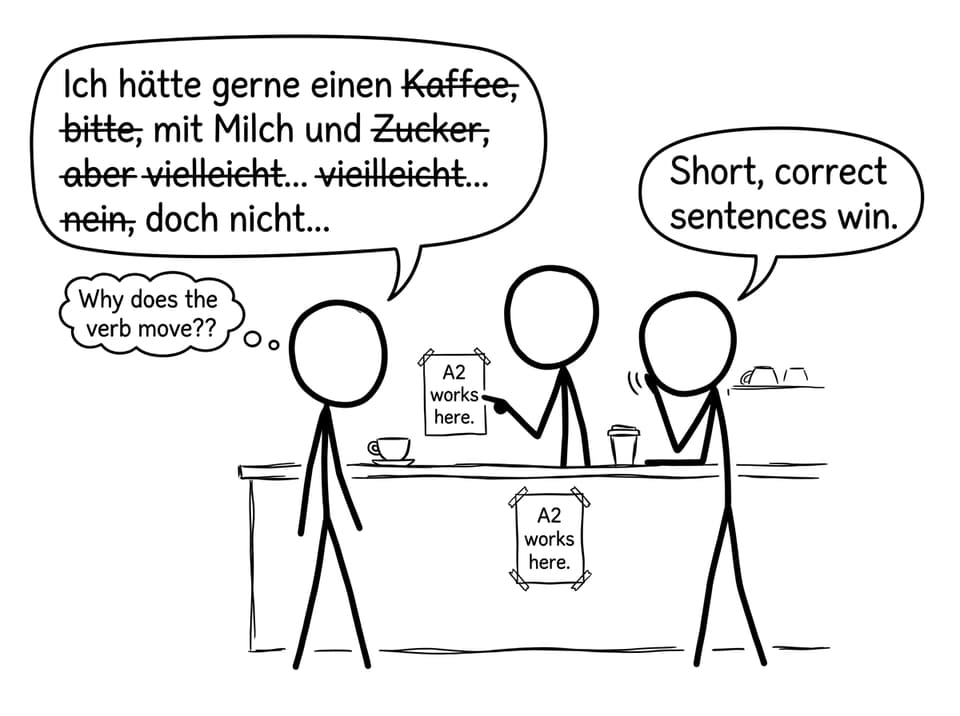
Most students finishing IB German Ab Initio land around A2. That’s not a guessy internet number. It matches the course design: beginner content, high-frequency situations, and a focus on communicating meaningfully with limited grammar.
What A2 German feels like in real life
A2 is often called “survival plus.” You can survive at A1. At A2, you start living a little.
At A2, you can usually:
-
Introduce yourself, talk about family, school, routines, and preferences
-
Ask for directions and understand simple responses
-
Order food, buy tickets, and manage basic problems (late train, wrong size, etc.)
-
Understand common phrases when people speak clearly and don’t race ahead
-
Write short messages that have a beginning, a middle, and an end
In other words: IB Languages at ab initio level trains you for daily usefulness and for exam performance built on those situations.
The four skills: what you’ll realistically master
Ab Initio doesn’t reward you for knowing rare words. It rewards you for doing ordinary things well, consistently, under time pressure.
If you’re unsure what the exams actually test, anchor yourself with IB German Ab Initio Exam Format (2025 Guide). It helps you connect “German level” to actual exam tasks.
Listening: catching meaning, not every word
By the end, you should be comfortable understanding short, clear audio about familiar topics. Think: announcements, school instructions, weekend plans, weather, shopping, travel.
A useful milestone in IB Languages listening is this: you stop panicking when you miss a word. You keep listening. You use context. You recover.
Speaking: simple, clear, and brave
Your speaking won’t sound advanced. It will sound functional. You’ll be able to:
-
Describe your routine and experiences
-
Give opinions with basic justification (because, therefore, however)
-
Ask follow-up questions to keep an interaction going
-
Use repair phrases when you get stuck
That last point matters. In IB Languages, confidence often comes from having a plan for what to do when you forget something.
Reading: skimming and scanning like an exam athlete
Reading at A2 means you can identify key information quickly. You’ll handle:
-
Signs, ads, emails, short notices
-
Simple articles with predictable structure
-
Messages that include familiar theme vocabulary
On RevisionDojo, practising this becomes easier when you combine theme knowledge with exam-style tasks in the Paper 2 Reading hub.
Writing: structure wins marks
Writing is where many beginners either level up or stall. Not because of creativity, but because of structure.
In German Ab Initio, you’ll learn to produce short texts in expected formats (email, blog, diary entry, article-style). The goal isn’t fancy grammar. It’s clarity: topic sentences, connectors, correct tense choices, and vocabulary that fits the theme.
If you want to build that foundation efficiently, start with What Study Resources Are Best for IB German Ab Initio?. It breaks down the most efficient inputs for ab initio progress.
German Ab Initio vs German B: why the difference matters
A lot of anxiety comes from comparing the wrong things.
-
German Ab Initio (SL only): typically ends around A2
-
German B (SL/HL): often moves into B1 to B2 territory, depending on level and student background
This is one reason IB Languages has different tracks: the IB is trying to place you where your growth is realistic. If you already have years of German, Ab Initio may feel too small. If you’re truly new, it’s the right size challenge.
For a broader comparison across language pathways, see IB Language B vs Language ab initio: Key Differences and How to Choose.
Is A2 enough for university or work?
For most German-taught university programs, A2 is not enough. Many require B2 or C1 for academic study because lectures, readings, and written assessments demand independent language control.
But A2 is still valuable.
If you study in a German-speaking country in an English-taught program, A2 German helps you navigate housing, transport, shopping, and basic social life. And for certain entry-level jobs (especially customer-facing roles), A2 can be a starting point, though professional careers usually need higher levels.
In other words: IB Languages at ab initio level won’t unlock every door, but it can stop daily life from feeling like a locked hallway.
How to finish closer to B1 (without burning out)
The course targets A2. Your outcome depends on your system.
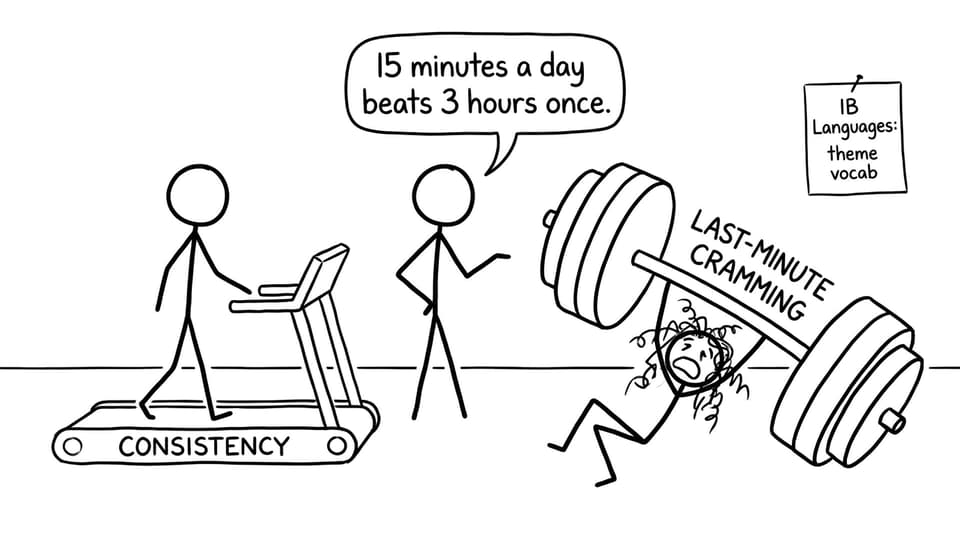
Some students leave Ab Initio brushing B1 because they build exposure outside class. Not heroic effort. Just consistent, well-aimed practice.
A simple weekly routine that actually works
-
Vocabulary by theme (10-15 minutes/day): build it with spaced repetition
-
One listening session (15-20 minutes, 3x/week): short clips you can replay
-
Two short speaking reps (5 minutes each): describe a photo, your day, an opinion
-
One timed writing task (weekly): then get feedback and rewrite
RevisionDojo makes this workflow feel less scattered because the tools connect: Study Notes for the theme content, Flashcards for recall, Questionbank for targeted exam practice, AI Chat when you need instant clarification, and Grading tools to tighten writing and self-correct patterns.
To build your memory efficiently, use Flashcards | RevisionDojo and the broader IB Flashcards with Spaced Repetition (SRS) hub.
Practice the way IB Languages are marked
A quiet secret of IB Languages: marks come from control, not ambition.
That’s why targeted practice matters. If you want exam-style drilling, start with the German ab initio - IB Resources hub, then sharpen your weaknesses using the External Assessment Questionbank. It’s one of the fastest ways to turn “I kind of know this” into “I can do this under time.”
If you’re curious how theme learning can feel more natural, you might like IB Languages: Can Video Games Teach You a Language? for a surprisingly practical approach to exposure.
The real answer: the level is A2, but the outcome is bigger
So, what level of German will you achieve in IB German Ab Initio? For most students, the clearest, fairest answer is A2. In CEFR terms, that’s basic user competence with real-world utility: you can understand, speak, read, and write in the everyday lanes of life.
And in the context of IB Languages, that’s the point. The course isn’t trying to make you advanced. It’s trying to make you reliably communicative, under the exact pressures the exams will place on you.
If you want to get the most out of German Ab Initio, build a system that turns small daily effort into exam confidence. Use RevisionDojo’s Questionbank, Study Notes, and Flashcards to train the core skills, lean on AI Chat and Grading tools to correct patterns quickly, pressure-test yourself with Mock Exams and Predicted Papers, and tap the Coursework Library and Tutors when you need guidance that saves time. That’s how IB Languages stops being a subject you worry about and becomes a skill you can actually use.