

If you have ever stared at your calendar and thought, “I’m doing exams, career training, and now this?” you are not alone. In the IBCP, the Reflective Project can feel like the quiet extra that suddenly becomes the loudest deadline in the room. But it exists for a reason: it is the moment the programme asks you to prove you can think ethically about the world you are preparing to enter.
In simple terms, the Reflective Project is where the IBCP stops being a collection of courses and becomes a coherent story about you: what you value, how you reason, and how you communicate when the topic is complicated.
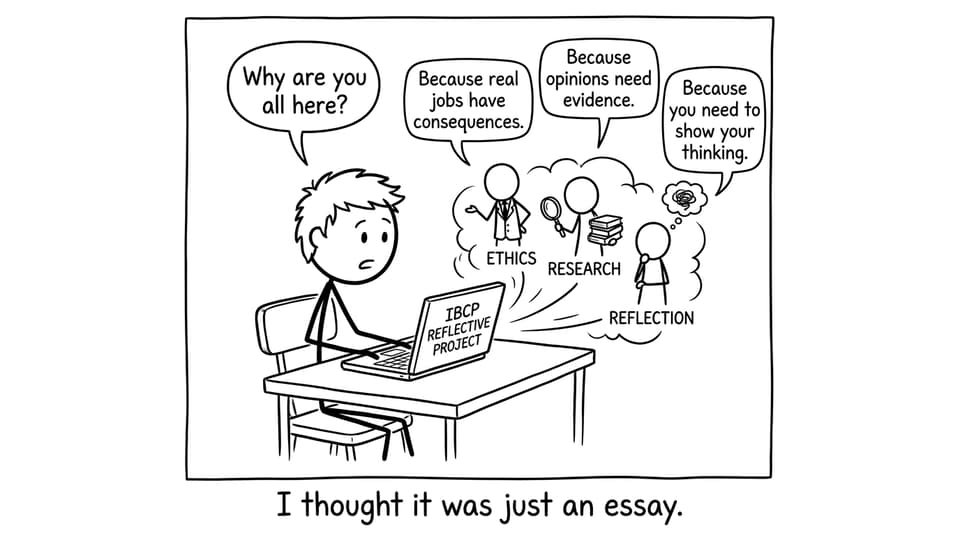
Quick overview: what the Reflective Project does in the IBCP
Use this checklist as your orientation before you dive into details:
-
It is a mandatory CP Core component of the IBCP.
-
It is an ethical inquiry connected to your career-related study (CRS).
-
It is teacher-assessed and IB-moderated for global consistency.
-
It requires roughly 50 hours of work in total.
-
You submit either a 3,000-word essay or a shorter essay plus a creative format.
-
You must earn at least a D to receive the IBCP Certificate.
If you want the broader context of where it sits in the CP Core, read The Four Components of the IB Career-related Programme (CP) Core Explained.
The real role of the Reflective Project in the IBCP
The best way to understand the Reflective Project is to picture a professional decision that looks “efficient” on paper but messy in real life.
A hospital adopts AI triage to reduce waiting times. A company uses customer data to personalize pricing. A construction project promises green energy but disrupts local land rights. None of these are only technical problems. They are ethical problems with trade-offs.
That is the role of the Reflective Project in the IBCP: it trains you to identify a real ethical dilemma that emerges from your CRS, explore competing perspectives, and make a reasoned judgment supported by evidence. You are not being asked to be perfect. You are being asked to be precise.
For a deeper orientation to the project itself, see Understanding the IB Career-related Programme Reflective Project.
What you actually produce: formats and what they are for
In the IBCP, you choose one of two approved routes:
Essay-only format
-
One essay of up to 3,000 words.
-
Reflection is recorded separately in the RPPF (Reflections on Planning and Progress Form).
Essay plus creative format
-
A written component of about 1,500--2,000 words.
-
An additional format (for example: film, interview, performance, visual display, or presentation).
-
The written and creative elements must still meet the assessment objectives together.
The choice is less about what is “easier” and more about which format helps you communicate your argument clearly. A creative element is only useful if it adds insight, evidence, or perspective -- not if it simply decorates the topic.
How it is assessed: what examiners want you to show
The Reflective Project is graded using a criterion-based rubric aligned to AO1--AO5, for a maximum of 36 marks. While details vary by task and guidance, the big idea stays stable: the most rewarded work is thinking that is structured and supported.
You will be assessed on:
-
Focus and method: a clear ethical dilemma and a sensible approach.
-
Knowledge and understanding: accurate, relevant context.
-
Critical thinking: weighing perspectives, building an argument, evaluating evidence.
-
Communication: organization, clarity, and appropriate academic style.
-
Engagement and reflection: documented through the RPPF and supervisor meetings.
To understand how the CP is assessed more broadly (and why moderation matters), use IBCP Assessment and Grading: What Counts (and Why).
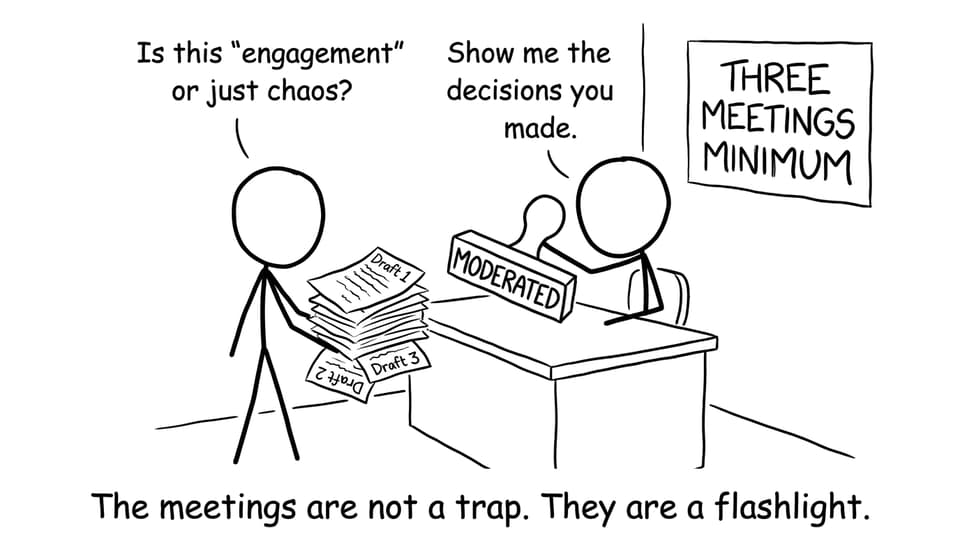
Supervision and moderation: why the meetings matter
Every IBCP student has a supervisor, usually a CP teacher or someone connected to the CRS. You should expect at least three formal meetings.
Here is what those meetings are really for:
-
To help you shape a dilemma that is ethical (not just “interesting”).
-
To prevent scope creep before it costs you weeks.
-
To confirm academic honesty and make your thinking visible.
After your school marks the project, a sample is sent for external moderation by the IB. That is why clear reflection and a transparent process matter: you are not only submitting an outcome, you are showing a defensible journey.
Exam prep reality: balancing the IBCP Reflective Project with revision
The Reflective Project lands when your brain is already busy. The smartest move is to treat it like training, not like a side quest.
A practical loop many students can sustain:
-
Draft a one-sentence dilemma.
-
Collect 6--10 strong sources (not hundreds).
-
Write a plan that forces two perspectives to disagree.
-
Build paragraphs like mini debates: claim, evidence, counterclaim, evaluation.
-
After each supervisor check-in, write a short reflection on what changed and why.
When you are preparing for exams at the same time, RevisionDojo helps you keep your energy for the work that converts into marks: targeted practice and feedback loops. Use Study Notes to clarify concepts fast, drill weak areas in the Questionbank, lock in definitions with Flashcards, and use AI Chat when you are stuck on a line of reasoning. If you are writing structured responses, Grading tools can help you understand what “clear communication” looks like under a rubric. And when you need realism, Mock Exams and Predicted Papers can make time pressure feel familiar.
If reflection is the part you keep postponing, Creating Actionable Reflection Prompts for IB Students is a strong starting point. If you want to see how reflection becomes measurable progress, read Harnessing Reflection Data to Support IB Learner Profile Development.
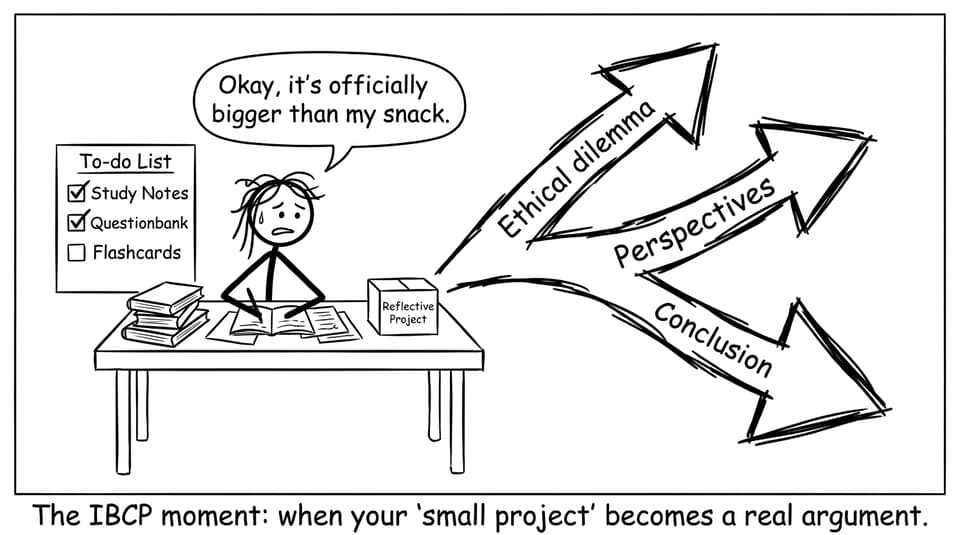
Closing: the point of the IBCP Reflective Project
The Reflective Project is the IBCP asking a serious question: when your career path puts you near real-world trade-offs, will you notice the ethical weight of your decisions -- and can you argue your way through it with evidence and clarity?
If you want to build that skill while you also prepare for exams, RevisionDojo gives you a complete workflow: sharpen knowledge with Study Notes, test it with the Questionbank, retain it with Flashcards, unblock confusion with AI Chat, and build confidence under pressure with Mock Exams and Predicted Papers. When you are ready, use those same habits -- practice, feedback, reflection -- to make your IBCP Reflective Project not just “done,” but genuinely persuasive.