


In IB Chemistry, there’s a tiny moment that repeats in labs, classrooms, and revision sessions everywhere: someone reads “neutral solution” and their brain auto-fills pH = 7.
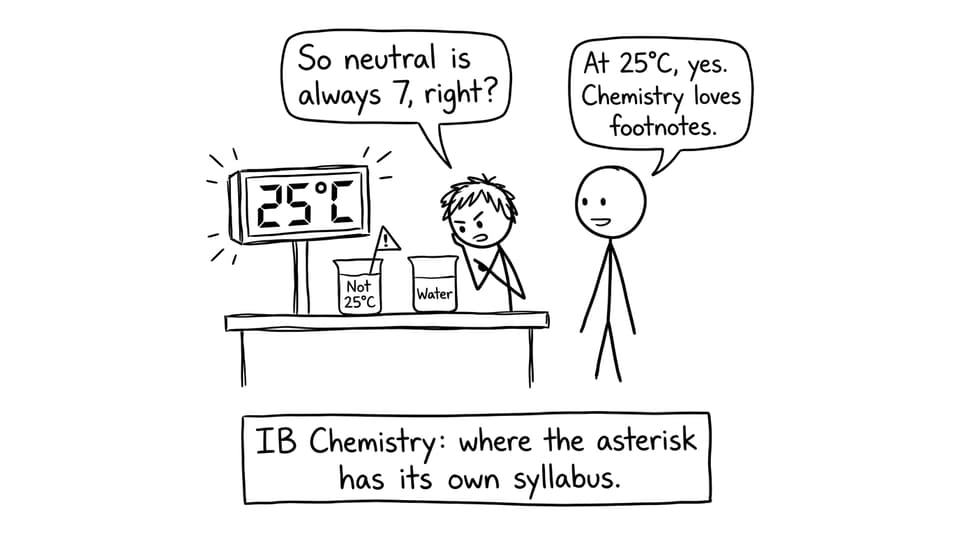
At 25°C, that instinct is right. But the reason it’s right matters more than the number itself. Because in exams, the IB doesn’t just reward memory. It rewards the student who can explain why pH 7 appears, and when the same logic produces a different neutral pH.
Quick checklist: neutral pH at 25°C (save this)
Use this as your IB Chemistry micro-check before any acids and bases question:
-
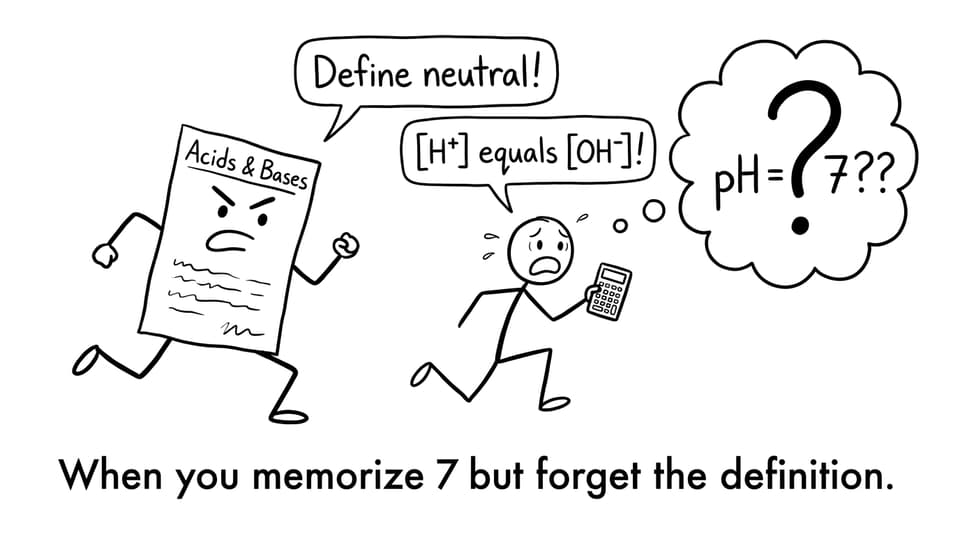
Neutral means [H⁺] = [OH⁻] (definition first, number second).
-
At 25°C, Kw = 1.0 × 10⁻¹⁴.
-
In pure water at 25°C: [H⁺] = [OH⁻] = 1.0 × 10⁻⁷ mol dm⁻³.
-
Therefore, pH = 7.00 at 25°C.
-
Neutral pH can shift with temperature even if the solution stays neutral.
If you want the pH definition and log reminders in one place, anchor your revision with pH and the hydrogen ion concentration (R3.1.4).
IB Chemistry: what is the pH of a neutral solution at 25°C?
In IB Chemistry, the pH of a neutral solution at 25°C is 7.00.
That’s the headline. But the exam marks are usually hiding in the explanation.
A neutral solution is defined by equality:
- [H⁺] = [OH⁻]
Not by a particular pH value.
pH is simply a way to express hydrogen ion concentration:
- pH = −log₁₀[H⁺]
So the real question becomes: what is [H⁺] in neutral water at 25°C?
The equilibrium that creates pH 7
Pure water undergoes autoionization:
- H₂O(l) ⇌ H⁺(aq) + OH⁻(aq)
The equilibrium constant for this is the ion product of water, Kw:
- Kw = [H⁺][OH⁻]
At 25°C, Kw = 1.0 × 10⁻¹⁴.
In neutral water, the ions form in equal amounts, so let:
- [H⁺] = [OH⁻] = x
Then:
-
Kw = x² = 1.0 × 10⁻¹⁴
-
x = 1.0 × 10⁻⁷ mol dm⁻³
Now the pH:
- pH = −log(1.0 × 10⁻⁷) = 7.00
For a clean syllabus-aligned explanation of this equilibrium, revise with The ion product of water, Kw (R3.1.5).
Why “neutral = 7” can fail (but neutrality doesn’t)
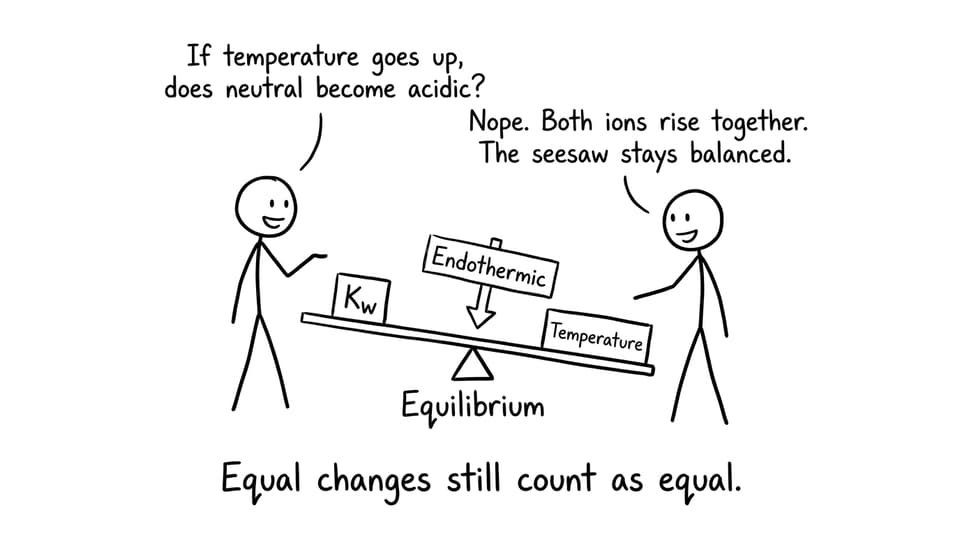
This is the twist that makes IB Chemistry questions feel unfair until you see the pattern: neutral pH depends on temperature.
The autoionization of water is endothermic. When temperature increases, the equilibrium shifts to produce more ions. That means:
-
Kw increases when temperature increases
-
[H⁺] and [OH⁻] both increase (still equal)
-
the pH of a neutral solution becomes less than 7
At lower temperatures, the reverse happens:
-
Kw decreases
-
[H⁺] and [OH⁻] both decrease (still equal)
-
the pH of a neutral solution becomes greater than 7
So neutrality stays the same (equal concentrations), but pH changes because pH tracks the size of [H⁺], not the comparison between [H⁺] and [OH⁻].
If you want to connect this to titration logic (where students often assume “equivalence point = 7”), review pH curves for neutralization (R3.1.8).
How this shows up in IB Chemistry exam questions
In IB Chemistry, examiners love prompts that test whether you separate definitions from defaults. “pH 7” is a default at 25°C. The definition is [H⁺] = [OH⁻].
A classic style of question is:
- “A solution has pH 6.9 at 50°C. Is it acidic, neutral, or basic?”
Many students see “6.9” and say “acidic.” But at 50°C, neutral pH is lower than 7. If [H⁺] equals [OH⁻], the solution is neutral even if the pH is below 7.
To practise this the way the IB marks it, do targeted sets in the pH scale Questionbank (8.3), then check your reasoning with RevisionDojo AI Chat before you repeat the same mistake.
If acids and bases still feel broad, start from the topic hub and narrow down: IB Chemistry Acids and Bases.
A simple revision loop (built for IB Chemistry)
When pH questions go wrong, it’s usually not because the math is hard. It’s because the thinking order is flipped. Try this loop:
-
State the definition first: acidic/basic/neutral in terms of [H⁺] and [OH⁻].
-
Write the key relationship: Kw = [H⁺][OH⁻] (and note temperature if given).
-
Only then convert to pH using logs.
RevisionDojo is built to make that loop automatic: learn fast with Study Notes, lock recall with Flashcards, and convert it into marks with the Questionbank and Mock Exams.
If you’re balancing revision pressure across subjects, the planning ideas in Exam Stress Management Tips for IB Candidates help keep chemistry from taking over your entire week.
Conclusion: the answer is 7.00 (and the reason earns the marks)
In IB Chemistry, the pH of a neutral solution at 25°C is 7.00, because Kw = 1.0 × 10⁻¹⁴ and therefore [H⁺] = [OH⁻] = 1.0 × 10⁻⁷ mol dm⁻³.
But the real upgrade is remembering that neutral means equal ions, not “pH equals 7.” Once you carry that definition into every acids and bases question, temperature twists stop feeling like tricks and start feeling like free marks.
To make this automatic, use RevisionDojo’s IB Chemistry ecosystem: Study Notes for clarity, Flashcards for recall, Questionbank for exam-style practice, AI Chat for fast feedback, and Mock Exams (plus Predicted Papers, Grading tools, the Coursework Library, and Tutors) to turn understanding into consistent results.