



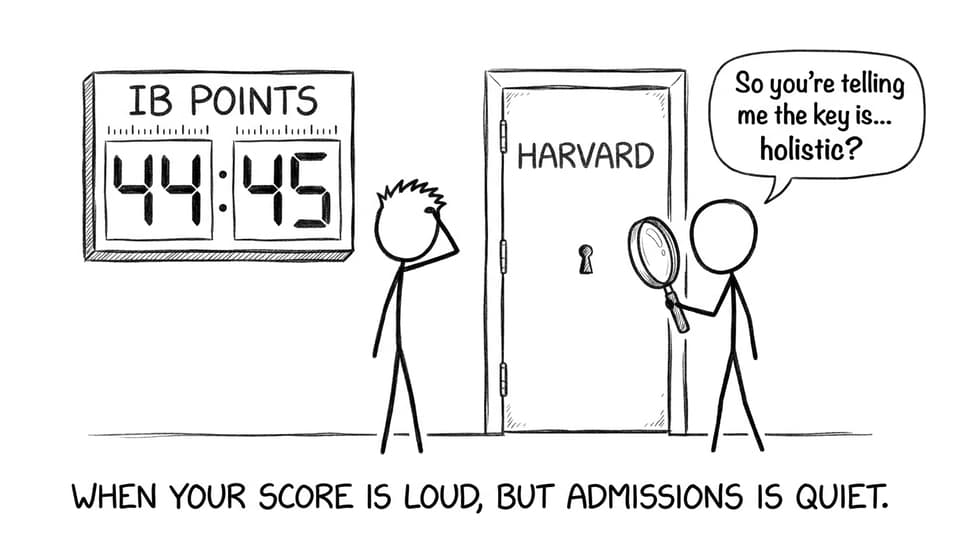
Your friend says, “Harvard is just a 45 or nothing.” Another friend says, “Scores don’t matter, it’s all essays.”
The truth sits in a quieter, more useful middle: IB points matter a lot because they are one of the clearest signals of academic readiness. But Harvard is also famous for reading the whole story of a student, not just the number at the top of a transcript.
So what is the average IB score for a Harvard-level applicant, and how should you plan your revision if you’re aiming that high?
The quick answer: what IB score is “Harvard competitive”?
Harvard does not publish an official minimum IB score. Still, patterns from admissions advising and applicant outcomes point to a consistent range:
-
Competitive range for serious consideration: 40-44
-
Often reported “average accepted” zone: about 44/45
-
A realistic floor (with a very strong overall profile): 38+
If you want a longer breakdown focused on predicted grades (what most applicants apply with), see Ideal Predicted IB Score for Harvard.
Harvard admissions context: why a great IB score helps, but doesn’t decide
Harvard’s admit rate is famously low, which means many applicants with outstanding academics will still be rejected. In that environment, your IB score is less like a “ticket” and more like proof you can handle pressure, workload, and complex thinking.
Here’s what a high IB score communicates:
-
You can perform across six subjects, not just one strength.
-
You can manage the “core” demands (TOK and EE) without your grades collapsing.
-
You can sustain performance over time, which matters to selective universities.
But Harvard also asks, implicitly: What did you do with your ability? That’s where essays, recommendations, and activities start pulling weight.
IB scoring, clarified (so you can plan strategically)
The IB Diploma Programme totals 45 points:
-
6 subjects x 7 points = 42
-
TOK + EE bonus = up to 3 points
The global IB average tends to hover around 30 points, which matters because it shows how far “40+” is above typical performance. A 40+ is not just “pretty good.” It’s a signal you’ve learned to play the assessment game well.
If you’re building your exam plan from the ground up, start here: RevisionDojo for IB.
So what average IB score should you actually aim for?
Think in ranges, not fantasies. Ranges keep you calm and concrete.
If you’re aiming for Harvard-level competitiveness
Target 42-44 as your working goal.
Why? Because it gives you breathing room. A single 6 in a subject (or a missed bonus point) doesn’t collapse your entire profile. In IB, resilience matters.
If you’re currently around 36-39
A Harvard application can still be possible, but you need two shifts:
-
Raise the academics where you can (especially HL consistency)
-
Build a standout “spike” elsewhere: research, national-level achievement, meaningful leadership, or creative work with real impact
In this range, your revision plan becomes your leverage. The fastest way to improve is rarely “study more.” It’s to practice more realistically and get feedback faster.
A practical checklist: how to push your IB score upward (without burning out)
Use this as a simple weekly loop. It’s designed for students preparing for IB exams while juggling coursework and applications.
-
Study Notes (clarity): Learn the minimum content you need to attempt questions.
-
Flashcards (memory): 10-15 minutes daily for spaced repetition.
-
Questionbank (marks): Topic-filtered practice, then review mistakes.
-
AI Chat (speed): Unstick confusion quickly so you don’t lose an hour.
-
Mock Exams + Predicted Papers (timing): Weekly timed rehearsal.
-
Grading tools (precision): Rubric-based feedback on essays and long responses.
RevisionDojo is built around exactly this loop: Questionbank, IB Coursework Grader, and IB Predicted Papers all work together so your practice turns into points.

What else Harvard cares about (and how IB students can show it)
A high IB score is powerful, but it’s not the whole application. Harvard tends to reward students who can show depth: intellectual curiosity with real output.
Essays and recommendations: make your thinking visible
Great essays aren’t “dramatic.” They’re specific. They show how you think, what you notice, and how you respond to difficulty.
A surprisingly good source of essay material is your IB core work, especially the EE. If you want to turn your EE into a compelling application story, use How Do I Use My EE Topic in College Applications?.
Extracurriculars: impact beats activity lists
Harvard is not counting clubs. They are looking for meaningful contribution: starting something, improving something, building something, or sticking with a hard craft long enough to get good.
Your advantage as an IB student is that your subjects already train you to think across disciplines. Use that. Pair a subject strength with a real-world project, and you’ll have a narrative that feels coherent.
How RevisionDojo helps you chase a Harvard-level IB score
There’s a moment in every IB season where motivation stops working. That’s when systems matter.
RevisionDojo is designed to be that system:
-
Study Notes to cut through content fog
-
Flashcards to keep daily recall alive
-
Questionbank to practice exam-style thinking
-
AI Chat to diagnose mistakes in mark-scheme language
-
Grading tools to improve TOK/EE/IA writing with rubric feedback
-
Predicted Papers and Mock Exams to build timing and composure
-
Coursework Library and Tutors when you need examples or a human plan
If you want to see how the full workflow fits together, read RevisionDojo App: The Smarter Way to Prep for IB Exams.
Conclusion: use IB as your advantage, not your anxiety
If you’re aiming for Harvard, the useful target is simple: treat 40+ in IB as the baseline for competitiveness, with 42-44 as a strong goal and 44-45 as exceptional.
But don’t let the number swallow the story. Build the score, then build the student behind it: clear interests, real output, and calm consistency.
When you’re ready to turn effort into points, start your loop on RevisionDojo: use Study Notes and exam prep tools for IB, drill with the Questionbank, and rehearse under pressure with IB Predicted Papers. Your future self will thank you for making practice feel real now.