




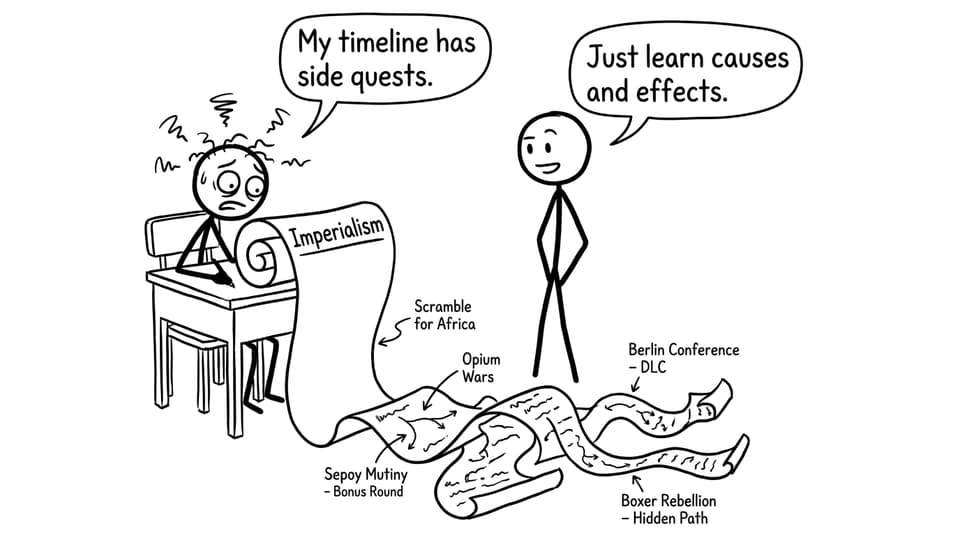
Imperialism is one of those IB History words that looks simple on a syllabus, then quietly expands until it takes over your entire essay plan. You start with a definition. Then you realize it connects to trade, racism, industry, borders, resistance, and the way powerful states explain themselves when they want more.
In this IB History guide, you’ll learn what imperialism is, how it changed between early expansion and “New Imperialism,” and how to turn the topic into clear Paper 2 cause-and-effect writing.
What is imperialism in IB History?
In IB History, imperialism is the policy or ideology of extending a state’s power over other regions through colonization, military force, political control, or economic dominance. The key idea is control: sometimes direct (formal empire), sometimes indirect (influence without annexation).
Imperialism matters because it shaped the modern world’s wealth patterns, borders, and hierarchies. It also created the conditions for anti-colonial nationalism and decolonization later on.
If you want a central place to organize topics, start with the IB History resources hub, then branch out into targeted notes and practice.
Quick checklist: how to score on imperialism questions
Use this IB History checklist before you write anything:
-
Define imperialism in one sentence (control via political, military, or economic means).
-
Identify the phase (early imperialism vs New Imperialism).
-
Categorize causes: economic, political/strategic, ideological/social.
-
Choose 2--3 specific examples (regions, crises, policies).
-
Evaluate: which cause mattered most in that case and why.
-
Link consequences to continuity and change (short-term vs long-term).
For Paper 2 structure help, keep this open while revising: IB History Paper 2 explained.
Early imperialism vs New Imperialism (and why IB History cares)
Imperialism did not arrive all at once. In IB History, it’s useful to split it into two broad waves.
Early imperialism (15th--18th centuries)
This phase is tied to exploration, conquest, and trade empires. European states expanded into the Americas and parts of Africa and Asia, often driven by mercantilism, bullion, and control of sea routes. It also laid foundations for transatlantic slavery and global commodity networks.
New Imperialism (1870--1914)
This later phase is the one that dominates IB History essays on global expansion. Industrialization increased demand for raw materials and markets, rivalries sharpened, and empire-building became a public symbol of national status. The Scramble for Africa is the classic example of rapid territorial acquisition.
To deepen context and get examples fast, see RevisionDojo’s own topic guide: What Is Imperialism? Global Expansion and Power.
Causes of imperialism: the IB History argument you actually need
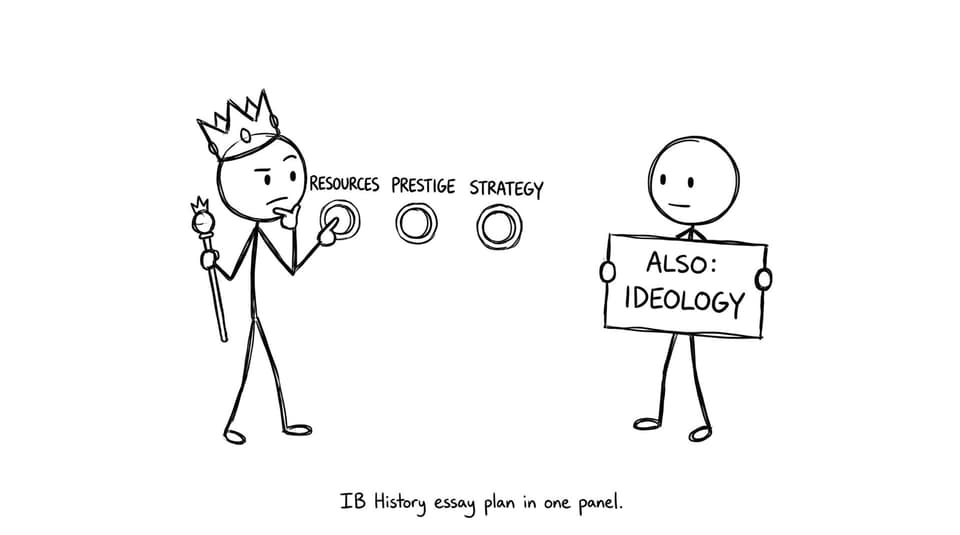
Most IB History prompts are not asking you to list causes. They’re asking you to weigh them.
Economic motives
Industrial economies sought raw materials (like rubber or oil) and new consumers. Economic influence also mattered even without formal colonization: control of loans, trade terms, and key ports could produce dependency.
Political and strategic motives
Empires offered prestige and bargaining power. Naval bases protected sea lanes. Rival powers sometimes grabbed territory simply to prevent opponents doing the same. These motives become stronger when you connect them to diplomacy and crisis.
A strong supporting example set is imperial rivalry feeding European tension. For that, use European diplomacy after 1871 notes.
Social and ideological motives
Ideas did real work. The “civilizing mission,” Social Darwinism, and missionary activity helped justify domination as morality. In essays, treat ideology as both belief and tool: it shaped policy and made policy acceptable at home.
Consequences of imperialism: how to evaluate, not just describe
Imperialism’s effects were layered, and IB History rewards students who show that complexity.
Political consequences
Borders were often drawn with little regard for local realities, creating later instability. Colonial administrations expanded bureaucracy and policing while restricting self-determination.
Economic consequences
Infrastructure grew (railways, ports), but typically served extraction and export. Many colonies became specialized economies, vulnerable to price shocks and dependent on imperial markets.
Social and cultural consequences
Education systems, language, and religion changed local societies, sometimes opening new opportunities while also eroding indigenous structures. Resistance movements grew over time, laying groundwork for mass nationalism.
If you want a case study that shows how conquest can accelerate later decolonization, explore Japanese victories in South-East Asia (1940--1942) notes.

How to revise imperialism for IB History exams (without drowning)
Imperialism can feel endless because it sits across themes and regions. The trick in IB History is to train argument and evidence together.
-
Build a definitions base with IB History Key Definitions.
-
Practice exam writing strategy with IB History exam prep guide.
-
Improve technique with IB History HL study techniques.
On RevisionDojo, you can turn that into a loop: use Study Notes to learn the content, Flashcards to keep it alive, the Questionbank to drill imperialism prompts, and AI Chat when your thesis won’t cooperate. Then use Grading tools to tighten evaluation, and rehearse timing with Mock Exams and Predicted Papers. If coursework pressure is bleeding into revision season, the Coursework Library and Tutors help you keep both under control.
To start the practice side, open the RevisionDojo Questionbank and build a short set focused on causes and consequences.
Closing: turn imperialism into marks
Imperialism isn’t just a chapter in IB History. It’s a pattern of power: how states justify control, how economies become dependent, and how resistance grows when people are treated as resources.
If you want your next imperialism essay to feel calmer, build it like training, not like cramming. Start at the RevisionDojo IB History hub, learn with Study Notes, test yourself with the Questionbank, tighten your evaluation using Grading tools and AI Chat, and then rehearse under pressure with Mock Exams and Predicted Papers. That’s how imperialism stops being overwhelming and starts becoming predictable.