

Hydrogen bonding is one of those ideas that feels small until you notice how often it quietly controls the whole story.
A kettle boils. Ice floats. Ethanol mixes with water. DNA holds itself together long enough for life to be boring and repetitive (in the best way). In IB Chemistry, hydrogen bonding is the hidden thread that makes these facts stop looking like trivia and start looking like patterns you can predict in an exam.
IB Chemistry quick checklist for spotting hydrogen bonding
Use this in IB Chemistry comparison questions (boiling point, viscosity, solubility, melting point):
-
Does the molecule contain H directly bonded to N, O, or F (N--H, O--H, F--H)?
-
Is there a lone pair on N, O, or F nearby (on the same molecule or a neighboring one)?
-
If yes, you can claim hydrogen bonding as the strongest intermolecular force present.
-
Then link it to a property: more energy needed to separate molecules.
If you need the full IMF hierarchy in one place, see Intermolecular Forces Explained.
What is hydrogen bonding (in IB Chemistry terms)?
In IB Chemistry, a hydrogen bond is an intermolecular attraction between:
-
a hydrogen atom covalently bonded to nitrogen, oxygen, or fluorine, and
-
a lone pair on a neighboring N, O, or F atom.
That “neighboring” detail matters. Hydrogen bonding is usually between molecules, not a new covalent bond inside one molecule. The covalent bond (like O--H) already exists; hydrogen bonding is the extra attraction between molecules that changes physical properties.
If you want syllabus-matched wording to memorize, the definition also appears in IB Chemistry Key Definitions.
Why only N, O, and F?
IB Chemistry keeps coming back to the same reasons:
-
High electronegativity makes the bond very polar.
-
Small atomic radius lets molecules get close.
-
Hydrogen is tiny, so its partial positive charge is unusually “exposed.”
Together, those make the δ+ hydrogen strongly attracted to lone pairs on nearby N/O/F atoms.
For the polarity background that makes this feel inevitable (not random), revise Bond polarity notes (S2.2.5).
Requirements for hydrogen bonding (what must be present)
A molecule can hydrogen bond only when both conditions are satisfied:
-
A donor: hydrogen bonded to N, O, or F.
-
An acceptor: a lone pair on N, O, or F (in the same substance or a molecule nearby).
Common examples you can safely use in IB Chemistry explanations:
-
Water, H₂O (O--H donor, O lone pairs acceptor)
-
Ammonia, NH₃ (N--H donor, N lone pair acceptor)
-
Alcohols, ROH (O--H donor, O lone pairs acceptor)
-
Carboxylic acids, RCOOH (O--H donor and carbonyl O lone pairs)
Why hydrogen bonding is “strong” (but not covalent)
Students sometimes hear “strong” and accidentally treat hydrogen bonding like an actual bond type. In IB Chemistry, keep the language precise:
-
Hydrogen bonding is strong for an intermolecular force.
-
It is still weaker than covalent bonds.
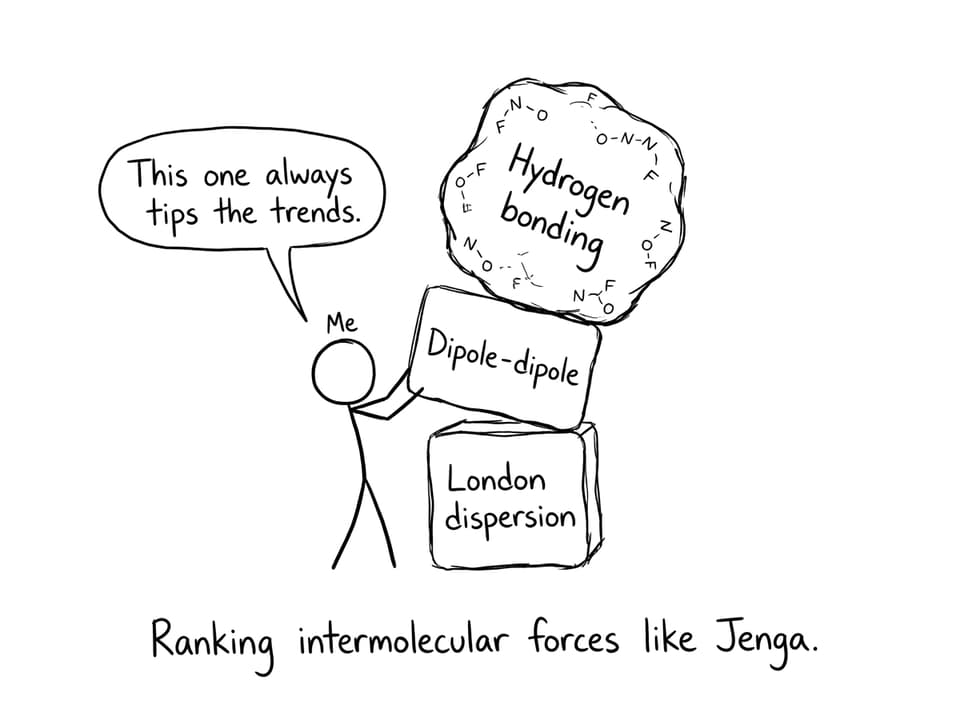
It beats typical dipole--dipole interactions mainly because the partial charges are bigger (highly polar bonds) and the molecules can approach closely (small atoms involved).
To practise writing those comparisons in examiner-friendly phrasing, drill questions from 4.4 Intermolecular forces Questionbank or the broader 4.4 Intermolecular forces topic page.
Effects of hydrogen bonding on physical properties (what exams actually ask)
Hydrogen bonding matters in IB Chemistry because it turns into marks. Here are the classic cause-and-effect chains.
Higher boiling points (the headline trend)
Boiling requires separating molecules. If hydrogen bonding is present, you must input more energy to overcome those attractions.
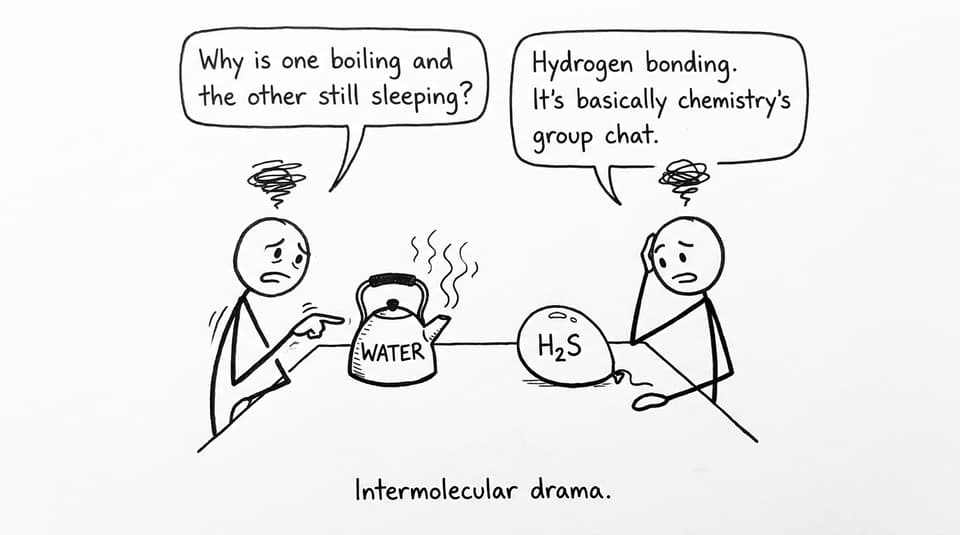
A famous comparison:
-
H₂O has extensive hydrogen bonding, so it boils high for its molar mass.
-
H₂S cannot hydrogen bond, so it boils far lower.
If boiling point questions are your weak spot, read How Hydrogen Bonding Affects Boiling Point.
Higher melting points (often, but explain carefully)
Melting point depends on how well molecules pack and how strong the attractions are in the solid lattice. Hydrogen bonding can create structured networks (like ice), so more energy is needed to disrupt the solid.
Your safest IB Chemistry phrasing is: hydrogen bonding can increase melting point by strengthening attractions and creating a more connected structure.
Higher viscosity and surface tension
Liquids with lots of hydrogen bonding resist flow because molecules keep “holding on” to each other. That shows up as higher viscosity (thicker flow) and higher surface tension (stronger surface).
Greater solubility in water (when H-bonding matches)
“Like dissolves like” becomes more detailed in IB Chemistry:
-
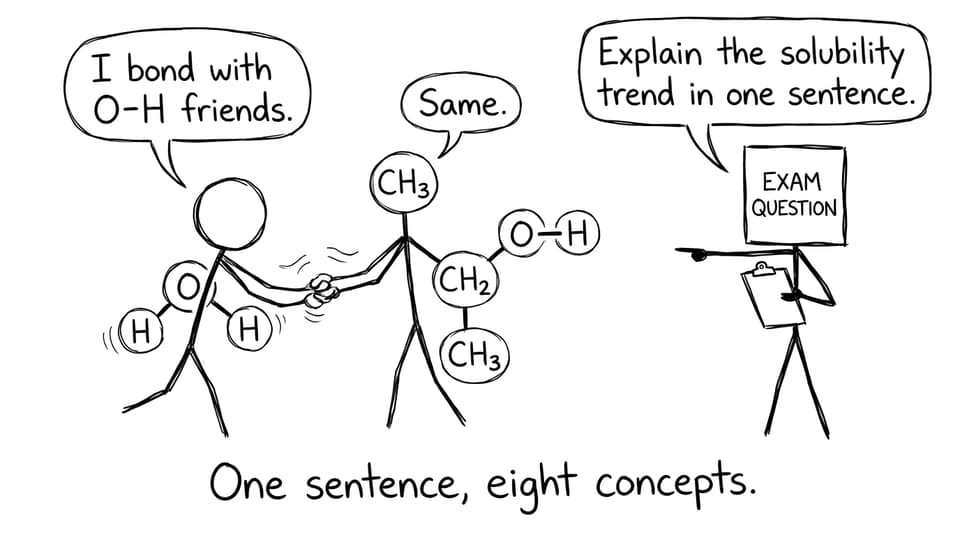
Molecules with O--H or N--H groups can form hydrogen bonds with water.
-
That strong interaction offsets the cost of separating water molecules.
So short-chain alcohols dissolve well; larger non-polar regions reduce solubility.
Hydrogen bonding in living systems (useful context, not extra fluff)
Even if you are focusing on IB Chemistry, biology examples help you remember what hydrogen bonding feels like:
-
DNA base pairs are stabilized by hydrogen bonds.
-
Protein secondary structure depends on hydrogen bonding patterns.
-
Water stays an unusually effective solvent because its hydrogen-bond network constantly forms and breaks.
For a water-focused explanation that reads like a clean model answer, see How Hydrogen Bonds Form in Water.
Common IB Chemistry mistakes to avoid
-
“Any molecule with hydrogen can hydrogen bond.” Not true. It must be H bonded to N, O, or F.
-
“Hydrogen bonds are covalent.” Not in IB Chemistry marking logic. Call them intermolecular attractions.
-
“Oxygen always means hydrogen bonding.” Oxygen needs a partnered hydrogen (O--H) to be a donor; lone pairs make it an acceptor.
Conclusion: turn hydrogen bonding into easy IB Chemistry marks
Hydrogen bonding in IB Chemistry is not just a definition to memorise. It is a quick diagnostic tool: spot N--H, O--H, or F--H, confirm lone pairs, then predict stronger intermolecular attraction and the property trend that follows.
To lock this in under exam pressure, use RevisionDojo as your routine: revise the syllabus points with S2.2.8 Intermolecular Forces notes, test recall with S2.2.8 flashcards, then build speed using the Questionbank, Mock Exams, and Predicted Papers inside the IB Chemistry hub. If you want feedback on how you phrase comparisons, RevisionDojo’s AI Chat and Grading tools help you turn “I get it” into “I can write it.”