

Chromatography is one of those IB Chemistry ideas that feels simple until you meet it in an exam question. In class, it’s “spots move, calculate Rf.” In a Paper 2-style prompt, it becomes a story about polarity, intermolecular forces, and why two nearly identical molecules refuse to travel together.
The good news is that chromatography has a clear purpose: it helps chemists separate mixtures so they can identify, check purity, and sometimes measure how much of each component is present. Once you see that through-line, the method stops feeling like a lab trick and starts feeling like a reliable decision tool.
Chromatography in IB Chemistry (fast overview)
If you’re revising IB Chemistry, keep this mini-checklist in mind:
-
Goal: separate components of a mixture
-
Two phases: a stationary phase (doesn’t move) and a mobile phase (moves)
-
Why separation happens: each component has a different “preference” for the two phases
-
What you read: spots (paper/TLC) or peaks/retention times (GC/HPLC)
For a syllabus-aligned hub, use S2.2.10 Chromatography and pair it with the Chromatography Notes.
What is chromatography used for?
Chromatography is used to separate a mixture into its components so you can:
Identify what’s inside an unknown mixture
In IB Chemistry, identification usually means: compare a result to a known reference. With paper chromatography or TLC, that reference might be an Rf value (under the same conditions). With gas chromatography, it might be a retention time.
If you want a clean explanation you can quote in your own words, see Principle of Chromatography Explained.
Check purity (the exam-friendly use)
Purity is the most tested “use case” because it’s visual and decisive.
-
One spot/one peak: suggests purity (under those conditions)
-
Multiple spots/peaks: suggests a mixture or impurities
A subtle IB Chemistry point: one spot doesn’t prove absolute purity forever. It means the sample behaves as one component in that system (stationary phase + mobile phase + temperature, etc.).
Monitor reactions (is it finished yet?)
TLC is often used to check whether reactants have disappeared and products have formed. That matters because reactions can look “done” (no bubbling, no color change) while still containing a stubborn starting material.
This also connects to how examiners think: chromatography becomes evidence. You’re not guessing; you’re showing a pattern.
Separate very similar substances
Chromatography can separate compounds with subtle differences (think isomers or similar functional groups). This is why it’s so widely used beyond school labs: it can do the patient, quiet work of separating things that look identical on paper.
Quantify components (advanced methods)
Techniques like HPLC and GC can measure how much of each component is present (based on peak areas). At IB Chemistry level, you mainly need the idea that chromatography can be analytical (identify) and also quantitative (measure amount), even if the math is not always required.
Why chromatography works (the mechanism examiners love)
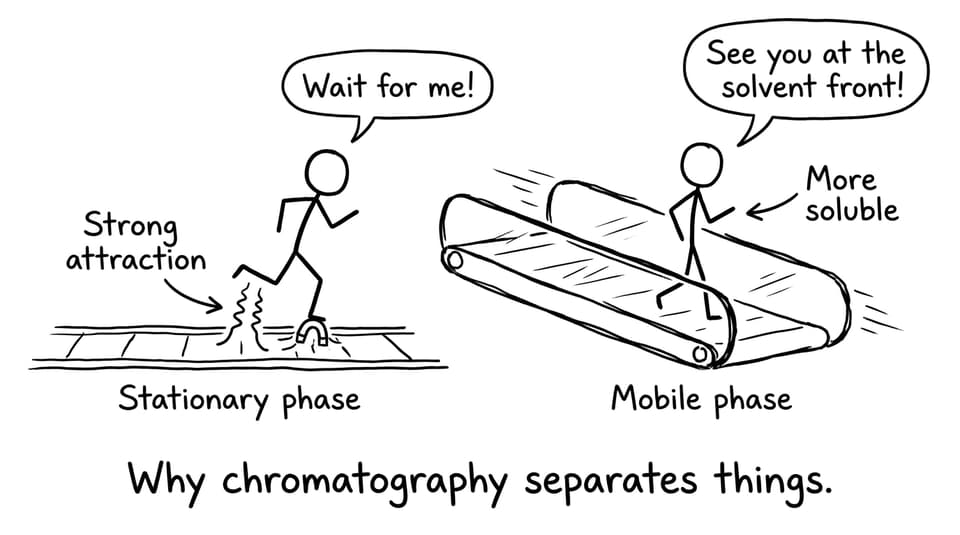
Separation happens because different substances spend different proportions of time:
-
adsorbed to the stationary phase (stuck more)
-
dissolved in the mobile phase (carried more)
Translate that into the language of IB Chemistry and you get the familiar drivers:
-
Polarity differences
-
Solubility differences
-
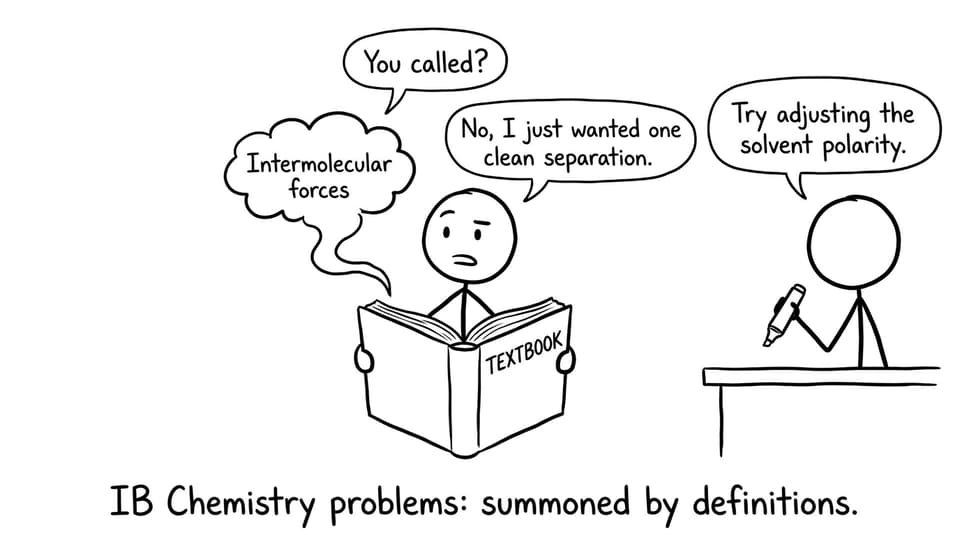
Intermolecular forces (dispersion, dipole-dipole, hydrogen bonding)
-
Volatility (especially for GC)
A practical way to remember it: the mobile phase rewards solubility; the stationary phase rewards attraction.
Types of chromatography you’ll meet in IB Chemistry
Paper chromatography
Often introduced with inks and dyes. It’s simple, visual, and great for understanding the “two phases” idea.
Thin-layer chromatography (TLC)
TLC is paper chromatography’s stricter sibling: better separation, clearer spots, and a common method for reaction monitoring.
To practice exam-style prompts on TLC and interpretation, use the S2.2.10 Chromatography Questionbank and build fluency fast.
Gas chromatography (GC)
Used for volatile compounds. In questions, it often appears as a chromatogram with peaks to interpret. The deeper idea is the same: components move at different rates because they interact differently with the stationary phase and because volatility and temperature matter.
Interpreting results: Rf and retention time
Rf value (paper/TLC)
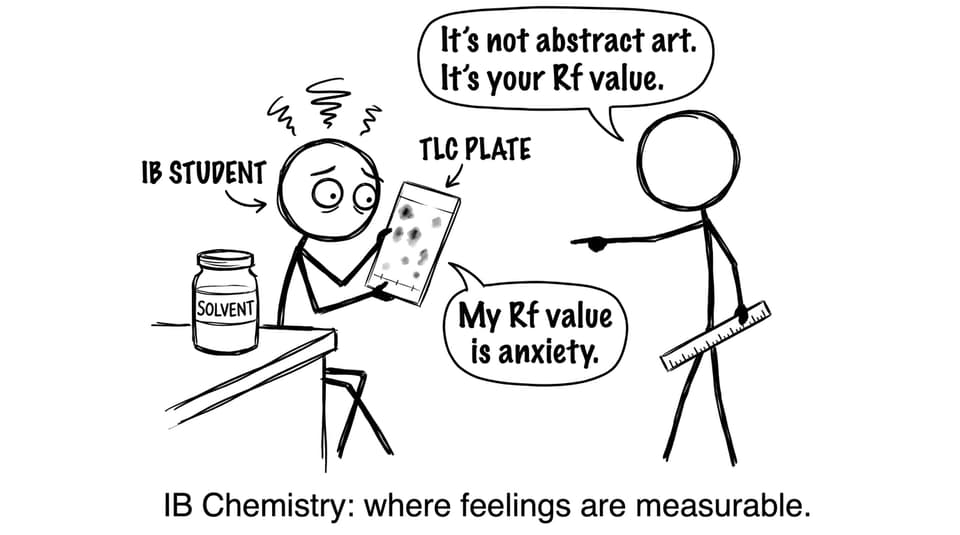
(R_f) is the distance traveled by the solute spot divided by the distance traveled by the solvent front. It must be between 0 and 1.
Two IB Chemistry habits that save marks:
-
measure from the baseline to the center of the spot
-
mark the solvent front immediately before it evaporates
For definitions and phrasing that match exam expectations, keep IB Chemistry Key Definitions open while you revise.
Retention time (GC)
Retention time is how long a component stays in the column before it reaches the detector. It depends on interaction strength with the stationary phase, volatility, and temperature.
Common mistakes IB Chemistry students make
-
Assuming Rf values are universal (they’re not; solvent choice matters).
-
Thinking bigger spots always mean higher concentration (application technique matters).
-
Forgetting GC needs volatility (non-volatile compounds won’t behave nicely).
-
Claiming chromatography gives a molecular structure (it separates and supports identification; structure needs other evidence).
Closing: make chromatography your “easy marks” topic
Chromatography is used to separate mixtures so chemists can identify components, check purity, monitor reactions, and (with advanced methods) quantify amounts. In IB Chemistry, it’s not just a technique to memorize; it’s a story about competition between phases, explained through polarity and intermolecular forces.
If you want this topic to feel automatic by exam day, revise it the RevisionDojo way: read the Chromatography Notes, practise with the Chromatography Questionbank, then lock it in with Flashcards, AI Chat, and timed Mock Exams and Predicted Papers. That’s how IB Chemistry stops being intimidating and starts becoming predictable.