
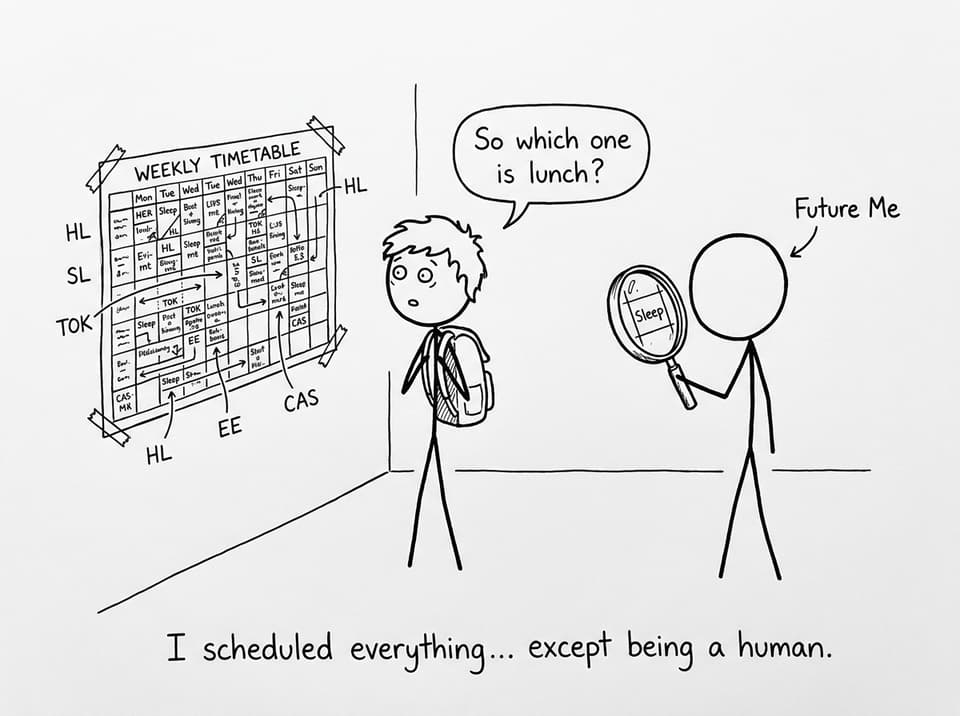
A funny thing happens in IB: you can have a color-coded timetable, three planners, and a perfectly sharpened pencil set… and still feel like your week is running you. The problem usually isn’t effort. It’s that you’re trying to “do IB” without seeing what a standard IB week is actually made of.
This guide gives a complete, realistic IB weekly breakdown, what most students’ schedules look like, how many hours different components tend to take, and how to build a week that supports exam prep without turning you into a sleep-deprived calendar manager.
The standard IB schedule at a glance
Most IB Diploma Programme schedules share the same skeleton, even if your school labels blocks differently.
Quick checklist
-
6 subjects across the IB groups (with Arts or a second subject)
-
3 HL + 3 SL in most schools
-
Core: TOK, Extended Essay (EE), CAS
-
A 5-day school week, usually with free periods
-
Extra time outside class for homework, revision, and coursework
If you want to orient yourself inside the programme first, start with the International Baccalaureate (IB) hub.
Weekly breakdown: how many hours does IB actually take?
A “standard” IB week has two layers: class time (set by school) and study time (set by you). The stress usually comes from underestimating the second layer.
Typical class time per week
These ranges vary by school, but they are common expectations:
-
Each HL subject: ~4-5 hours/week in class
-
Each SL subject: ~3-4 hours/week in class
-
TOK: ~1-2 hours/week
-
CAS: often not timetabled as a class (but still must happen)
Typical study time per week (outside class)
A realistic IB workload for many exam-focused students lands around:
-
HL total: ~12-15 hours/week
-
SL total: ~9-12 hours/week
-
TOK: ~1 hour/week (more near essay deadlines)
-
CAS: ~3-4 hours/week (spread across the week)
-
Homework + revision: ~10-12 hours/week
That puts many students around 30-40 hours/week of combined academic effort, depending on how efficiently they study.
A complete standard IB weekly schedule (example)
Below is a practical “shape” for a week. You’re not copying this minute-for-minute. You’re borrowing the logic: steady recall, targeted practice, and one timed session.
Monday to Thursday: the stable rhythm
-
After school (60-90 min): one HL focus block
-
10 min review from Study Notes
-
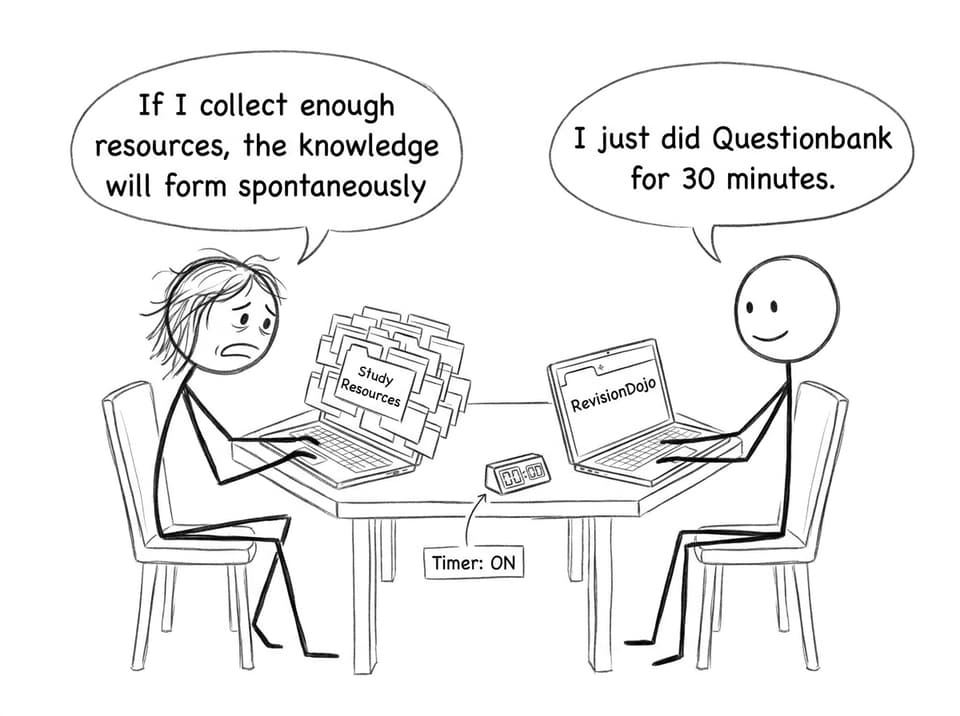
35-45 min Questionbank practice
-
10-15 min mistake review (turn errors into rules)
-
-
Evening (10-15 min): Flashcards for daily recall
RevisionDojo makes this loop simple because the tools sit together: Study Notes, Flashcards, and the Questionbank feature all feed into each other.
Friday: the “close loops” day
-
30-45 min: tidy unfinished homework or one IA/EE micro-task
-
20 min: TOK reading or planning (small, consistent)
-
10 min: flashcards (keep the chain unbroken)
For a clear picture of what the core demands across two years, read What Is the Core Requirement in IB?.
Weekend: one deep block + one life block
-
Saturday (90-120 min): one timed session (mini-mock or paper section)
-
Sunday (45-60 min): weekly reset + planning
-
pick 2 priority subjects
-
schedule one TOK/EE/CAS checkpoint
-
decide your next timed practice
-
If you want a calmer version of this rhythm, borrow the structure from How to Create a Balanced IB Study Schedule.
Where TOK, EE, CAS, and coursework fit in a normal IB week
Students struggle most when the IB core is treated like “extra.” It isn’t extra. It’s part of the schedule.
TOK (small but sharp)
TOK rarely needs daily work, but it benefits from weekly consistency.
-
Keep a running list of examples (real-world situations)
-
Do 20-30 minutes of reading or outlining weekly
-
Increase time near essay deadlines
When you’re ready to push your EE with more critical thinking, use How to Use TOK to Enhance Your Extended Essay.
Extended Essay (slow progress beats heroic sprints)
The EE is easier when it becomes a routine.
-
2 sessions/week of 30-45 minutes in quieter months
-
More time in the drafting window
If you’re unsure what “good progress” looks like, start at IB Extended Essay Guide.
CAS (protect it from exam-season guilt)
CAS works best when it’s steady and simple:
-
one creative habit
-
one activity habit
-
one service commitment
If you ignore CAS and it collapses later, the consequences are real. This is worth reading early: What Happens If You Fail TOK or CAS in IB?.
How to turn a standard IB schedule into exam prep
A standard IB schedule becomes exam prep when you add two things: feedback and timing.
A simple exam-prep workflow
-
Learn fast with Digital IB Study Notes
-
Lock recall with IB Flashcards with Spaced Repetition
-
Apply with IB Question Bank: How to Use It Effectively
-
Rehearse with IB Predicted Papers and Mock Exams
This is where RevisionDojo quietly becomes the advantage: you can move from Questionbank practice to AI Chat explanations, then use Grading tools to improve written work, pull exemplars from the Coursework Library, and use Tutors when you need a human to spot what you’re missing.
Build your IB week with less friction
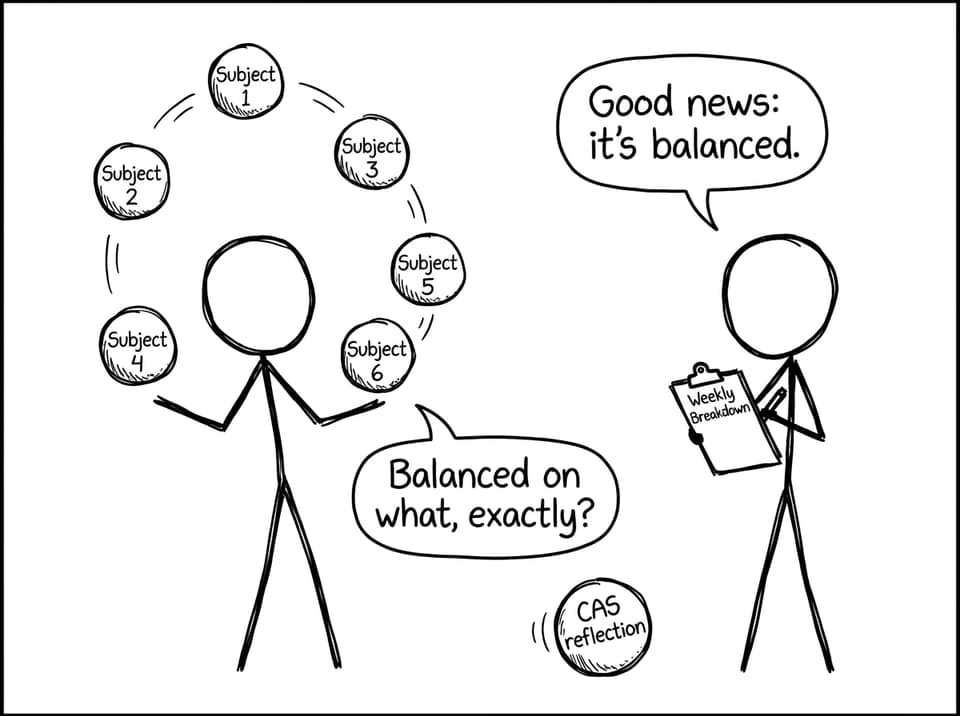
A standard IB schedule isn’t meant to be easy. It’s meant to be doable, if you stop relying on motivation and start relying on structure. Give HL subjects more attention, keep TOK/EE/CAS moving in small steps, and add one timed session each week so exam conditions feel normal.
When you’re ready to make your IB week sharper, use RevisionDojo as your home base: Study Notes for clarity, Flashcards for daily recall, Questionbank for exam-style practice, AI Chat and Grading tools for feedback, plus Predicted Papers, Mock Exams, the Coursework Library, and Tutors when you need support that actually changes your score.