


A conflict you can feel in real life
A queue forms. The customer wants a refund now. The employee wants a manager because the policy is unclear. And somewhere far from the store, a shareholder wants costs down and margins up.
That small moment is basically the whole point of IB Business Management: organizations run on trade-offs, and stakeholder conflict is what makes those trade-offs visible.
In exam questions, this often appears as: “What happens when customer needs conflict with employee or shareholder interests?” Your job is not to pick a side instantly. It is to explain the tension, show consequences, and then evaluate a realistic way forward.
Quick checklist for exam answers (keep it tight)
Use this mini-structure in IB Business Management Paper 1 or Paper 2:
-
Identify the stakeholders (customers, employees, shareholders/owners)
-
State each group’s objective (price/quality/service; wages/conditions; profit/returns)
-
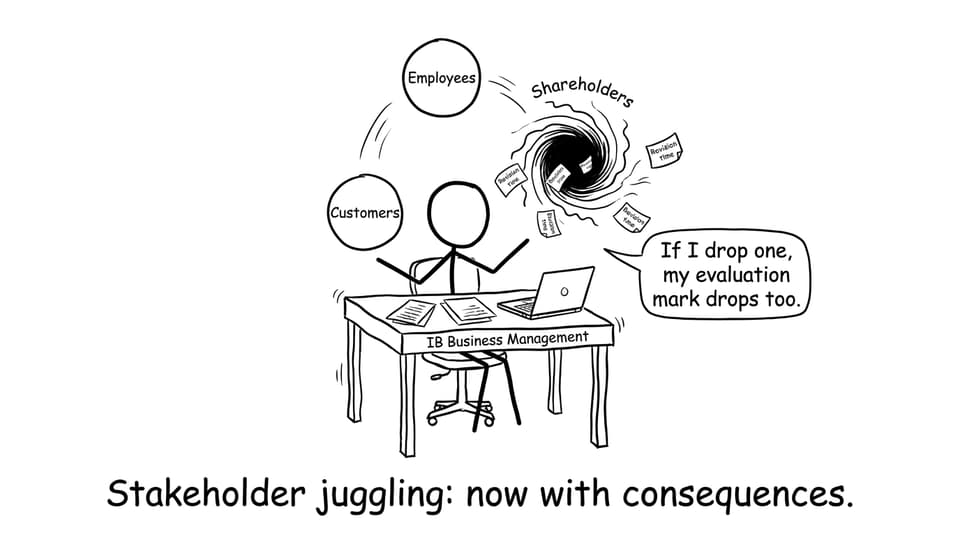
Explain the conflict (what improves one might harm another)
-
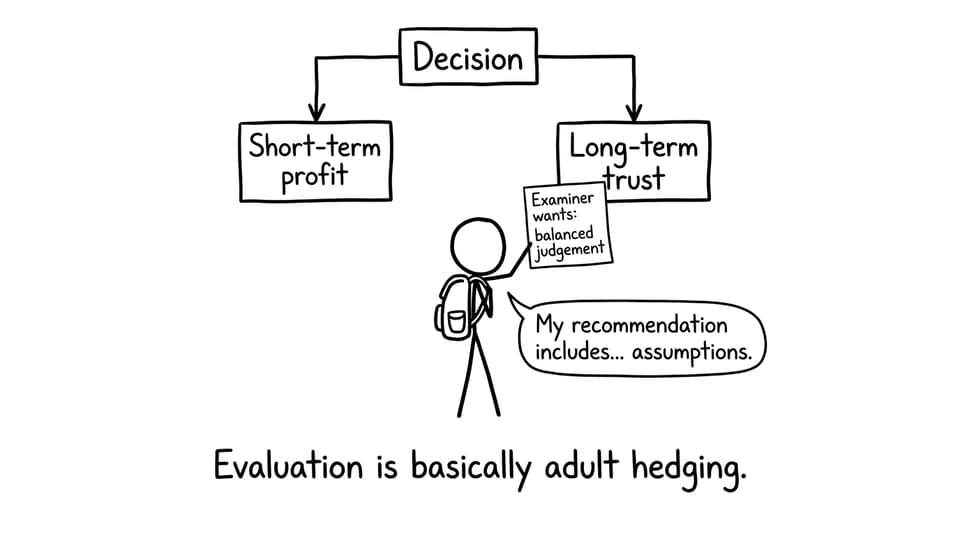
Add a short-term vs long-term angle
-
Finish with a balanced judgement and a justified recommendation
If you need to refresh the theory fast, start with RevisionDojo’s 1.4 Stakeholders hub.
Why customer needs collide with shareholder interests
Customers usually want some combination of lower prices, better quality, and faster service. Meeting those needs often requires investment: more staff on the floor, stronger customer support, better materials, quicker delivery systems.
Shareholders, however, tend to prioritize profitability, dividends, and long-term growth in share value. If a business cuts prices to win customers, profit margins may shrink. If it upgrades quality, costs may rise. If it speeds up service, staffing and logistics costs can increase.
In IB Business Management, you can link this to costs and profitability logic: decisions that benefit customers can raise variable or fixed costs, squeezing profit unless sales volume rises enough to compensate. A quick revision detour that helps here is RevisionDojo’s 3.3 Costs and Revenues topic.
Why customer needs collide with employee interests
Customers love “same-day delivery” and “24/7 support.” Employees often experience that as more intense workloads, longer shifts, and tighter performance targets.
When businesses push aggressively to satisfy customers at low prices, the pressure usually travels down the chain: fewer staff doing more tasks, stricter time limits, and less room for training or wellbeing. That can lead to burnout, absenteeism, higher labour turnover, and falling service quality, which ironically harms customers too.
This is where stakeholder conflict becomes a loop: short-term customer satisfaction can create long-term employee demotivation, which then damages the customer experience.
If you want a syllabus-aligned definition and examples, RevisionDojo’s 1.4.1 Internal and External Stakeholders notes are a quick win.
What businesses actually do when the conflict gets serious
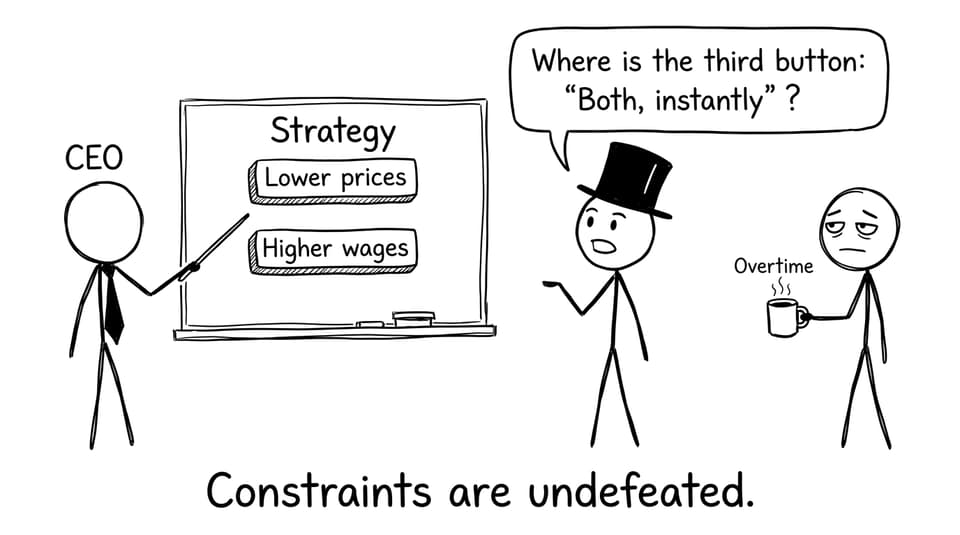
In IB Business Management, high-scoring responses show decision-making under constraints. Here are realistic approaches:
Aim for long-term value, not short-term wins
Investing in employee training and conditions may raise costs today, but it can improve productivity and customer service tomorrow, supporting profit later. This is an easy evaluation point: stakeholders are interconnected.
Use transparency to reduce resistance
When businesses explain why prices rise, why targets change, or why profit expectations exist, they often lower conflict intensity. Trust does not remove trade-offs, but it makes compromise possible.
Innovate the process (not just the messaging)
Automation, better systems, and redesigned workflows can cut costs without simply squeezing wages or quality. In exam terms, this is a “third way” solution that shows evaluation.
For more direct wording you can reuse in exams, see RevisionDojo’s 1.4.2 Conflict Between Stakeholders notes.
How to turn this into marks fast
A simple way to practise this in IB Business Management is to write one paragraph for each stakeholder, then add a recommendation that includes conditions (for example, “in the short term,” “if cash flow is stable,” “if brand reputation is premium”).
RevisionDojo makes this practice loop easier with:
-
IB Business Management Questionbank for stakeholder-conflict exam questions
-
1.4 Stakeholders Questionbank for targeted drills
-
Flashcards for 1.4.1 Stakeholders to lock in definitions
-
The full IB Business Management Resources hub to connect Study Notes, Flashcards, AI Chat, Grading tools, Predicted Papers, Mock Exams, the Coursework Library, and Tutors
Closing: the exam is really testing balance
When customer needs conflict with employee or shareholder interests, the business is forced to choose between speed, cost, quality, and fairness. That tension is not a flaw in the system; it is the system. If you can explain the trade-off clearly and then evaluate a realistic response, you are thinking like an IB Business Management student aiming for top-band marks.
If you want to practise this the way the exam demands, build a quick routine on RevisionDojo: Study Notes for clarity, Flashcards for definitions, Questionbank for application, AI Chat to test counterarguments, and Grading tools to sharpen evaluation. Then use Predicted Papers and Mock Exams to make it feel automatic under time pressure.