
A calm truth about missing an IB exam
The moment you realize you missed an IB exam, your brain writes a horror story in under three seconds. Diploma gone. University offer gone. Life ruined.
But real life rarely follows panic logic. The IB is strict, yes. It’s also procedural. And procedures exist for exactly this kind of messy human moment: illness, emergencies, accidents, mental health crises, and genuine disruptions.
This guide walks you through what actually happens if you miss an IB exam, what counts as a valid reason, what your school can request, and how to recover without making the situation worse.
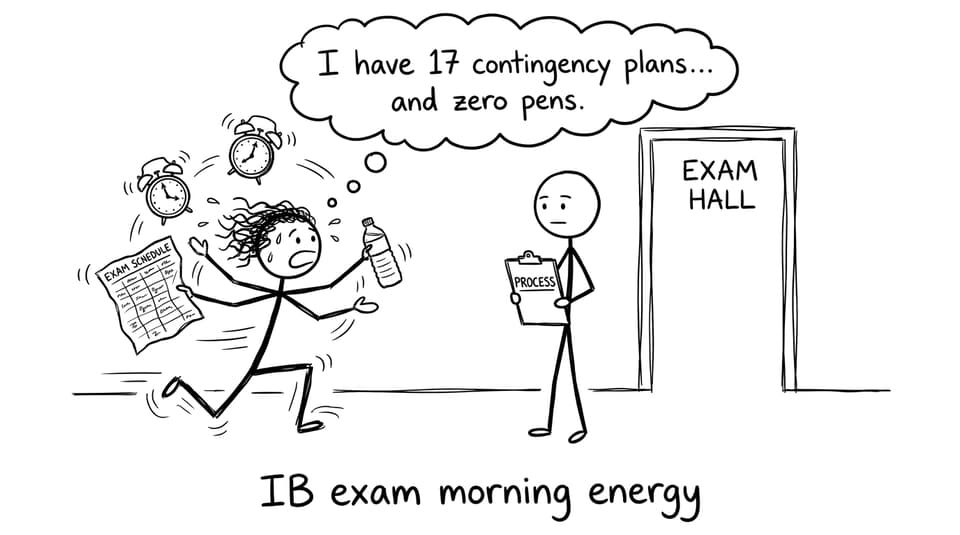
The 60-minute checklist: what to do right away
If you take nothing else from this article, take this. When an IB exam is missed, the first hour matters because it sets up documentation and the school’s next steps.
-
Contact your IB coordinator immediately (call, then email for a paper trail)
-
Explain what happened in simple facts (no long justification speech)
-
Ask what evidence is required (doctor’s note, hospital discharge note, police report, counselor letter, etc.)
-
Write down: time, location, who you spoke to, and what they advised
-
Do not contact the IB directly (your school communicates on your behalf)
If you’re also dealing with anxiety or shock, use a tiny script: “I missed my exam. I’m safe. I need to report this and follow the process.” Then stop talking and start the steps.
For exam logistics you can control going forward, keep IB Exam Day Checklist: The Ultimate Guide open in a tab and treat it like a pilot’s pre-flight list.
Valid vs invalid reasons: how the IB tends to view absences
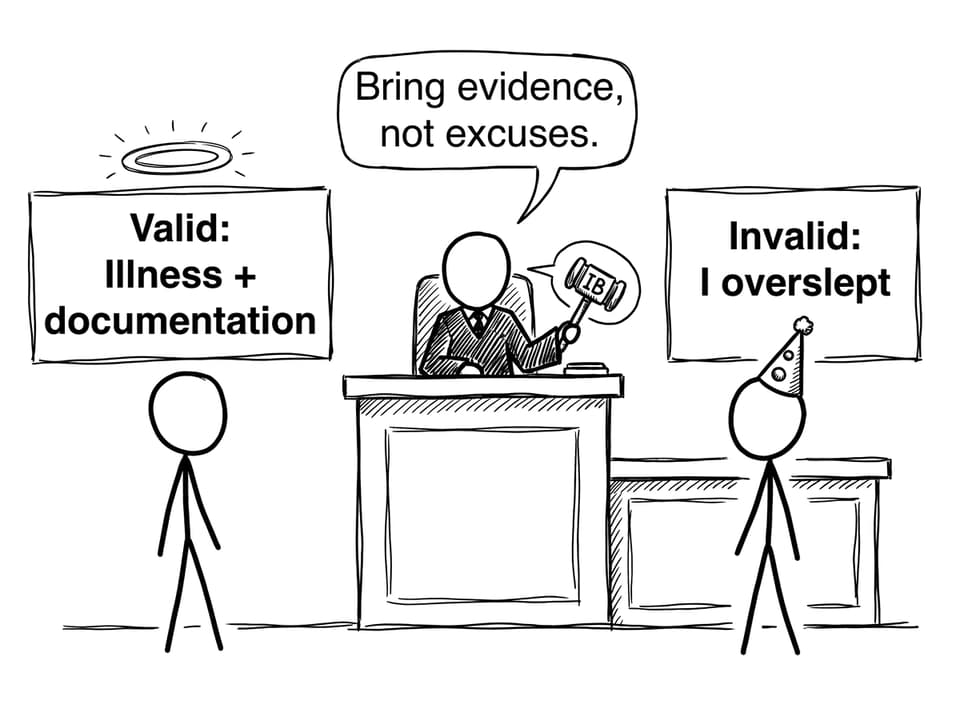
An IB exam absence is not judged by how bad you feel about it. It’s judged by whether there’s a documented, credible reason.
Valid reasons (usually, with documentation)
These tend to be considered legitimate when supported by evidence:
-
Acute illness or medical emergency
-
Accident or injury
-
Family emergency (bereavement or serious event)
-
Mental health crisis (when documented as a medical issue)
-
External disruption (natural disaster, serious local event)
If mental health is part of your story, read Do IB Deadlines Get Extended for Mental Health? for how schools usually document and communicate these situations inside the IB system.
Invalid reasons (usually)
These are the ones students wish counted, but typically don’t unless there’s a bigger documented issue:
-
Oversleeping
-
Misreading the timetable
-
“I wasn’t ready”
-
Unverified travel delays
-
Forgetting the start time
Here’s the hard but useful truth: the IB doesn’t grade intentions. It grades evidence and completed components.
What happens in the IB system if you miss an exam
When an IB exam is missed, your school (through the coordinator) becomes your voice. They document the absence, gather evidence, and submit the appropriate request.
There are a few realistic outcomes, depending on what you already completed in that subject.
You missed one paper, but completed other components
In some cases, if enough of the assessment components are completed (for example, coursework plus another paper), your school may be able to request a form of special handling so you can still receive a final grade.
This is not something you can demand, and it’s not automatic. It depends on:
-
Whether the reason is valid and documented
-
How many components you completed
-
What the IB regulations allow for that specific situation
You missed the entire subject’s exams
If you miss all examination components for a subject, it becomes much harder to receive a subject grade in that session. In many cases, the practical route is a resit in the next exam session.
You missed multiple exams
Missing multiple IB exams often affects diploma eligibility for that session. Your school will explain whether you can still be awarded the diploma based on what was completed, or whether you’ll receive certificates and need to resit to complete the diploma requirements.
If you need a mindset reset while you’re waiting on next steps, How to Beat IB Exam Anxiety (Without Burning Out) is worth reading once, slowly.
Can you get an IB grade without sitting the exam?
Sometimes, in limited situations, a student can still be awarded a grade when an IB exam is missed. The mechanism is typically handled through your school, with documentation, under formal procedures.
What the IB may consider when enough components exist:
-
Your coursework performance (like IAs)
-
Your predicted grades (as evidence, not as a guarantee)
-
Any completed papers or components in that subject
This is exactly why it matters to take coursework seriously even when exam season feels far away. Coursework can become your safety net if the worst day happens.
If predicted grades are now part of the conversation, see IB Predicted Grades Missed? What to Do Next for a practical way to communicate and rebuild evidence.
Resits: the cleanest recovery plan when you can’t be graded
If you need to resit, it can feel like you’re being pushed off the main timeline of your friends’ lives. But a resit is often the most straightforward way to protect your final outcome in the IB.
A resit plan usually involves:
-
Re-registering through your school
-
Building a shorter, smarter study cycle (not repeating the entire year emotionally)
-
Practicing under timed conditions early, so exam day isn’t “new” again
A good structure is:
-
One weekly timed paper section (to rebuild stamina)
-
Three short accuracy sessions (to rebuild confidence)
-
One review day focused on recurring mistakes
RevisionDojo is built for this exact loop: use the Questionbank to rebuild accuracy, Flashcards to keep daily recall light, and then rehearse realism with IB Predicted Papers by IB Examiners. Add AI Chat when you’re stuck, Grading tools when you need rubric-level feedback, and Tutors when you need a human to diagnose what’s really holding you back.
To make that practice feel manageable, borrow the setup from Custom IB Mock Exams: Build Practice Tests by Topic.
Universities and missed IB exams: what usually matters
Universities tend to care about three things when an IB exam is missed:
-
Was the reason genuine and documented?
-
Did the school communicate clearly and early?
-
Is there a concrete plan (special handling outcome or resit timeline)?
Many admissions teams have seen disrupted exams before. What makes situations go badly is silence, vague explanations, or late communication.
A calm way to handle it is to ask your coordinator what the school can confirm in writing, then send a short update to the university: what happened, what the school is doing, and when you’ll know more.
How to prevent missing an IB exam (without becoming paranoid)
Most prevention is boring. That’s good news.
-
Read your exam timetable twice daily during exam week
-
Pack your exam kit the night before (and re-check in the morning)
-
Set two alarms and one “get out the door” alarm
-
Plan transport with buffer time
-
Don’t rely on group chats for critical timing
For a simple routine that lowers mistakes, use What to Do the Night Before IB Exams and The Biggest Mistake Before IB Exams (and the Fix).
Closing: you didn’t end your IB story, you hit a detour
Missing an IB exam is serious. It’s also survivable. The system is built around rules, and rules create pathways: document the reason, involve your coordinator immediately, and take the next step that can be verified.
When you’re ready to move from panic to plan, use RevisionDojo as your home base: drill weak spots with the Questionbank, stabilize memory with Flashcards, get unstuck with AI Chat, and rebuild exam confidence with Predicted Papers and Mock Exams. Add Grading tools, the Coursework Library, and Tutors when you need faster feedback and real strategy.
If you missed an IB exam and need a recovery plan for the next session, start at RevisionDojo | IB & MYP Resources and build a calm loop you can repeat.