


Failing an IB Higher Level (HL) subject can feel like a trapdoor opening under your feet.
One moment you’re thinking about university deadlines and summer plans. The next, you’re staring at a number and trying to translate it into a future.
Here’s the part most students don’t hear clearly enough: in IB, an HL setback is serious, but it’s rarely the end of your story. The diploma is awarded through a web of requirements, not a single grade. And if you miss a condition, there are real recovery routes: remarks, retakes, and strategic rebuilding.
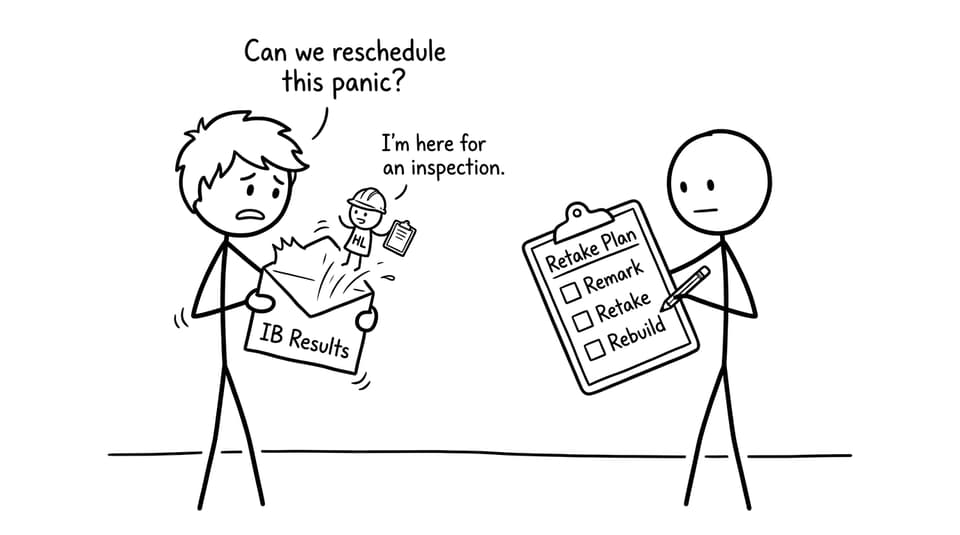
The fast checklist: what to do if you fail an IB HL
If you want the calm, practical version first, use this IB checklist:
-
Confirm your subject grade and your overall diploma status (don’t guess).
-
Ask your coordinator for component marks and how close you are to the next boundary.
-
Decide between a remark (Enquiry Upon Results) vs an IB retake.
-
If university offers are involved, email admissions with a short factual update.
-
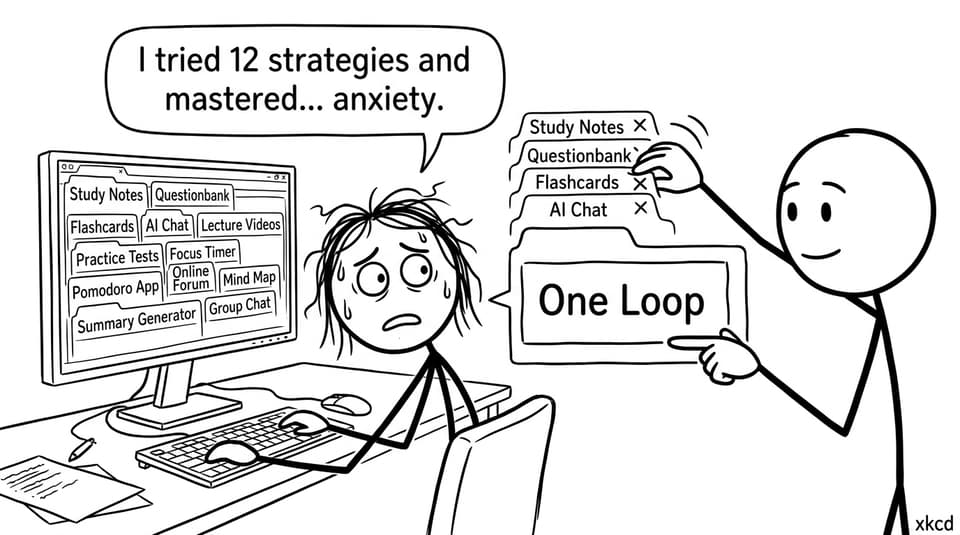
Build a recovery loop: Study Notes (clarity), then Questionbank (practice), then feedback, then timed Mock Exams.
RevisionDojo is designed to make that loop simple: RevisionDojo for IB.
What counts as “failing” an HL subject in IB?
In IB, each subject is graded from 1 to 7. Most students and schools treat 4 as the practical “pass.” But “failing an HL” can mean two different things:
-
You didn’t reach the grade you wanted (for your course, offer, or confidence).
-
You didn’t meet IB diploma conditions.
As a rough guide:
-
4-7: generally fine
-
3: weak/borderline, but not automatically fatal
-
2 or below: usually the danger zone for diploma eligibility
The nuance matters because IB diploma rules care about totals and minimums across your whole program, not just one HL result.
Can you still earn the IB Diploma if you fail one HL?
Sometimes, yes.
The IB Diploma Programme is scored out of 45 (six subjects plus up to three core points from TOK/EE). But the diploma is not just “get 24 points and you’re done.” There are pass conditions around HL/SL totals and minimum subject grades.
A simplified set of requirements many students check first:
-
24 total points or more
-
12 points across your three HL subjects
-
9 points across your three SL subjects
-
meet minimum grade rules (especially at HL)
-
complete TOK, EE, and CAS requirements
What this means in practice:
-
A 3 at HL might still allow a diploma depending on the rest of your profile.
-
A 2 at HL often triggers a diploma condition failure, even if your total points look decent.
If you want a broader map of what happens after disappointing results, see: Failing IB: What Actually Happens (and What to Do Next).
Realistic scenarios: why one IB HL grade can change everything (or not)
Two students can both “fail” an HL in the emotional sense, yet have totally different outcomes.
One student gets an HL 3, but their other HLs are strong, their SLs are steady, and their core points lift them above key thresholds. In IB, that can still be a diploma.
Another student gets an HL 2, even with a high total, and the diploma conditions can collapse immediately. That’s why the best next step is not spiraling. It’s getting the facts: your exact grade profile, your component marks, and your coordinator’s guidance on next actions.
If results day is part of what you’re worrying about, this helps you plan the next 48 hours: Parents’ Guide to IB Results Day (For Students Too).
Your recovery options in IB: remark, retake, or reset
Enquiry Upon Results (remark)
A remark is worth considering if you are close to a boundary and your component marks suggest a realistic jump. In IB, you request this through your coordinator, and there are deadlines and fees. The goal is not “maybe they were unfair.” It’s “I’m within range, and the marking could plausibly shift.”
IB retakes
Yes, IB retakes are a normal path. You typically retake the subject in a future exam session (often May or November), usually registering through an IB World School or retake centre. Many students retake one subject strategically, especially when the weakness is concentrated.
For a deeper retake overview, read: Can You Retake IB Exams? A Calm, Strategic Guide and Can I Retake the IB Exam? Complete Guide 2025.
Rebuild your system (not just your motivation)
If you’re retaking, the most important change is rarely “study more.” It’s “study differently.”
A clean IB rebuild looks like this:
-
Study Notes to rebuild understanding quickly: Study Notes and Digital IB Study Notes
-
Flashcards for daily recall (small, consistent reps): IB Subject Note Collections
-
Questionbank practice by topic, not random panic sets: Questionbank and IB Question Bank: How to Use It Effectively
-
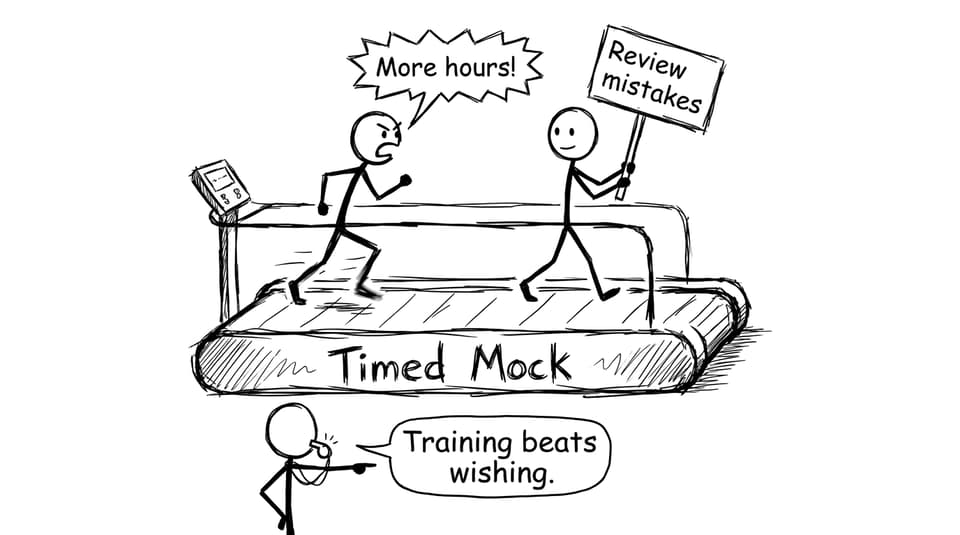
timed Mock Exams to train performance, not just knowledge: Online IB Mock Exams and Custom IB Mock Exams
-
AI Chat and Grading tools when you need fast feedback on why marks were lost (especially in written responses)
-
Coursework Library to stop IA/TOK/EE uncertainty from stealing your revision energy
-
Tutors when you need a human diagnosis and accountability
If you want the “one platform” view of how these fit together, see: RevisionDojo App: The Smarter Way to Prep for IB Exams.
How failing an IB HL affects university admissions
Universities often care more about HL subjects because HL choices signal academic direction. If you’re applying to competitive programs (medicine, engineering, economics, law), an HL dip can matter if it’s a required subject.
But universities also understand something students forget: performance is not always stable at 17.
If you’re retaking, your best move is to communicate clearly and early, then show evidence you’re rebuilding. Tools like the IB Grade Calculator can also help you understand what improvements would change your overall IB outcome.
Closing: an IB HL setback is data, not a verdict
In IB, one HL disappointment can feel like a label. But it’s closer to a diagnosis: information that tells you what needs to change.
If you’re facing an HL fail, don’t rebuild your plan out of panic. Rebuild it out of proof: topic-by-topic practice, feedback you trust, and timed rehearsal that makes exam day familiar.
When you’re ready to reset with structure, make RevisionDojo your home base for IB recovery: Questionbank, Study Notes, Flashcards, AI Chat, Grading tools, Predicted Papers, Mock Exams, Coursework Library, and Tutors working together in one system: International Baccalaureate (IB) Resources.