
RevisionDojo logoRevisionDojo logo
FeaturesSubjectsPricingSchools
Back to all posts
  1. Home
  2. /Blog
  3. /IB Chemistry: What Electrolytes Do in Chemistry

IB Chemistry: What Electrolytes Do in Chemistry

IB Chemistry
RevisionDojo Team
•Last updated: 19 Jul 2026•6 min read
ShareShare on XShare on WhatsAppShare on LinkedInShare on Facebook
Add as a preferred source on Google
IB Chemistry: What Electrolytes Do in Chemistry

Join 650k+ students breezing through the IBReady to breeze through the IB?

Footer

General

  • Download apps
  • For parents
  • For schools
  • Pricing
  • Gift RevisionDojo
  • Tutoring
  • IB syllabus
  • MYP syllabus
  • Blog
  • Student Questions

Features

  • Question Bank
  • Test Builder & Exam Mode
  • Predicted Papers
  • Past Papers
  • Study Notes
  • Interactive Lessons
  • Flashcards
  • Jojo AI Tutor
  • Coursework Studio
  • View all features

Research

  • All research
  • Jojo AI vs leading AI study tools
  • 2026 State of Learning Survey
  • 2025 State of Learning Survey
  • IB Moderation Analysis
  • Jojo AI vs ChatGPT
  • Jojo AI vs Gemini
  • Jojo AI vs Perplexity
  • Jojo AI vs Claude
  • Jojo AI vs Poe

Platform

  • About RevisionDojo
  • RevisionDojo vs Others
  • Content philosophy
  • Trustpilot
  • Join usWe're hiring
  • Student Ambassador
  • Help center
  • Contact us
  • Terms of Service
  • Data & privacy
  • Privacy policy
  • Cookie policy
  • Trust Center

IB Subjects

  • Arabic A
  • Arabic A Lit
  • Arabic ab initio
  • Arabic B
  • Biology
  • Business Management
  • Chemistry
  • Chinese A Lang & Lit
  • Chinese B
  • Computer Science (CS)
  • Computer Science (First Exam 2027)
  • Design Technology (DT)
  • Design Technology (First Exam 2027)
  • Digital Society (DS)
  • Economics
  • English A Lang & Lit
  • English A Lit
  • English B
  • Environmental systems and societies (ESS)
  • French A
  • French A Lit
  • French ab initio
  • French B
  • Geography
  • German A
  • German A Lit
  • German ab initio
  • German B
  • Global Politics
  • History
  • History (First Exam 2028)
  • Mathematics Analysis and Approaches (AA)
  • Mathematics Applications & Interpretation (AI)
  • Philosophy
  • Physics
  • Psychology
  • Psychology (First Exam 2027)
  • Spanish A
  • Spanish A Lit
  • Spanish ab initio
  • Spanish B
  • Sports, exercise and health science (SEHS)
  • Theory of Knowledge (TOK)
  • World Religions
  • Arabic A
  • Arabic A Lit
  • Arabic ab initio
  • Arabic B
  • Biology
  • Business Management
  • Chemistry
  • Chinese A Lang & Lit
  • Chinese B
  • Computer Science (CS)
  • Computer Science (First Exam 2027)
  • Design Technology (DT)
  • Design Technology (First Exam 2027)
  • Digital Society (DS)
  • Economics
  • English A Lang & Lit
  • English A Lit
  • English B
  • Environmental systems and societies (ESS)
  • French A
  • French A Lit
  • French ab initio
  • French B
  • Geography
  • German A
  • German A Lit
  • German ab initio
  • German B
  • Global Politics
  • History
  • History (First Exam 2028)
  • Mathematics Analysis and Approaches (AA)
  • Mathematics Applications & Interpretation (AI)
  • Philosophy
  • Physics
  • Psychology
  • Psychology (First Exam 2027)
  • Spanish A
  • Spanish A Lit
  • Spanish ab initio
  • Spanish B
  • Sports, exercise and health science (SEHS)
  • Theory of Knowledge (TOK)
  • World Religions

MYP Subjects

  • MYP Biology
  • MYP Chemistry
  • MYP Design
  • MYP English Lang & Lit
  • MYP Extended Mathematics
  • MYP History
  • MYP Individuals & Societies
  • MYP Integrated Sciences
  • MYP Physics
  • MYP Standard Mathematics
  • MYP Biology
  • MYP Chemistry
  • MYP Design
  • MYP English Lang & Lit
  • MYP Extended Mathematics
  • MYP History
  • MYP Individuals & Societies
  • MYP Integrated Sciences
  • MYP Physics
  • MYP Standard Mathematics
RevisionDojo logo

© 2022 - 2026 RevisionDojo (MyDojo Inc)

RevisionDojo was developed independently of the IBO and as such is not endorsed by it in any way.

Download on the App StoreGet it on Google Play
GDPR compliant

Electrolytes are one of those IB Chemistry ideas that feel obvious right up until the moment a question asks why a bulb lights up in one beaker but not the other. The frustrating part is that both liquids can look identical: clear, colourless, harmless. Yet in exam terms, one is a busy highway of charged particles, and the other is a silent room where nothing can carry charge.

That difference: the presence of mobile ions, is what electrolytes do in chemistry. And once you see that clearly, electrolysis, conductivity, acid strength, and electrochemical cells start to connect like pieces of the same puzzle.
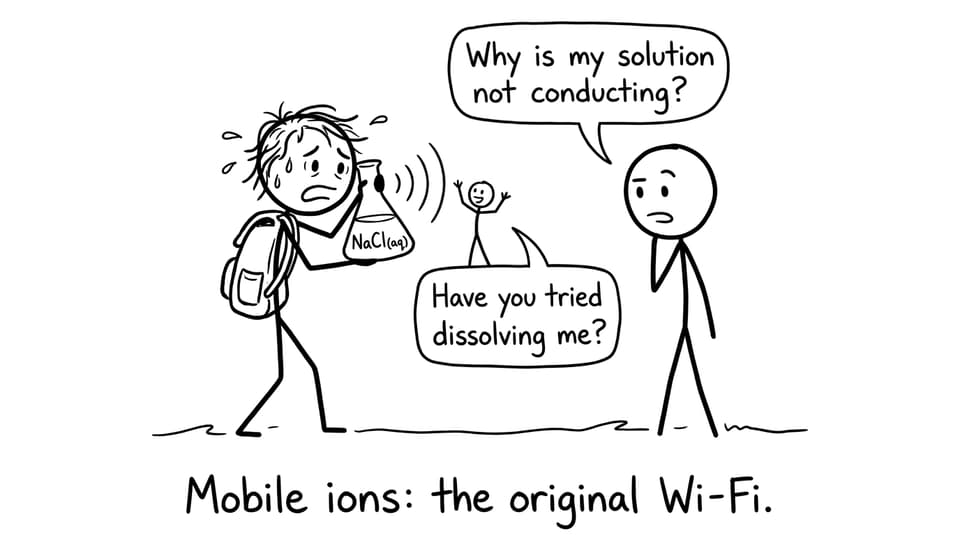
Mobile ions: the original Wi-Fi.

What is an electrolyte in IB Chemistry?

In IB Chemistry, an electrolyte is a substance that produces ions when it is molten or dissolved in water, so the liquid can conduct electricity.

Two words carry most of the marks: produces ions and mobile. A solid ionic compound contains ions, but they are locked into a lattice and cannot move, so it does not conduct. When the lattice breaks (melting) or the ions separate and become hydrated (dissolving), those ions can move and carry charge.

If you want a quick companion explanation, RevisionDojo breaks this down neatly in Electrolyte Solutions Explained.

Quick checklist: spotting electrolytes fast

Use this when you are moving quickly through IB Chemistry multiple-choice or data-based questions:

  • Soluble ionic compound in water becomes electrolyte (e.g., NaCl(aq))

  • Strong acid or strong base becomes strong electrolyte

  • Weak acid or weak base becomes weak electrolyte (equilibrium present)

  • Covalent molecules that stay as molecules (sugar, ethanol) becomes non-electrolyte

For more practice on the ionic model behind this logic, try S2.1 The Ionic Model Questionbank.

How electrolytes conduct electricity

Electric current in a solution is not carried by electrons moving through the water. In IB Chemistry, the current is carried by ions drifting under an electric field.

  • Cations (+) move toward the cathode

  • Anions (-) move toward the anode

The more ions you have (and the more easily they move), the higher the conductivity. That is why concentration matters, and why strong electrolytes usually conduct better than weak ones.
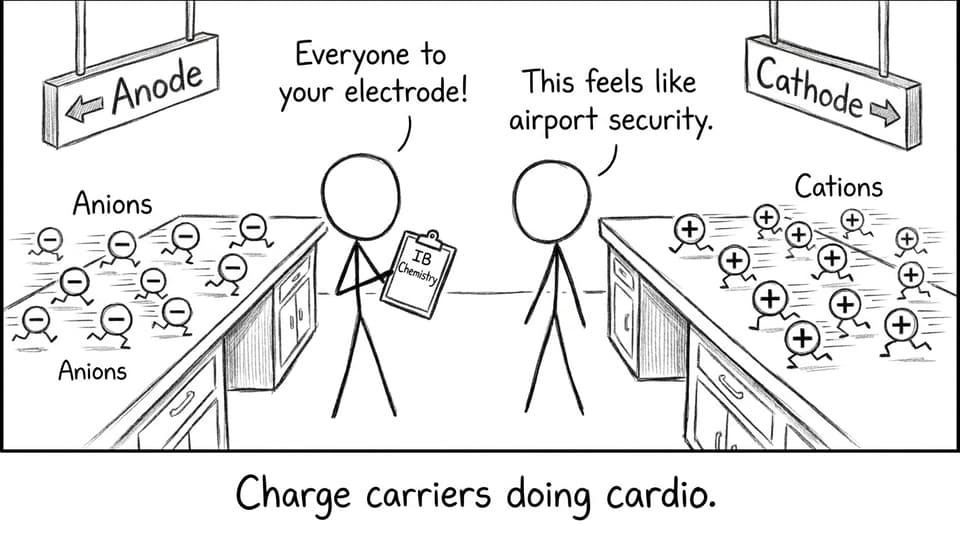
Charge carriers doing cardio.

Strong vs weak electrolytes (and the exam trap)

Electrolytes are often classified by degree of dissociation/ionisation.

Strong electrolytes in IB Chemistry

Strong electrolytes fully dissociate (or essentially fully ionise) in water, producing lots of ions.

Examples:

  • Strong acids (HCl, HNO₃, H₂SO₄)

  • Strong bases (NaOH, KOH)

  • Many soluble salts (NaCl, KBr)

Weak electrolytes in IB Chemistry

Weak electrolytes partially ionise, establishing an equilibrium. That means fewer ions in solution, so weaker conductivity.

Examples:

  • Weak acids (CH₃COOH)

  • Weak bases (NH₃)

This is where students slip: weak does not mean none. In IB Chemistry, weak acids still produce ions, just not many.
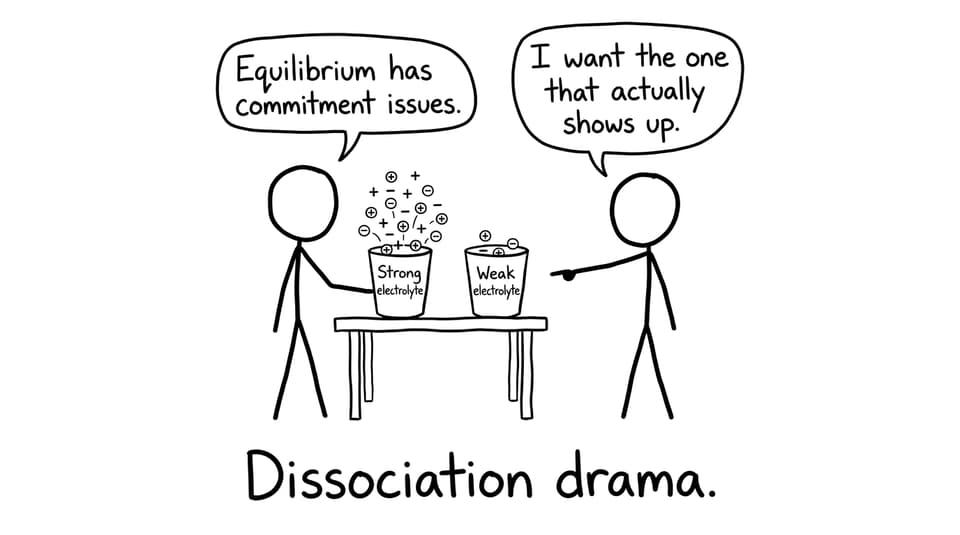
Dissociation drama.
Dissociation drama.

What electrolytes do across IB Chemistry topics

Electrolytes are not a single chapter idea. They are a supporting character that shows up everywhere.

Electrolytes make electrolysis possible

Electrolysis needs a path for charge inside the liquid. The electrolyte provides ions that migrate to electrodes, where redox happens. If you are revising electrolysis products and electrode rules, pair this with Electrolysis Explained for IB Chemistry (Fast + Clear) and the syllabus-aligned notes in IB Chemistry R3.2.8 Electrolytic Cells Notes.

Electrolytes keep electrochemical cells running

In galvanic cells, electrons move through the wire, but ions must move in solution to prevent charge build-up. That is why the electrolyte (and often a salt bridge) matters. A focused explanation is in Purpose of a Salt Bridge in Electrochemical Cells, and for the broader topic hub see 9.2 Electrochemical Cells.

Electrolytes sit underneath acids and bases

Acids and bases are electrolytes because they form ions in water (H₃O⁺/H⁺ and OH⁻). Strength is about degree of ionisation, not concentration, which connects directly to conductivity and equilibrium reasoning. Use IB Chemistry Acids and Bases to lock the foundations, and then reinforce the equilibrium side with pKa Explained for IB Chemistry.

Bring it home: electrolytes are the “movement” behind IB Chemistry

If you remember one sentence for IB Chemistry, make it this: electrolytes create mobile ions, and mobile ions make charge flow possible. From conductivity tests to electrolysis to redox in cells to acid strength, the storyline stays the same.

To turn that understanding into marks, RevisionDojo is built for repetition that feels focused: use Study Notes to anchor definitions, Flashcards for recall, the Questionbank for exam-style application, AI Chat when you are stuck on a mechanism, and Mock Exams plus Predicted Papers when you need timing practice. When you are ready to zoom out and organise the whole course, start at the IB Chemistry - RevisionDojo hub and build momentum from there.

How helpful was this article?
Add as a preferred source on Google

Continue studying with RevisionDojo

  • IB Coursework GraderCheck an IA, EE, or TOK draft against IB assessment criteria.
  • IB Coursework ExamplesLearn from high-scoring coursework across IB subjects.
  • IB Grade CalculatorEstimate an IB grade using session-specific boundaries.
  • IB Grade BoundariesExplore historical grade boundaries by subject and session.

Frequently Asked Questions

Related Articles

IB en España · Oct 17, 2026 · 10 min read

Cómo estudiar Química del IB en inglés

Aprende a estudiar Química del IB en inglés con vocabulario técnico, estrategias para interpretar preguntas y métodos de redacción para NM y NS.

IB en España · Oct 17, 2026 · 12 min read

Cómo estudiar Química IB: guía completa para NM y NS

Aprende cómo estudiar Química IB en NM y NS con un plan de dos años, técnicas para cálculos y mecanismos, y estrategias para las Pruebas 1 y 2.

IB en España · Oct 16, 2026 · 10

TdC química IB: conexiones y estrategias

Aprende a conectar Química del IB y TdC mediante preguntas de conocimiento, objetos de exposición y ejemplos eficaces para el ensayo.

IB Chemistry · Oct 15, 2026 · 11

IB Chemistry IA Criteria: How It Is Actually Marked

Understand the IB Chemistry IA criteria, four 6-mark bands, best-fit marking, moderation, and practical ways to improve each section clearly.

IB en España · Oct 15, 2026 · 12

Monografía de Química del IB: ventajas, riesgos e ideas

Descubre si te conviene hacer la monografía de Química del IB, cómo formular la pregunta de investigación y qué temas y riesgos debes valorar.

IB Chemistry · Oct 14, 2026 · 9

How to Build an IB Chemistry Study Group for Fall

Build a productive IB Chemistry study group for September-November with clear roles, weekly agendas, exam practice, accountability, and IA safeguards.

min read
min read
min read
min read