
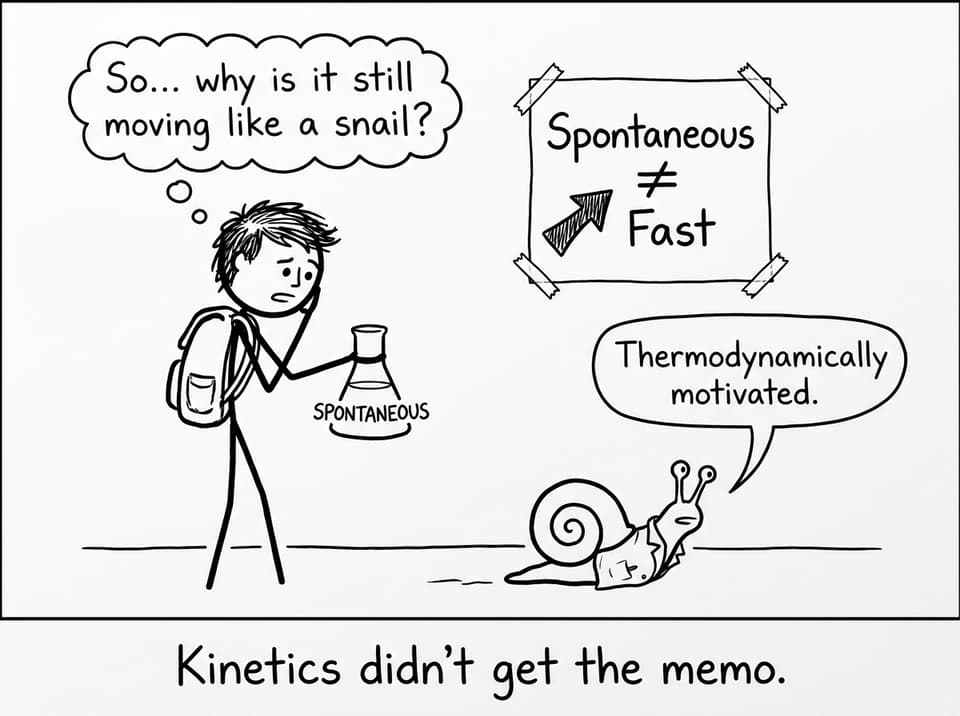
Reaction spontaneity is one of those IB Chemistry ideas that feels obvious until an exam question quietly flips the script. You see the word spontaneous and your brain hears instant. Then you meet rust: undeniably spontaneous, painfully slow. That moment matters, because in IB Chemistry, spontaneity is never about speed. It’s about whether a process is thermodynamically allowed under a set of conditions.
Quick exam checklist for IB Chemistry spontaneity
When you’re under time pressure, use this IB Chemistry checklist before you calculate anything:
-
Spontaneous means “can proceed without continuous external energy input,” not “fast.”
-
Decide whether the question is thermodynamics (ΔG, ΔH, ΔS) or kinetics (activation energy, catalysts).
-
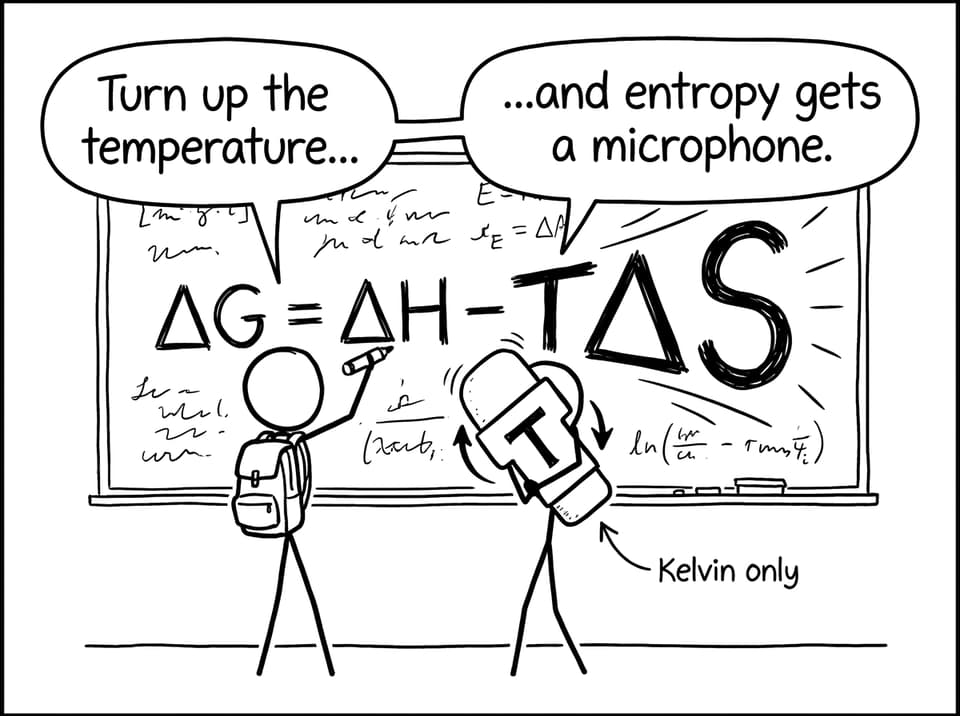
Write the core relationship: ΔG = ΔH - TΔS.
-
Temperature must be Kelvin.
-
Entropy is often given in J K⁻¹ mol⁻¹; convert to kJ K⁻¹ mol⁻¹ if ΔH is in kJ.
If you want a clean, syllabus-aligned home base for this topic, start with IB Chemistry R1.4 Entropy and Spontaneity.
What “spontaneous” actually means in IB Chemistry
In IB Chemistry, a reaction is spontaneous if the forward direction is thermodynamically feasible for the conditions stated. That’s it. No promises about whether it takes milliseconds or years.
This is why pairing spontaneity with kinetics is so helpful: a reaction can be spontaneous but slow if it has a large activation energy. If you need a reminder of that separation, What Is the Role of a Catalyst? IB Chemistry Explained is a good reset.
The three things that determine spontaneity in IB Chemistry
Every spontaneity question in IB Chemistry is really asking you to balance three influences.
Enthalpy change (ΔH)
ΔH tracks heat transfer at constant pressure.
-
Negative ΔH (exothermic) often supports spontaneity.
-
Positive ΔH (endothermic) can still be spontaneous, but it needs help from entropy and temperature.
For background on energy changes, RevisionDojo’s Energetics and Thermochemistry notes can sharpen your instincts.
Entropy change (ΔS)
Entropy is best remembered as the number of possible arrangements (microstates) available to particles. More ways to arrange energy and matter usually means higher entropy.
In IB Chemistry, ΔS tends to be:
-
positive when gases form, when the number of particles increases, or when mixing/dissolving spreads particles out
-
negative when gases are consumed, or when a system becomes more ordered
If entropy feels fuzzy, IB Chemistry: Entropy Explained Simply is a fast clarity boost.
Temperature (T)
Temperature decides how loudly entropy “speaks” in the final verdict, because it multiplies the entropy term.
Gibbs free energy: the decision rule in IB Chemistry
This is the line that turns three ideas into one answer:
ΔG = ΔH - TΔS
Interpretation (pure IB Chemistry marks):
-
ΔG < 0: spontaneous
-
ΔG > 0: non-spontaneous (forward direction)
-
ΔG = 0: equilibrium
A deeper walkthrough with examples is in Gibbs Free Energy Explained Simply, and the HL-aligned notes live at R1.4.3 Spontaneity and Gibbs free energy (HL) Notes.
The four sign combinations you should memorize
In IB Chemistry, the fastest spontaneity questions are the ones you answer without calculating ΔG.
ΔH negative, ΔS positive
Always spontaneous (ΔG stays negative).
ΔH positive, ΔS negative
Never spontaneous (ΔG stays positive).
ΔH negative, ΔS negative
Spontaneous only at low temperature (the -TΔS term becomes less harmful).
ΔH positive, ΔS positive
Spontaneous only at high temperature (the -TΔS term can outweigh +ΔH).
Mini-examples you can reuse in IB Chemistry answers
-
Melting ice above 0°C: ΔH positive, ΔS positive; it becomes spontaneous at sufficiently high T.
-
Rusting: thermodynamically favorable but slow, a kinetics reminder.
-
Electrolysis: non-spontaneous forward direction unless driven by electrical energy.
When the question shifts toward equilibrium language, connect ΔG to equilibrium thinking using Dynamic Equilibrium Explained for IB Chemistry and HL extension at R2.3.7 Gibbs free energy and equilibrium (HL) Notes.
Conclusion: the IB Chemistry way to predict spontaneity
If you remember only one idea for IB Chemistry, make it this: spontaneity is determined by ΔG, and ΔG is a tug-of-war between ΔH, ΔS, and temperature. Once you can spot sign patterns and keep Kelvin and units consistent, spontaneity questions become predictable.
To lock this in, use RevisionDojo’s IB Chemistry R1.4 Entropy and Spontaneity hub, drill exam-style prompts in the IB Chemistry R1.4 Entropy and Spontaneity Questionbank, then tighten recall with Flashcards and Study Notes. When you’re ready to check explanations step-by-step, the AI Chat and Grading tools help you see exactly where marks are won or lost, and Mock Exams plus Predicted Papers give you the timing practice your understanding deserves.