

If you have ever watched a perfectly clear organic reaction turn messy, it is usually not the chemistry that failed first--it is the water. In IB Chemistry, dehydrating agents are the quiet bouncers of the lab: they keep water out, pull water away, and sometimes even force a reaction to choose one pathway over another. Once you see them as reaction controllers (not just “random reagents”), exam questions on equilibrium, mechanisms, and lab technique start to feel more predictable.
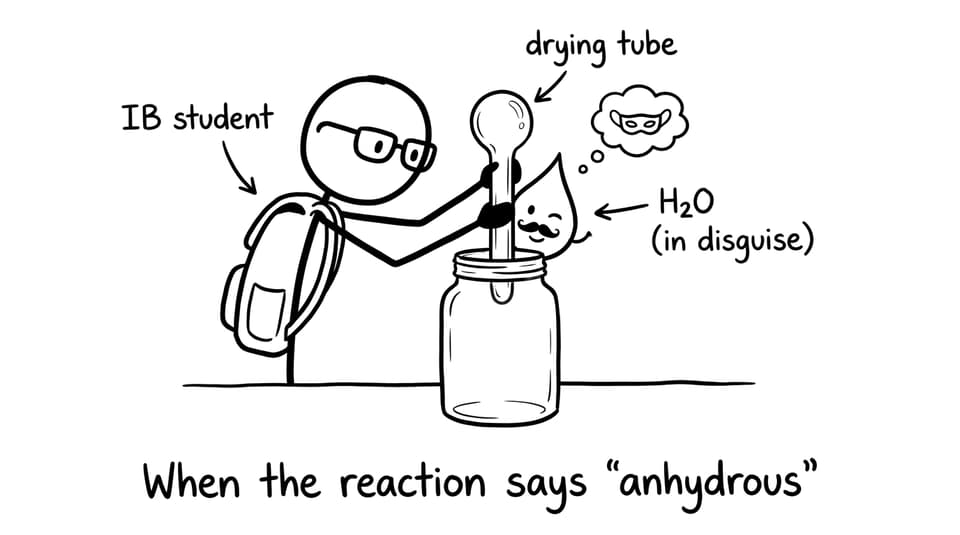
What is a dehydrating agent in IB Chemistry?
A dehydrating agent is a substance that removes water (H₂O) from another substance or from a reaction mixture. In IB Chemistry, that can mean four slightly different things, and examiners love when you can name which one is happening.
Quick checklist: how dehydrating agents remove water
-
Chemical reaction with water (water gets consumed to form new products)
-
Physical absorption (water is trapped without changing it chemically)
-
Equilibrium shifting (water is removed as a product, pushing the reaction forward)
-
Elimination support (components of water are removed from a molecule during a mechanism)
When you revise this, connect it to the syllabus topics you already know: equilibrium, acids and bases, and organic reaction types. RevisionDojo’s IB Chemistry Revision Notes are helpful for building those links quickly.
Common dehydrating agents you should know
These show up again and again in IB Chemistry explanations and lab-based questions:
-
Concentrated sulfuric acid, H₂SO₄
-
Phosphorus(V) oxide, P₄O₁₀
-
Aluminium oxide, Al₂O₃ (often heated)
-
Calcium oxide, CaO (quicklime)
-
Concentrated phosphoric acid, H₃PO₄
A good exam habit: whenever you see one of these, ask “Is it drying the mixture, shifting equilibrium, or enabling elimination?” That one sentence often becomes your justification mark.
What dehydrating agents do (the roles that get tested)
Drive equilibrium toward products
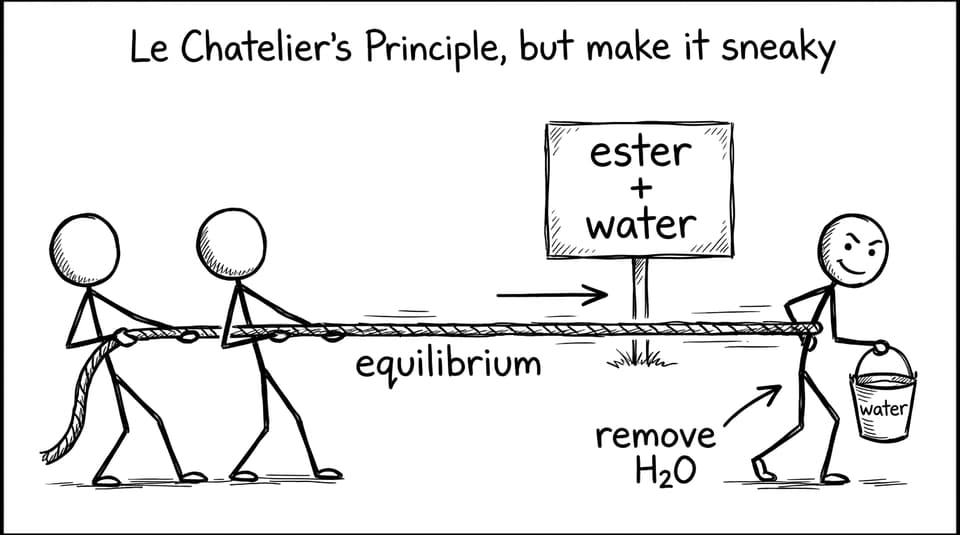
Many reactions produce water. By Le Chatelier’s principle, removing a product (water) shifts equilibrium to the right, increasing yield.
Classic example in IB Chemistry: esterification
Carboxylic acid + alcohol ⇌ ester + water
Remove water, and the system responds by forming more ester. If equilibrium is your weak spot, anchor it with targeted practice from the Equilibrium topic and then apply the idea to organic questions.
Promote elimination (dehydration) reactions
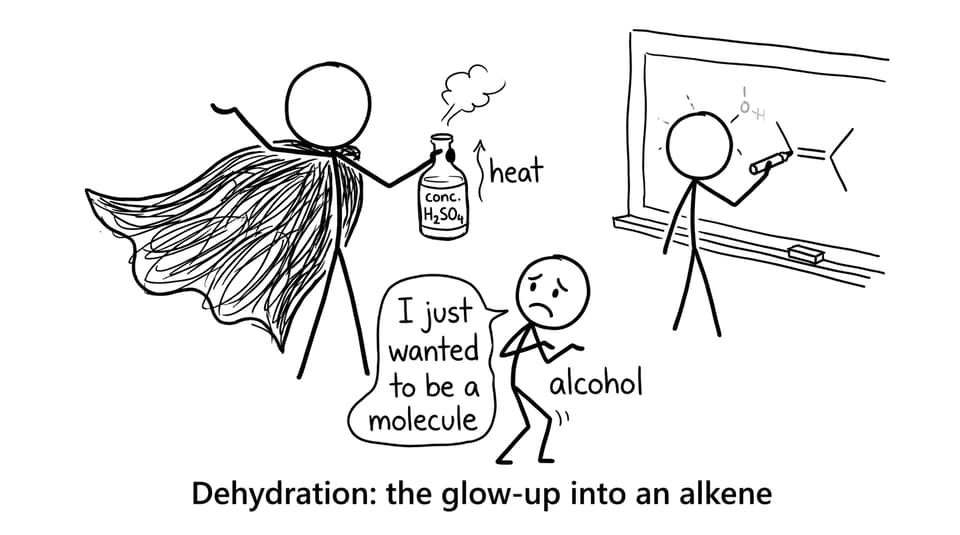
In organic mechanisms, “dehydration” often means an elimination that removes the elements of water from a molecule.
A headline reaction in IB Chemistry is:
Alcohol → alkene + water
Common conditions:
-
Concentrated H₂SO₄ (acidic dehydration)
-
Heated Al₂O₃ (surface-catalyzed dehydration)
-
Concentrated H₃PO₄ (often used as a milder acid option)
Mechanistically, your explanation should sound like this:
-
The alcohol is activated (often by protonation in acid)
-
Water becomes a better leaving group and leaves
-
A double bond forms (elimination)
This links neatly to reaction-type thinking in 20.1 Types of organic reactions and the deeper practice sets in the Organic Chemistry Questionbank.
Remove water of crystallization from hydrates
Hydrated salts contain water molecules in their crystal lattice. A dehydrating agent (or heating) can remove that water, producing anhydrous salt.
Example you should be able to describe:
CuSO₄·5H₂O (blue) → CuSO₄ (white) + 5H₂O
This is not just a colour-change fact. In IB Chemistry, it is also a gateway to discussing experimental design and mass change, which matters for your IA planning. RevisionDojo’s IB Chemistry Internal Assessment Guide is a good place to connect the concept to investigation quality.
Dry gases and solvents (keeping conditions anhydrous)
Sometimes the goal is not to change the reactant at all--it is to remove moisture so a sensitive reaction can proceed.
Common drying substances include calcium chloride, silica gel, and P₄O₁₀ (very strong). The practical story is simple: water can hydrolyze reagents, poison catalysts, or compete in equilibria.
Why dehydrating agents work (what to say in 1-2 marks)
Dehydrating agents are effective because they have a strong affinity for water. In IB Chemistry, that usually means one of these exam-friendly justifications:
-
They react with water to form more stable products (often exothermically)
-
They form hydrates (locking water into a new structure)
-
They create acidic conditions that make dehydration mechanisms feasible
If acids confuse you, keep your definitions sharp with the Acids and Bases topic and the focused 8.4 Strong and weak acids and bases notes.
Exam moments that love dehydrating agents
-
Concentrated H₂SO₄ dehydrating sugar (charring): water removed, carbon remains
-
Ethanol dehydration to ethene (conditions, products, and explanation)
-
Esterification yield arguments using Le Chatelier’s principle
-
Drying a gas stream in a preparation setup (choosing an appropriate drying agent)
To turn recognition into marks, practise explaining your choice of reagent. RevisionDojo’s IB Chemistry Resources hub plus its Questionbank, Study Notes, and Flashcards make this fast: you learn the pattern, test it immediately, then lock it in with active recall.
Closing: make dehydrating agents predictable
Dehydrating agents are not random extras; in IB Chemistry they are deliberate levers. They remove water to shift equilibria, enable elimination mechanisms, dry sensitive conditions, and convert hydrates back to anhydrous salts. If you learn to name which role is happening, you start writing explanations that sound like an examiner wrote them.
When you are ready to turn this into exam marks, use RevisionDojo as your system: build confidence with Study Notes, drill patterns with the Questionbank, memorise key agents with Flashcards, and pressure-test everything using Mock Exams and Predicted Papers. The goal is simple: in your next IB Chemistry question, you should be the one removing uncertainty--like a dehydrating agent removes water.