
Vapor pressure feels like one of those quiet ideas in IB Chemistry that only becomes loud the night before an exam. You read the definition, nod along, and then a data-based question asks you to explain why ethanol behaves differently from water, or why boiling changes on a mountain. Suddenly, vapor pressure isn’t a definition anymore. It’s the hidden logic behind phase change, volatility, and the phrase examiners love: dynamic equilibrium.
This guide explains vapor pressure in clean IB Chemistry language, then shows you how to use it in graphs and explanations under time pressure.
Vapor pressure in IB Chemistry: a quick checklist
Use this fast checklist whenever vapor pressure appears in IB Chemistry questions:
-
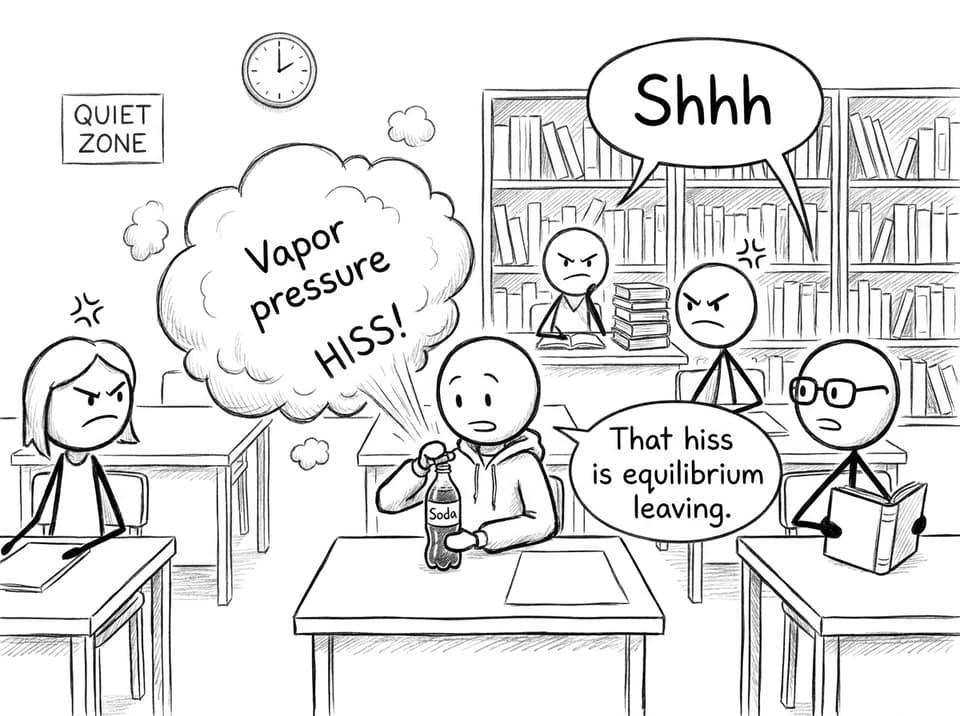
Vapor pressure is measured at equilibrium in a closed system.
-
Temperature up == vapor pressure up.
-
Stronger intermolecular forces (IMFs) == vapor pressure down.
-
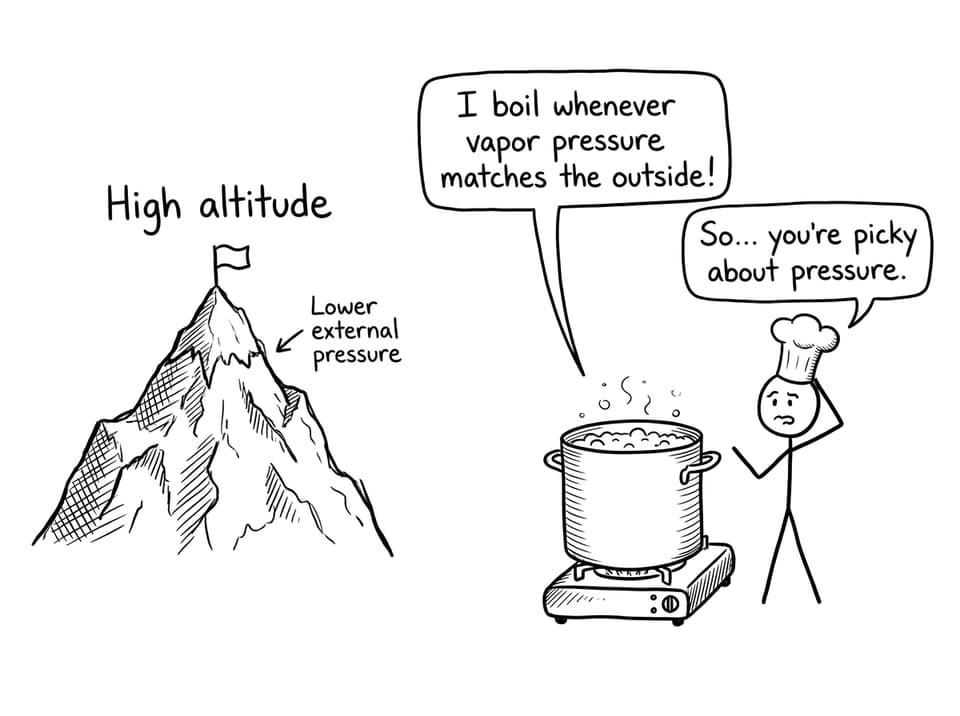
Boiling happens when vapor pressure == external pressure.
-
High vapor pressure == high volatility and usually a lower boiling point.
If you want structured practice on the surrounding syllabus ideas (IMFs, boiling, volatility), RevisionDojo’s IB Chemistry hub is the quickest place to connect the dots: IB Chemistry - RevisionDojo.
What is vapor pressure?
In IB Chemistry, vapor pressure is the pressure exerted by vapor particles when a liquid (or solid) is in dynamic equilibrium with its vapor at a given temperature.
The “story” is simple:
-
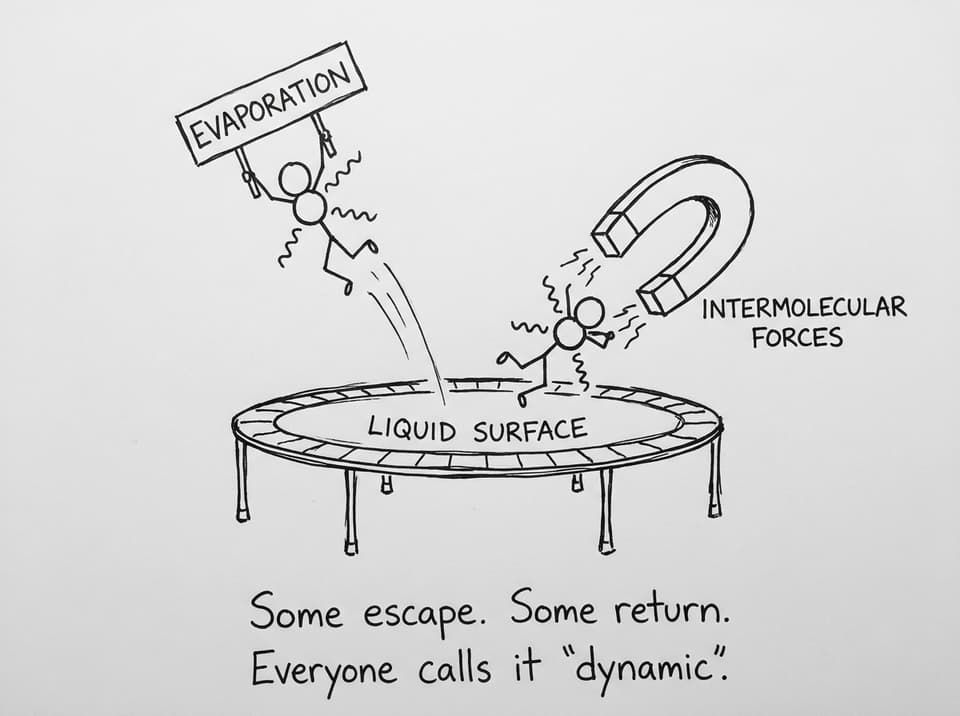
Some surface particles escape the liquid and enter the gas phase (evaporation).
-
Some vapor particles collide with the surface and re-enter the liquid (condensation).
-
In a closed container, these two rates eventually become equal.
At that point, the vapor above the liquid produces a steady pressure: the vapor pressure.
This links naturally to kinetic theory language. If you need a quick refresher on particle motion and state changes, RevisionDojo’s notes on the kinetic molecular theory help you keep definitions exam-tight: Kinetic Molecular Theory notes.
Why vapor pressure exists (even when it’s cold)
A common trap in IB Chemistry revision is thinking evaporation only happens when a liquid is “warm.” But at any temperature, particles in a liquid have a range of kinetic energies. A few have enough energy to overcome the attractive forces holding them in the liquid.
Those faster particles escape from the surface into the gas phase. In a closed container, they collide with the walls and create pressure. Over time, as more vapor forms, condensation becomes more frequent until equilibrium is established.
So the key idea is not “heat makes vapor” but energy distribution makes escape possible.
How temperature changes vapor pressure
Temperature is the easiest lever in IB Chemistry vapor pressure questions.
When temperature increases:
-
average kinetic energy increases,
-
more particles have enough energy to escape,
-
the equilibrium amount of vapor rises,
-
the vapor pressure increases (often shown as an exponential curve).
This is why solvents smell stronger in warm rooms and why a liquid can feel like it “disappears faster” on a hot day. The vapor pressure is higher, so more particles occupy the gas phase at equilibrium.
For a broader phase-change framing (evaporation vs boiling, and the energy story behind both), see: Vaporization Explained Simply.
Vapor pressure and boiling point (the exam sentence)
The sentence that earns marks in IB Chemistry is:
A liquid boils when its vapor pressure equals the external pressure.
At that moment, bubbles of vapor can form throughout the liquid, not just at the surface. That is the difference between boiling and evaporation in the most examinable way.
Practical implications you can explain quickly:
-
At sea level, external pressure is about 100 kPa, so water boils at 100°C.
-
At high altitude, external pressure is lower, so water boils at a lower temperature.
-
In a pressure cooker, external pressure is higher, so boiling point increases.
RevisionDojo has a focused explanation that helps you phrase this in IMF language (which examiners love): Why boiling requires breaking stronger intermolecular forces than evaporation.
Intermolecular forces: the reason vapor pressure differs between liquids
If temperature is the easy lever, intermolecular forces are the deep one. In IB Chemistry, you’re expected to connect structure to properties.
-
Stronger IMFs hold particles in the liquid more tightly.
-
Fewer particles can escape into the vapor at a given temperature.
-
Therefore vapor pressure is lower.
That’s why water (hydrogen bonding) has a relatively low vapor pressure and a higher boiling point compared to many molecules of similar size.
To strengthen your explanations, pair this article with:
And if you want targeted practice, RevisionDojo’s Questionbank for this exact area is ideal for turning concepts into marks: 4.4 Intermolecular forces Questionbank.
Volatility: vapor pressure in everyday language
Volatility is just vapor pressure with personality.
-
High vapor pressure == particles escape easily == high volatility.
-
Low vapor pressure == particles stay in the liquid == low volatility.
That’s why substances like acetone evaporate quickly and produce a strong smell: lots of particles enter the gas phase at room temperature.
In IB Chemistry, this is often assessed through comparisons: you’ll be given two liquids, asked which has higher vapor pressure, then expected to justify using IMF strength, molar mass, and sometimes shape (surface area contact affects London dispersion forces).
Bringing it home: how to turn vapor pressure into marks
Vapor pressure is the quiet engine behind big IB Chemistry topics: phase change, boiling point, volatility, and intermolecular forces. If you can say “dynamic equilibrium,” explain why temperature raises vapor pressure, and link stronger IMFs to lower vapor pressure, you’re already writing examiner-friendly chemistry.
To convert understanding into results, use RevisionDojo as a loop: read the relevant Study Notes, drill with the Questionbank, lock terms with Flashcards, and ask AI Chat to check your explanation wording. Then test yourself under pressure using Predicted Papers and Mock Exams, and use the Grading tools to see exactly where marks are gained or lost. Start here: IB Chemistry - RevisionDojo and add exam rehearsal here: Chemistry Predicted Papers.