


Mise-en-scene is the quiet part of theatre that shouts.
You can watch a scene and feel the meaning before you can explain it: a chair placed too far from the table, a costume that looks slightly wrong on purpose, a pool of light that makes one character feel trapped. In IB Theatre, that feeling is not a happy accident. It is evidence. When you use mise-en-scene effectively while staging play texts, you turn interpretation into something the audience can see, and you give the examiner something concrete to reward.
If you are juggling rehearsal stress and written reflection, keep this promise in mind: strong mise-en-scene choices reduce the amount of explaining you need to do later. The stage picture does the work.
Quick checklist for IB Theatre mise-en-scene (save this)
Use this before rehearsal and again before you write reflection in IB Theatre:
-
Identify the scene’s one-sentence intention (what should the audience realise or feel?)
-
Choose 2-3 mise-en-scene priorities (not everything at once)
-
Make one choice in each lane: space, light, objects, costume, movement
-
Test alternatives quickly (A/B/C versions) and record the impact
-
Link each choice to theme, practitioner influence, and audience response
If you want the wider staging workflow around this, pair it with How to Approach Staging Play Texts in IB Theatre Coursework.
What mise-en-scene means in IB Theatre (examiner-friendly)
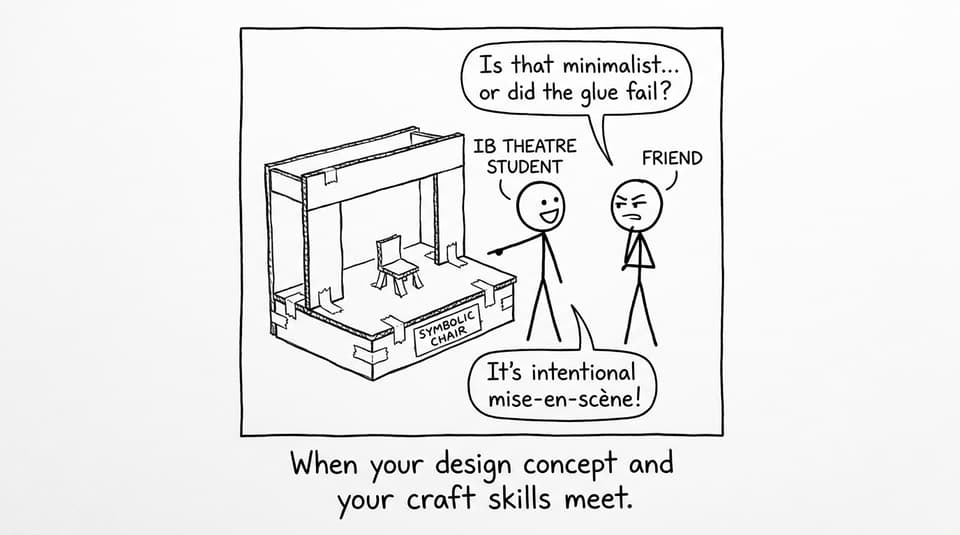
In IB Theatre, mise-en-scene means everything arranged on stage to create meaning: setting, props, costume, makeup, lighting, actor movement and blocking, and the overall composition of the stage picture. The keyword you want in your head is intention.
Examiners are not grading how expensive your set looks. They are grading how clearly your choices communicate ideas, relationships, and tension. That is why minimalist staging can score highly when it is coherent and justified.
To stay aligned with course expectations, it helps to keep the bigger map nearby: Dive into the World of IB Theatre: An In-Depth Syllabus Overview.
The five mise-en-scene elements that move marks
Setting and props: build a world, not a furniture catalogue
A stage environment is an argument about what matters. A bare stage can make absence feel heavy. A crowded one can make characters look swallowed by their own lives. Props work best when they earn their place by doing at least one of these jobs:
-
Function: enables action (keys, letters, food, weapons)
-
Symbol: repeats or transforms to carry theme (a glass that keeps being refilled)
-
Status: signals power or class (who owns the best chair?)
In IB Theatre, write your reflection in cause-and-effect language: When the prop moved from centre stage to the edge, the audience focus shifted from authority to isolation.
Costume and makeup: show identity, change, and contradiction
Costume is character logic you can see. Use it to reveal:
-
Belonging vs. outsider status (fits the world or resists it)
-
Transformation (a gradual shift is often stronger than a sudden swap)
-
Inner conflict (polished exterior, chaotic detail)
A simple technique that reads well in IB Theatre portfolios: choose one costume feature (colour, silhouette, texture) and track how it changes across scenes as the character’s power changes.
Lighting: the invisible director
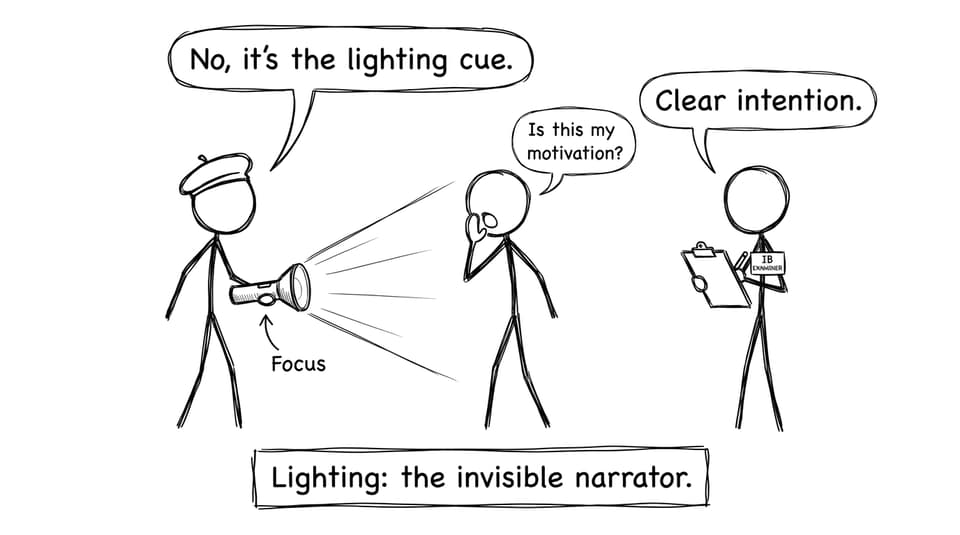
Lighting decides what the audience is allowed to notice. You can use it to create mood, isolate thought, or expose conflict. Keep it simple and deliberate:
-
High-key/open light: clarity, normality, safety
-
Low-key/shadows: secrecy, threat, moral ambiguity
-
Side/back light: tension, distortion, heightened theatricality
Even if you have limited equipment, you can still show lighting intention by planning focus areas and transitions. That planning becomes strong evidence in IB Theatre reflection.
Actor movement and blocking: relationships in space
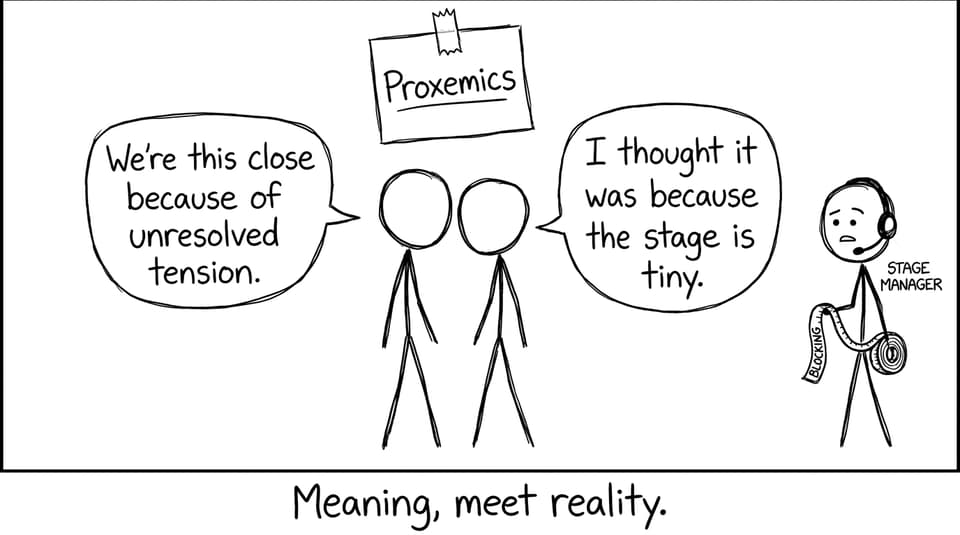
Blocking is where your interpretation becomes physical. In IB Theatre, proxemics and pathways can express power dynamics faster than dialogue.
Try these quick tests:
-
Distance test: play the same lines far apart, then uncomfortably close
-
Levels test: who sits, who stands, who climbs, who is grounded?
-
Ownership test: who controls centre stage, and who is pushed to the edge?
Then write what changed in the audience’s reading. If nothing changed, your blocking is decorative, not dramatic.
Composition: make a stage picture with a point of view
Composition is the pattern your audience reads at a glance. Symmetry can suggest order, ritual, or oppression. Imbalance can suggest instability or conflict. You can also use barriers (tables, doorframes, bodies) to show separation without adding dialogue.
A useful IB Theatre habit: freeze key moments, photograph them, then annotate what the image communicates.
Using mise-en-scene effectively when staging play texts
Start with theme, then choose constraints
The easiest way to over-design is to start with “cool ideas.” Start with meaning instead:
-
Name the theme in plain language
-
Choose one constraint (minimalist, monochrome, symbolic props, visible theatre tech)
-
Let that constraint unify your mise-en-scene
This is also where text analysis saves you time. If you need a method for extracting playable meaning from dialogue and stage directions, use Best Ways to Analyze a Play Text for Performance Intentions.
Use practitioners as lenses, not costumes
In IB Theatre, practitioners help you justify choices, but only if you adapt them.
-
Stanislavski: realistic detail supports believable behaviour; props become lived-in, not symbolic clutter.
-
Brecht: visible lighting, signs, and direct address keep the audience critically awake.
-
Artaud: sensory choices (sound, light, rhythm) push the audience into feeling before explanation.
If you are preparing a theorist-driven performance pathway, connect this to How to Approach the IB Theatre Solo Theatre Piece (HL Only).
Plan like a designer, reflect like an examiner
Pre-production is where strong mise-en-scene is born. Sketch ground plans, list prop rules, and write lighting intentions even if the final tech is basic. After each rehearsal, capture one paragraph that answers:
-
What did we change?
-
Why did we change it?
-
What did the audience (or peer feedback) seem to feel?
-
What will we test next?
For a sustainable routine around this, use Best Study Strategies for IB Theatre Students (SL & HL).
Common mise-en-scene mistakes (and quick fixes)
-
Mistake: Treating mise-en-scene as decoration.
Fix: For every element, write one sentence: This supports theme by... -
Mistake: Too many symbols competing.
Fix: Keep one dominant symbol and make everything else serve clarity. -
Mistake: Blocking without power logic.
Fix: Re-block using one question only: Who owns the space right now? -
Mistake: Copying a practitioner style without purpose.
Fix: Keep 2-3 practitioner principles and show them consistently.
If you want a fuller breakdown of pitfalls, read Common Mistakes When Staging Play Texts and How to Fix Them.
Bring it home: mise-en-scene as your unfair advantage in IB Theatre
When you are staging play texts, mise-en-scene is how you prove you are thinking like an artist and writing like a student who understands assessment. In IB Theatre, the most convincing work feels cohesive: setting, costume, lighting, props, movement, and composition all pointing in the same direction.
RevisionDojo helps you build that cohesion without adding stress: tighten your terminology with Study Notes and Flashcards, test understanding with the Questionbank, pressure-test ideas with Mock Exams and Predicted Papers, and refine reflection with AI Chat, Grading tools, and Tutors. Use mise-en-scene to make your interpretation visible, then let RevisionDojo help you make it examinable.