
A tiny dot that decides the whole story (IB Chemistry)
If you have ever looked at a phase diagram and felt oddly offended by how much meaning is packed into one small intersection, you are not alone. In IB Chemistry, the triple point is that intersection: one precise set of conditions that quietly explains why some substances refuse to be liquids at normal pressure, why “skipping” a state change is sometimes the only option, and why exam questions love asking you to interpret a single point.
The good news: once you can explain the triple point in one calm paragraph, the rest of phase-diagram questions start to feel predictable.
Triple point definition you can write in 10 seconds
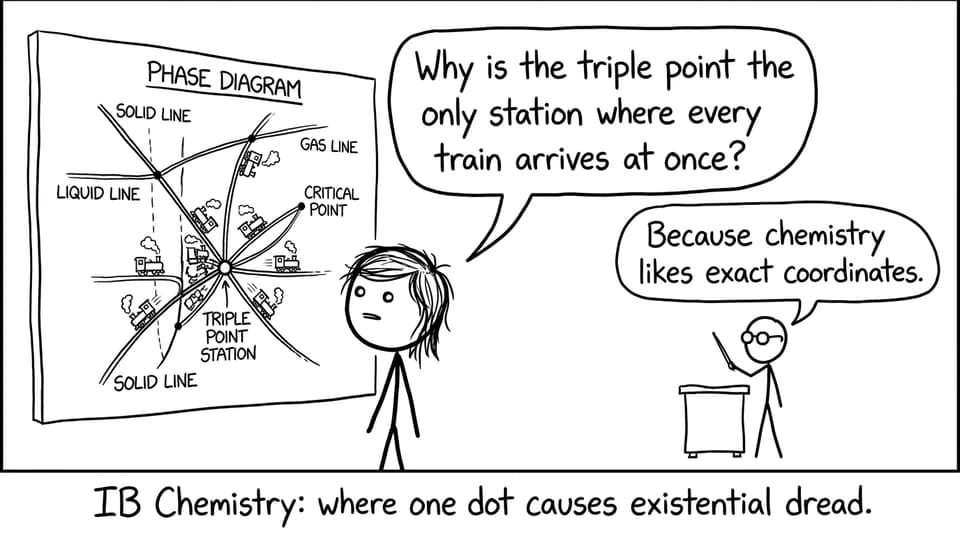
In IB Chemistry, the triple point is the unique temperature and pressure at which a substance’s solid, liquid, and gas phases all coexist in equilibrium.
Three details matter for marks:
-
It is a single point, not a region.
-
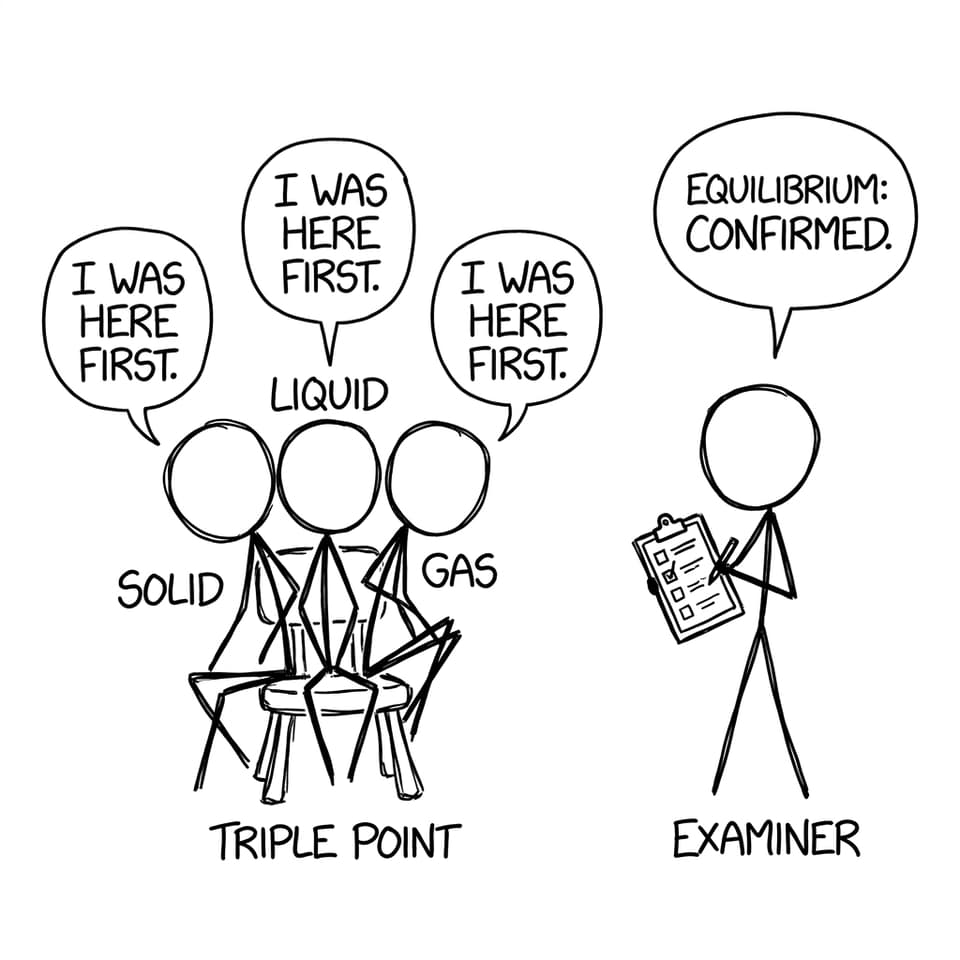
All three phases are present at the same time.
-
The system is in equilibrium (no net change overall).
If you want the bigger picture first, pair this with Phase Diagrams Explained Simply. It makes the triple point feel less like trivia and more like navigation.
Quick checklist: how to spot triple point questions
Use this checklist whenever IB Chemistry gives you a phase diagram or mentions “cannot exist as a liquid”:
-
Do you see three boundary lines meeting? That intersection is the triple point.
-
Are they asking about equilibrium between phases? Triple point language often appears.
-
Do they mention very low pressure (or “below a certain pressure”)? That’s usually a triple point clue.
-
Do they mention sublimation or deposition? Triple point pressure often explains why liquid is not stable.
For targeted practice, build a mini-set of phase-change questions using RevisionDojo’s Questionbank, then use Grading tools to tighten your wording.
Where the triple point sits on a phase diagram (and why it matters)
A typical phase diagram has three main regions (solid, liquid, gas) and three boundary curves where two phases coexist in equilibrium. In IB Chemistry, the triple point is where all three boundaries meet:
-
Solid-liquid boundary (melting/freezing)
-
Liquid-gas boundary (boiling/condensation)
-
Solid-gas boundary (sublimation/deposition)
At the triple point, you can move energy in or out and watch competing transitions occur while the overall temperature and pressure remain exactly at that coordinate (assuming a stable, closed setup). Move away from that coordinate and equilibrium breaks: only one phase region (or a two-phase boundary) remains stable.
This is why the triple point is examined so often in IB Chemistry: it rewards precision. Exams like concepts that are defined cleanly and tested visually.
The most tested consequence: “Can this substance be a liquid here?”
Here’s the exam-friendly insight in IB Chemistry:
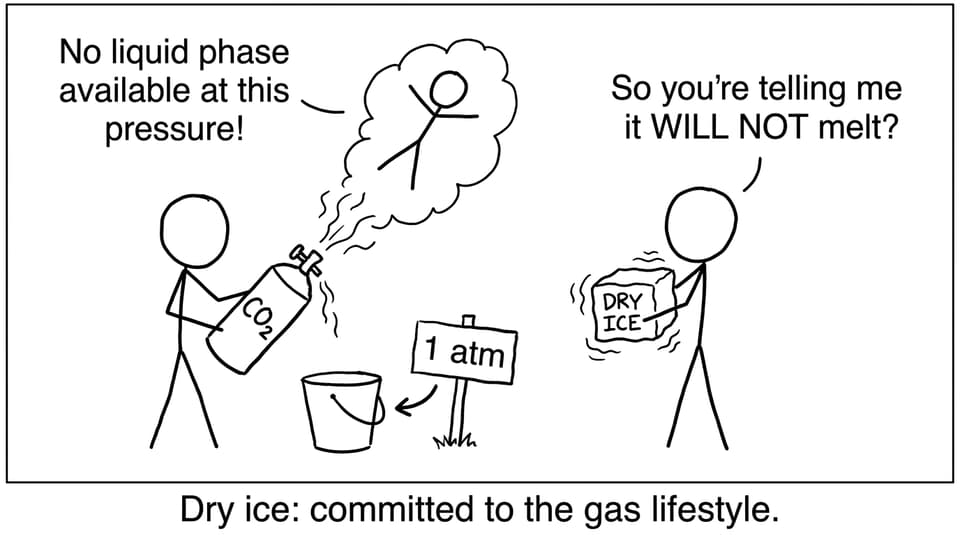
If the pressure is below a substance’s triple point pressure, the liquid phase cannot exist.
That one sentence explains a lot of “weird” behaviour:
-
Some substances sublime instead of melting.
-
Some conditions force direct solid-gas transitions.
To make those transitions feel natural, revise the companion ideas:
These are classic IB Chemistry link-ups: triple point pressure tells you whether liquid is even allowed to be part of the story.
Examples you should know (water and CO₂ do the heavy lifting)
Examples matter because they turn the definition into prediction. In IB Chemistry, two substances appear again and again:
Water
Water’s triple point occurs at 0.01°C and 0.006 atm. Below that pressure, liquid water is not stable, so ice tends to sublime rather than melt. This is a neat way to connect phase diagrams to low-pressure environments.
Carbon dioxide (CO₂)
CO₂’s triple point occurs at -56.6°C and 5.11 atm. At 1 atm, CO₂ cannot be a liquid, which is why dry ice goes straight from solid to gas.
If you want to connect triple point to the other famous “special point,” read IB Chemistry: Critical Point Explained Simply. Triple point and critical point are often paired in explanations, but they mean very different things.
Why triple point matters beyond the diagram
In IB Chemistry, you can earn strong explanation marks by connecting the triple point to real processes:
-
Calibration and measurement: the triple point of water is used as a highly reproducible reference for temperature standards.
-
Space and planetary conditions: very low pressures can remove the “liquid option,” making sublimation common.
-
Freeze-drying: operates at pressures where ice can sublime efficiently (conceptually tied to being below the triple point pressure).
RevisionDojo helps here because you can move from concept to application quickly: use Study Notes for the clean definitions, Flashcards for the one-line exam phrasing, then Mock Exams and Predicted Papers to practise interpreting unfamiliar diagrams under time pressure.
For syllabus-aligned support, these are good hubs to keep open while revising IB Chemistry:
Closing: learn the dot, earn the marks
The triple point in IB Chemistry is the one coordinate where solid, liquid, and gas coexist in equilibrium. It explains whether a liquid phase is even possible, makes sublimation questions feel logical, and turns a messy phase diagram into a map with rules.
If you want this to stick before exams, do it in three steps on RevisionDojo: review the idea in Study Notes, drill the definition with Flashcards, then apply it through the Questionbank and Mock Exams using AI Chat to refine your explanations. Master the triple point once, and you get a surprising number of IB Chemistry marks back for free.