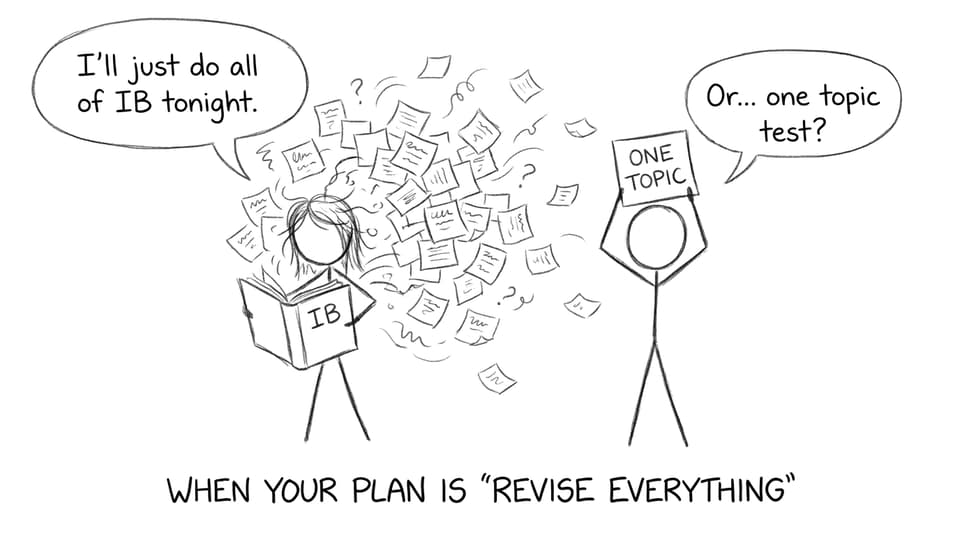
The night before your next IB mock, you make a promise that sounds heroic in your head: I’ll revise everything.
Then reality arrives. The syllabus is bigger than your available time, your confidence depends on the last question you saw, and you start confusing “busy” with “prepared.” In the IB, that’s a costly illusion. Because exams don’t reward the student who touched every page. They reward the student who can reliably produce marks on demand.
That’s why topic-specific IB tests work so well: they let you master one subject (and one slice of that subject) at a time, with the right level of difficulty for where you are today.
When your plan is 'revise everything'
Topic-specific IB tests (quick checklist)
Use this checklist whenever you create a topic-specific IB test so it actually changes your score:
Pick one subject, then one topic you consistently drop marks on.
Choose the paper skill you’re training (MCQ accuracy, data response, essay structure, calculations).
Set a short timer (20--40 minutes) so focus stays high.
Mark immediately using a mark scheme or rubric logic.
Write one “error rule” per mistake (what you’ll do differently next time).
Random revision feels comforting because it’s open-ended. Topic-specific IB tests feel uncomfortable because they measure you. But measurement is where improvement hides.
A targeted IB test does three things broad revision rarely does:
It turns “understanding” into performance
You can understand a concept and still lose marks because you misread command terms, skip steps, or write vaguely. Topic-specific IB tests convert fuzzy understanding into exam behavior.
For daily practice, link your learning straight into questions: read the relevant Study Notes, then prove it with questions, not highlighting.
It keeps motivation intact
When you narrow the scope, you get faster wins. Wins create momentum. Momentum makes you consistent. Consistency is a superpower in the IB.
A short, topic-specific test also pairs naturally with spaced repetition. Lock the facts and definitions in with IB Flashcards, then come back to apply them under time pressure.
It makes your weaknesses honest
A full mock can hide what went wrong. You just feel “bad at the subject.” A topic-specific IB test is more precise: I’m losing marks on evaluation paragraphs or I’m dropping method marks in multi-step questions.
That precision tells you what to do next.
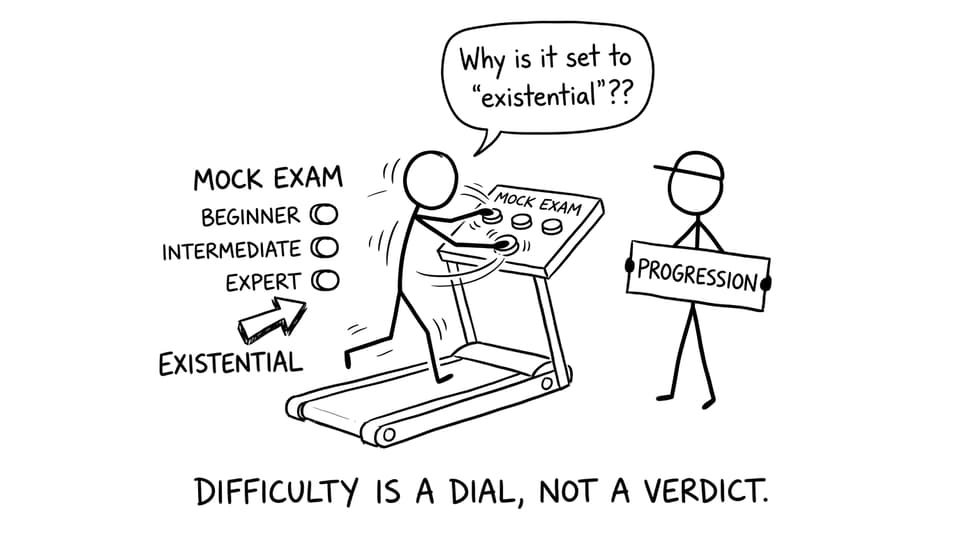
The secret weapon: difficulty tiers (use them on purpose)
Not all topic-specific IB tests should feel the same. If every session is brutal, you burn out. If every session is easy, you plateau.
A practical approach is to rotate difficulty tiers. They’re not official IB labels, but they match how learning builds: knowledge first, then application, then judgment.
Beginner topic tests: build accuracy
Use these when you’re still consolidating content.
Focus: definitions, key steps, core methods
Goal: fewer silly errors, stronger recall
Best moment: early revision, or when a topic is shaky
Beginner tests pair well with quick refreshers from Study Notes and short daily reviews on Flashcards.
Intermediate topic tests: build control
Use these when you can do the basics, but consistency is missing.
Best moment: final phase, after you’ve earned the right to go hard
Difficulty is a dial, not a verdict.
How to build topic-specific IB tests on RevisionDojo
Here’s a simple way to create topic-specific IB tests without wasting time deciding what to do.
Use the Questionbank for precision
RevisionDojo’s Questionbank lets you practice by topic so you can stop revising in the dark. If you need a deeper strategy, IB Question Bank: How to Use It Effectively explains how to organize practice so it translates into marks.
Use Mock Exams for timed rehearsal
Once you’ve done a few topic tests, graduate into timed sessions that feel like the real thing. The guide on custom IB mock exams by topic is built around this exact idea.
Use Predicted Papers for full-paper realism
When you’re ready to test stamina, RevisionDojo’s IB Predicted Papers help you rehearse pacing and coverage in an exam-like format. If you’re unsure when to use them, IB Predicted vs Specimen Papers: What They Mean clarifies the role each one plays in a balanced plan.
Use AI Chat and Grading tools to shorten feedback loops
Most students don’t improve because they don’t see the pattern in their mistakes. RevisionDojo’s AI Chat and Grading tools help you diagnose why marks were lost, then correct the specific habit.
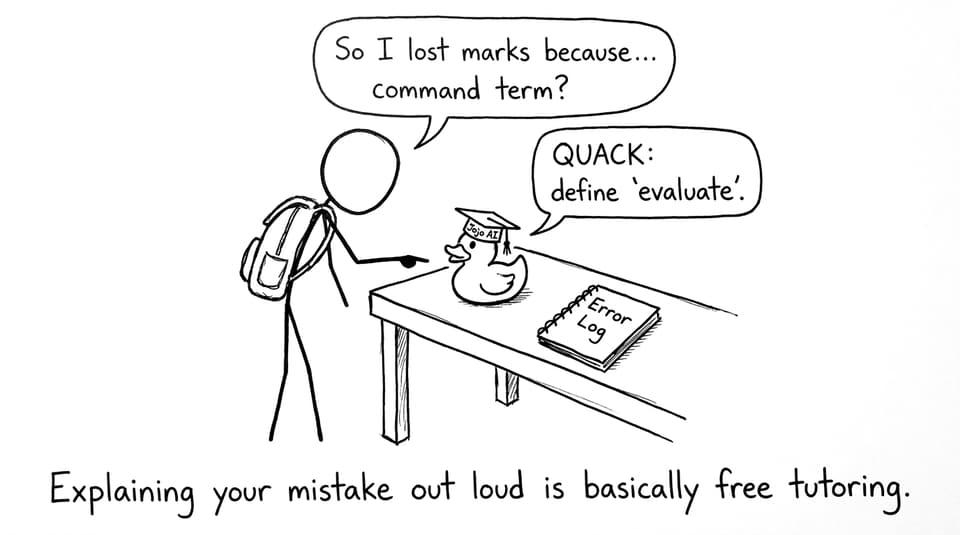
A useful ritual is keeping an error log. After each topic-specific IB test, write:
What I did wrong (in one sentence)
Why I did it
The rule I’ll follow next time
Explaining your mistake out loud is basically free tutoring.
Closing: master IB one subject at a time
The most reliable IB students aren’t the ones who panic harder. They’re the ones who practice narrower. Topic-specific IB tests give you a way to build confidence that isn’t based on vibes, but on repeated proof.
Start small: one subject, one topic, one timed session. Use RevisionDojo to connect the whole loop in one place: Study Notes for clarity, Flashcards for recall, Questionbank for targeted practice, AI Chat and Grading tools for fast feedback, then Mock Exams and IB Predicted Papers for realism when you’re ready.
If you want your next IB score to feel earned, build your revision the way marks are awarded: one focused skill at a time.
Grace holds an MA in English Literature from the University of Edinburgh and has taught IB English A for over 20 years, most recently as Head of English at an IB World School in Geneva. Her focus is the Paper 1 guided literary analysis and the Paper 2 comparative essay, teaching students to structure an argument around a text's effects rather than its plot.