


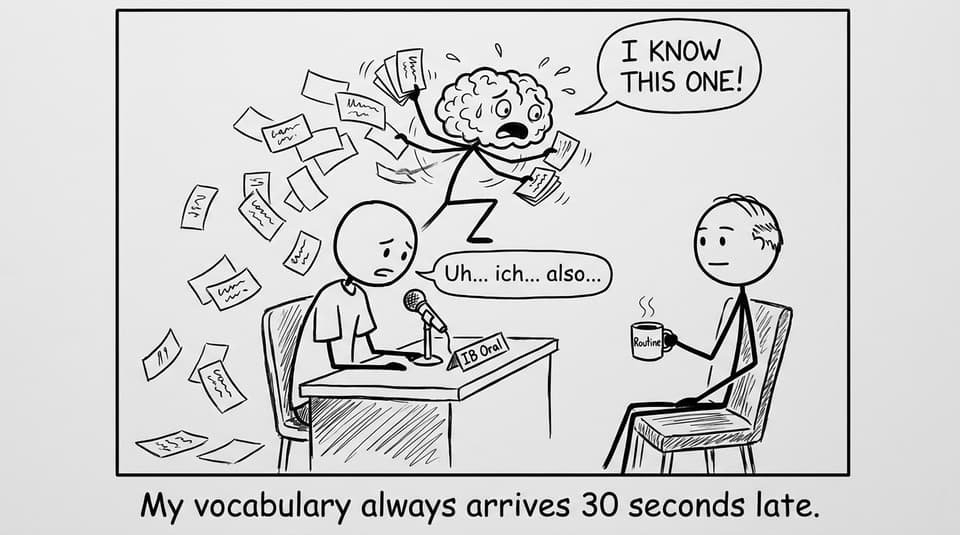
The first time you try to speak German under a timer, your mind does something strange: it knows the words, but it also forgets them. You can almost see the sentence forming, then slipping away like steam.
That feeling is exactly why the oral exam matters in IB Language B. In IB German Ab Initio, the oral isn’t a “bonus speaking task.” It’s the moment the course stops being vocabulary lists and becomes communication. And for many students, it’s the clearest proof that two years of small effort turned into a real skill.
If you’re preparing now, you don’t need to become flawless. You need to become reliable.
The oral exam’s role in IB German Ab Initio (and IB Language B)
In IB Language B, you’re always being assessed on whether language works in real situations: can you get meaning across, keep a conversation going, and show awareness of culture?
For German Ab Initio, the Individual Oral is worth 25% of your final grade. But its deeper role is bigger than the percentage:
-
It rewards active language (speaking and responding), not passive recognition.
-
It tests how you handle live interaction, not just prepared writing.
-
It reveals whether you can connect language to a theme and cultural context.
-
It encourages the most IB-like skill of all: staying calm while thinking.
If you want a clear overview of the full assessment mix, it helps to review the broader exam structure alongside your oral prep: IB German Ab Initio Exam Format (2025 Guide).
Quick checklist: what to prepare for the oral exam
Before you go deep, keep this short checklist (it’s built to match what earns marks in IB Language B):
-
Know the timing and phases of the oral
-
Practice describing a visual stimulus smoothly
-
Prepare flexible theme vocabulary (not a memorized script)
-
Train follow-up questions with unpredictable prompts
-
Build a small “repair phrase” toolkit for when you get stuck
-
Add at least one cultural comparison in most answers
If you want a full set of drills for this style of prep, Mastering Language B Oral Practice is a strong companion.
What the oral exam usually looks like
The oral is short, but it’s dense. You’re doing several things at once: describing, organizing, reacting, and showing cultural awareness.
Most schools run it in a pattern like this:
Preparation time
You get a visual stimulus and a short window to plan notes. Your notes are not a script. They’re a map: key nouns, verbs, opinions, comparisons, and one or two cultural links.
Presentation
You speak continuously for a short burst: what you see, what it suggests, how it connects to a course theme.
Discussion
This is where many students either rise or collapse. The teacher’s questions push you beyond description into explanation, opinion, and comparison. In IB Language B, discussion marks often come from how you develop your ideas, not how fancy your vocabulary sounds.
For a detailed, exam-style breakdown and practice approach, see How to Succeed in the IB German Ab Initio Oral Exam (2025 Edition).
What the oral exam is really testing (the four skills underneath)
On paper, the criteria can look technical. In practice, they’re simple. The oral exam in IB Language B is asking four questions:
Can you control language enough to be understood?
That’s vocabulary and grammar, yes. But it’s also pronunciation, pacing, and choosing simple structures you can deliver cleanly.
If German word order trips you up, build confidence with quick, targeted refreshers like Sentence Word Order: Main Clauses (Verb-Second Rule) and Notes for Subordinating Conjunctions: weil, dass, wenn.
Can you communicate a message, not just label the image?
A strong oral answer moves from “what I see” to “what it means.” Even at Ab Initio level, you can do this with basic frames:
-
Ich glaube, dass…
-
Das ist wichtig, weil…
-
Ein Problem ist…
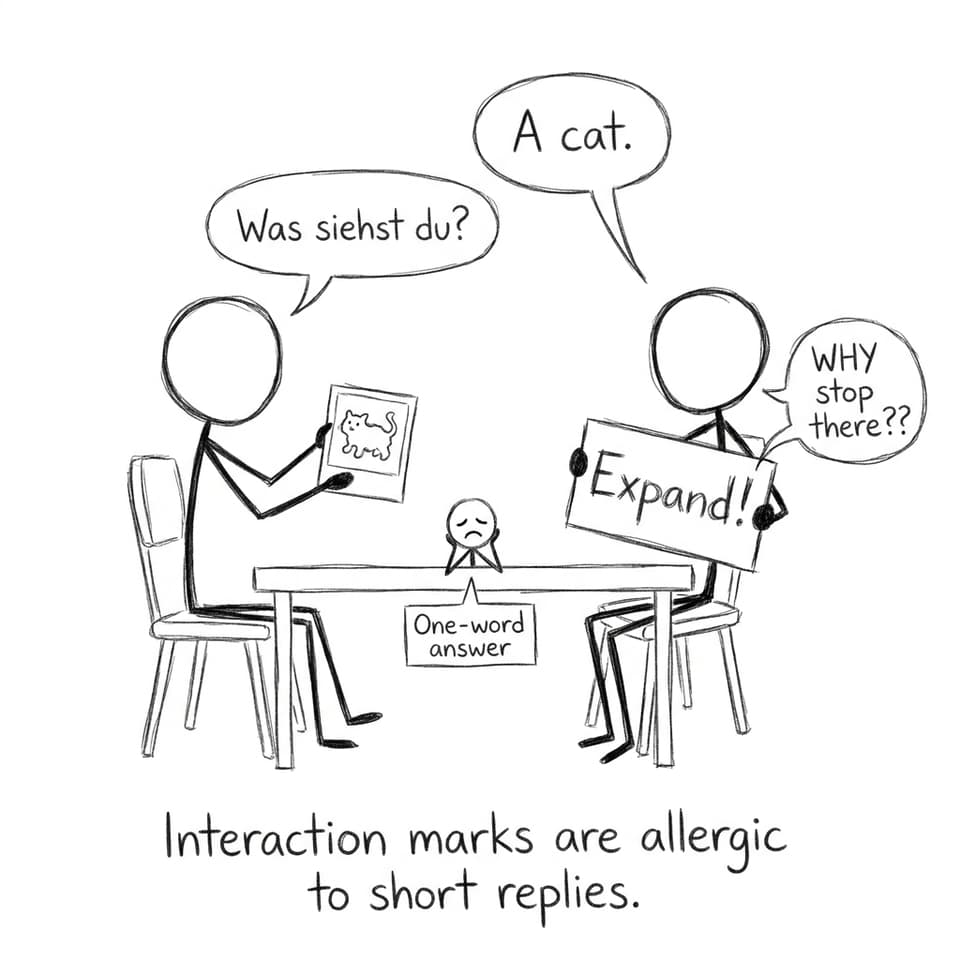
Can you interact naturally?
Interaction is not about being fast. It’s about being responsive. You can buy time and still sound fluent by using repair phrases:
-
“Could you repeat that?” (in German)
-
“Let me rephrase that…”
-
“What I mean is…”
This is also where tools help. RevisionDojo’s AI Chat can play examiner and ask follow-ups you can’t predict, so you practise recovering calmly.
Can you show cultural awareness without memorizing trivia?
Culture in IB Language B is not a fact dump. It’s perspective.
If your stimulus shows recycling, public transport, a festival, school life, or family routines, you’re being invited to:
-
Describe the context in a German-speaking setting
-
Compare it to your own environment
-
Share a personal response
To strengthen this area, use How Do IB German Ab Initio Exams Test Cultural Awareness? (2025 Guide).
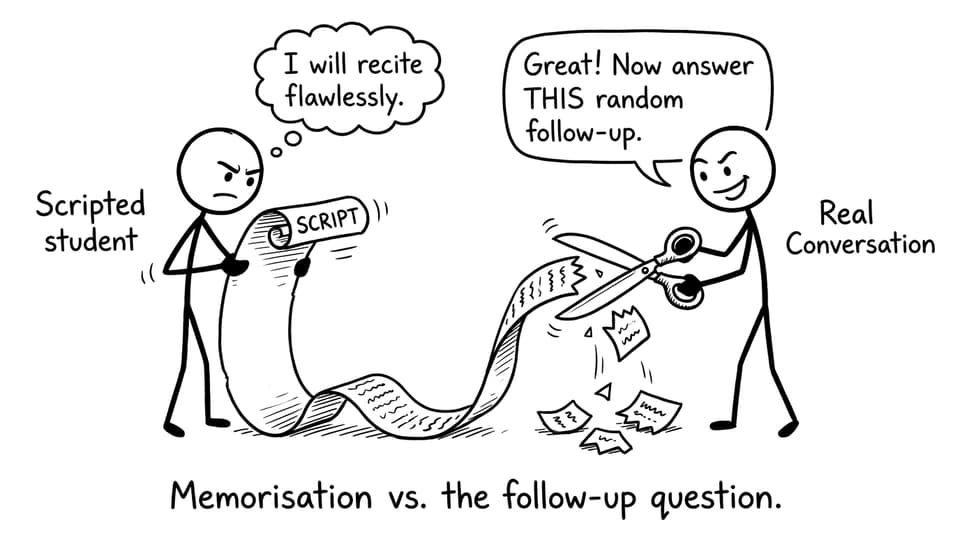
The biggest trap: memorising instead of preparing
Most oral exam stress comes from one misunderstanding: students think confidence equals having the perfect script.
But scripts break the moment the follow-up question goes somewhere else.
Instead, prepare “modules” you can move around:
-
A theme opinion (one sentence)
-
A reason (one sentence)
-
An example (one sentence)
-
A comparison (one sentence)
That structure survives surprises. And in IB Language B, surviving surprises is a skill.
How RevisionDojo fits into oral prep (without making it complicated)
A good oral routine needs two things: repetition and feedback.
RevisionDojo is built for that loop:
-
Use Study Notes to review themes and build ready-to-say ideas.
-
Drill grammar and vocab with Flashcards and spaced repetition.
-
Practise exam-style prompts in the Questionbank.
-
Run timed speaking practice as mini Mock Exams (short, repeatable simulations).
-
Use AI Chat to generate follow-up questions and practise interaction.
-
If you want human feedback, RevisionDojo Tutors can correct recurring speaking patterns.
To build a wider strategy across the course (not just speaking), you can also read IB Language B Exams: Format, Timing, Strategy and Top Mistakes in IB Language Oral Exams and How to Avoid Them.
Conclusion: the oral exam is proof you can communicate
The role of the oral exam in IB German Ab Initio is straightforward: it measures whether you can use the language in motion. Not perfectly. Not poetically. But honestly and effectively.
And that’s why it sits at the center of IB Language B. The oral exam is the closest thing to real life in the whole assessment: a picture, a question, a person listening, and you building meaning one sentence at a time.
If you want your prep to feel structured (and lighter), use RevisionDojo as your home base: theme-based Study Notes, targeted Flashcards, exam-style Questionbank practice, timed Mock Exams, supportive Tutors, and AI Chat that can act like an examiner whenever you’re ready to practise again.