



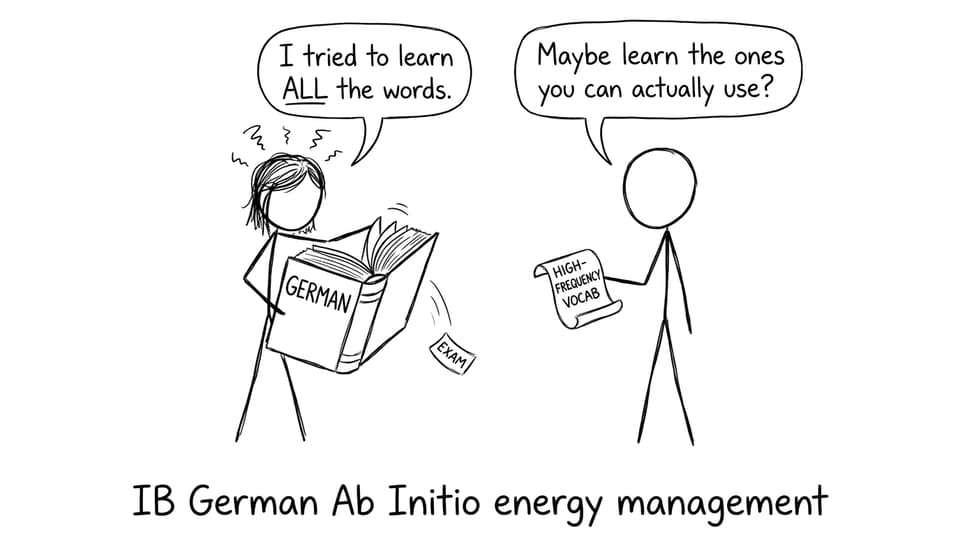
If you have ever stared at a German word that looks long enough to be a full sentence, you are not alone. In the early months of German Ab Initio, vocabulary can feel like a treadmill that speeds up every time you start to breathe.
The comforting truth is that you do not need a dictionary-sized memory to do well. You need useful words: the kind that let you explain, compare, justify, and react under exam pressure. That is what this 2025 guide is for: a focused vocabulary plan that fits how the course is assessed and how IB Language B skills are actually rewarded.
The essential vocabulary checklist (save this)
For German Ab Initio, aim to build vocabulary in five tight buckets:
-
Core conversation basics (greetings, time, numbers, question words)
-
High-frequency verbs (daily life verbs you can reuse everywhere)
-
Theme vocabulary across the five IB themes
-
Exam command terms + task language (instructions, question prompts)
-
Connectors and opinion phrases (to make writing and speaking flow)
This is the same logic that supports strong performance across IB Language B style tasks: communication first, accuracy second, and range built from high-yield building blocks.
If you want the assessment context beside you while you revise, keep this open: IB German Ab Initio Exam Format (2025 Guide).
Why vocabulary matters (more than you think)
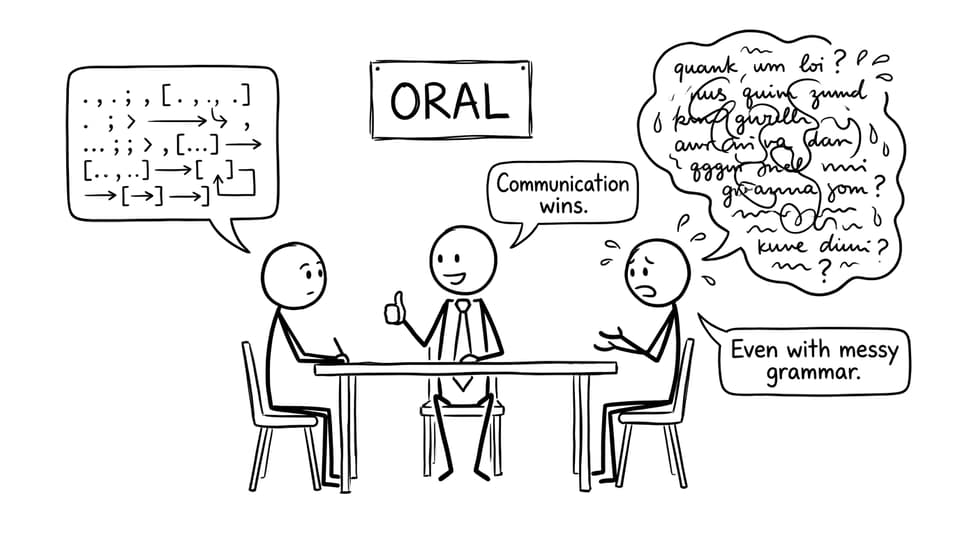
Grammar is the steering wheel, but vocabulary is the road. With limited vocabulary, you can know the rules and still have nowhere to go.
In practice, vocabulary powers every component:
-
Writing becomes clearer and more varied because you can choose the right word, not the closest one.
-
Reading and listening improve because you stop translating everything and start recognizing meaning faster.
-
The oral becomes calmer because you can keep talking even when a sentence goes slightly wrong.
That is also why the smartest IB Language B students treat vocabulary as a skill, not a list.
Core German Ab Initio vocabulary you will use every week
Greetings, introductions, and polite survival phrases
Start with phrases you can deploy automatically:
-
Hallo, Guten Morgen/Tag/Abend, Tschüss, Auf Wiedersehen
-
Wie geht’s? Mir geht’s gut/nicht so gut.
-
Ich heiße … / Ich bin … Jahre alt. / Ich komme aus …
-
Bitte, Danke, Entschuldigung, Kein Problem
These are small, but they reduce stress. In IB Language B terms, they improve “message delivery” immediately.
Numbers, dates, time, and frequency
You will constantly need:
-
Numbers (especially 1--60, 100, 1000)
-
Days, months, seasons
-
Time phrases: um … Uhr, am Montag, heute, gestern, morgen
-
Frequency: oft, manchmal, selten, immer, nie
Question words and classroom command terms
These unlock tasks and conversations:
-
wer, was, wo, wann, warum, wie, wie viel, welcher
-
erklären, beschreiben, vergleichen, auswählen, begründen
If you struggle with tasks, practice the wording used in questions. It is one of the most underrated accelerators for German Ab Initio and IB Language B exam confidence.
Theme vocabulary: what to learn for each IB theme
The five themes are not decoration. They are the system your course content and exam prompts keep returning to. A good shortcut is to build mini “word banks” per theme, then practice using them in short sentences.
For the official theme map, use: Core Themes for IB German Ab Initio.
Identities
Focus on family, food, health, and self-description.
-
Familie: Mutter, Vater, Geschwister, Freund/Freundin
-
Essen: Brot, Obst, Gemüse, Wasser, Frühstück
-
Gesundheit: krank, gesund, Arzt, Sport, sich fühlen
Experiences
This is routines, free time, travel, celebrations.
-
Alltag: aufstehen, lernen, Hausaufgaben, schlafen
-
Freizeit: lesen, Musik hören, ins Kino gehen
-
Reisen: Reise, Hotel, Ticket, Strand
Human ingenuity
Technology, media, transport, communication.
-
Handy, Computer, Internet, soziale Medien
-
Zeitung, Nachrichten, Fernsehen
-
Auto, Zug, Bus, Fahrrad
Social organization
School, work, community.
-
Schule: Lehrer, Schüler, Stundenplan, Prüfung
-
Arbeit: Beruf, Praktikum, Chef, Kollegen
-
Stadt: Nachbar, Geschäft, Polizei
Sharing the planet
Environment, geography, global issues.
-
Umwelt: Recycling, Energie, Klima, Müll
-
Orte: Berge, Fluss, Land, Stadt
-
Themen: Armut, Krieg, Migration
Want a broader study plan that matches this theme approach? How to Effectively Revise for Language B Exams is a strong framework you can adapt to German Ab Initio while keeping IB Language B habits.
Exam-ready vocabulary: the phrases that raise your marks
Connectors (your writing and oral will sound instantly better)
Memorize a small set you can control:
-
zuerst, dann, danach, schließlich
-
zum Beispiel, weil, aber, obwohl
-
meiner Meinung nach, ich denke, dass …
If your writing is losing marks for choppy structure, pair connector practice with the strategy in How to Avoid Common Mistakes in Language B Writing.
Oral “repair phrases” (keep talking when you blank)
These are not filler. They are control.
-
Ich meine … / Also … / Einen Moment bitte.
-
Das ist schwierig, aber …
-
Ich bin nicht sicher, aber vielleicht …
That ability to recover is central to IB Language B performance and it matters just as much in Ab Initio.
A simple routine to learn vocabulary without burning out
A routine beats motivation because it still works on tired days.
Try this weekly loop using RevisionDojo:
-
Study Notes to learn vocabulary in context (short, theme-based chunks) via Study Notes
-
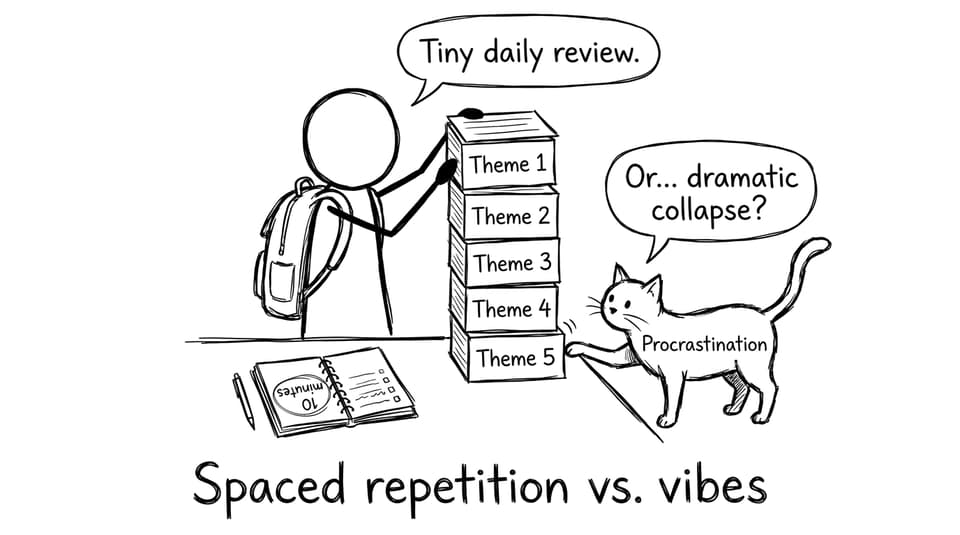
Flashcards for spaced repetition (7--10 minutes daily)
-
Questionbank-style practice to force active recall and sentence-building
-
AI Chat to ask, “Is this phrasing natural?” before you cement bad habits
-
Grading tools to see what examiners reward in writing structure
-
Mock Exams and Predicted Papers to rehearse timing and reduce surprise
-
Coursework Library and Tutors when you want real examples and feedback loops
If you are building a longer plan, How to Build a Full Self-Study Language Plan for One Year makes the work feel organized, not endless.
Conclusion: learn the words you can actually use
The essential vocabulary for IB German Ab Initio is not mysterious. It is practical: core conversation language, the five theme word banks, exam command terms, and a small set of connectors and opinion phrases that make you sound organized.
Treat it like training: short daily recall, frequent reuse in sentences, and regular exam-style practice. That is how you build confidence quickly, and it is the same mindset that helps students thrive in IB Language B courses too.
If you want one place to run that whole system, RevisionDojo is built for it: Questionbank practice, Study Notes, Flashcards, AI Chat, Grading tools, Predicted Papers, Mock Exams, a Coursework Library, and Tutors when you need a human reset. Start here for German-specific support: German Ab Initio IB Resources.