


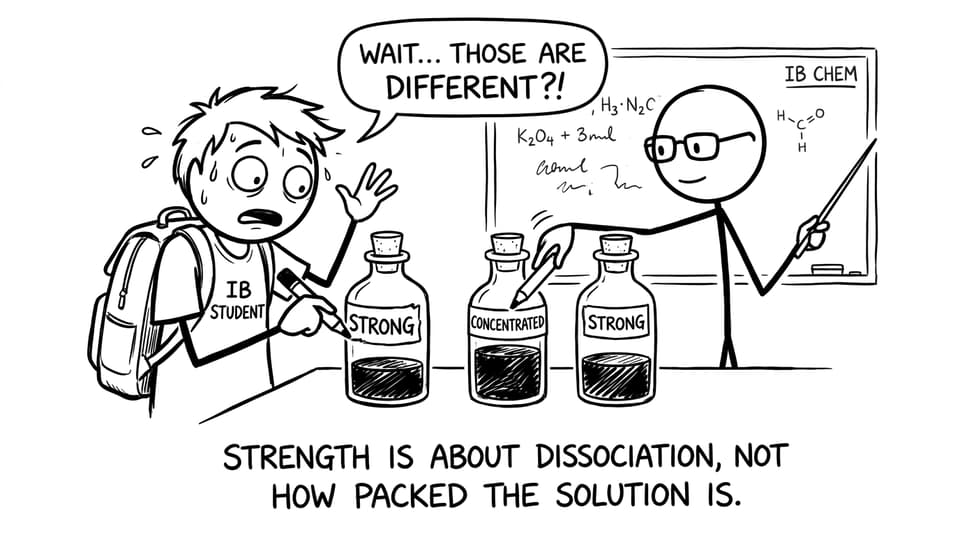
Strong and weak bases show up everywhere in IB Chemistry: pH calculations, equilibrium, conductivity, and titration curves. Yet the mistake that steals marks is almost always the same. A student sees a “strong” base and thinks “concentrated,” or sees a “weak” base and assumes “dilute.”
That confusion is understandable. In real life, we use “strong” to mean “a lot.” In IB Chemistry, strength means something quieter: how completely a base forms ions in water. Once you see that, the topic stops feeling like memorisation and starts feeling like logic.
Quick IB Chemistry checklist for strong vs weak bases
Use this mini-checklist before any IB Chemistry question on bases:
-
Ask: is the base fully dissociated or partially dissociated in water?
-
If it’s strong, treat it as essentially complete dissociation (stoichiometry style).
-
If it’s weak, write an equilibrium with a reversible arrow and use Kb reasoning.
-
Never swap strength with concentration (different ideas, different marks).
-
Link the idea to what you observe: pH, conductivity, and titration curve shape.
For the full syllabus map, anchor your revision with IB Chemistry Acids and Bases.
Strong base definition in IB Chemistry (and what it implies)
In IB Chemistry, a strong base is one that dissociates essentially completely into ions in aqueous solution. Practically, that means almost every formula unit produces hydroxide ions.
Classic examples are Group 1 hydroxides and some Group 2 hydroxides:
-
NaOH(aq) (\rightarrow) Na⁺(aq) + OH⁻(aq)
-
KOH(aq) (\rightarrow) K⁺(aq) + OH⁻(aq)
-
Ba(OH)₂(aq) (\rightarrow) Ba²⁺(aq) + 2OH⁻(aq)
What this gives you in exams: predictable () from concentration (for a monoprotic hydroxide, ( \approx c)). That’s why strong base pH problems often feel “clean” in IB Chemistry.
If you want targeted practice on the exact syllabus wording, use 8.4 Strong and weak acids and bases and then drill questions in the 8.4 Questionbank.
Weak base definition in IB Chemistry (the equilibrium mindset)
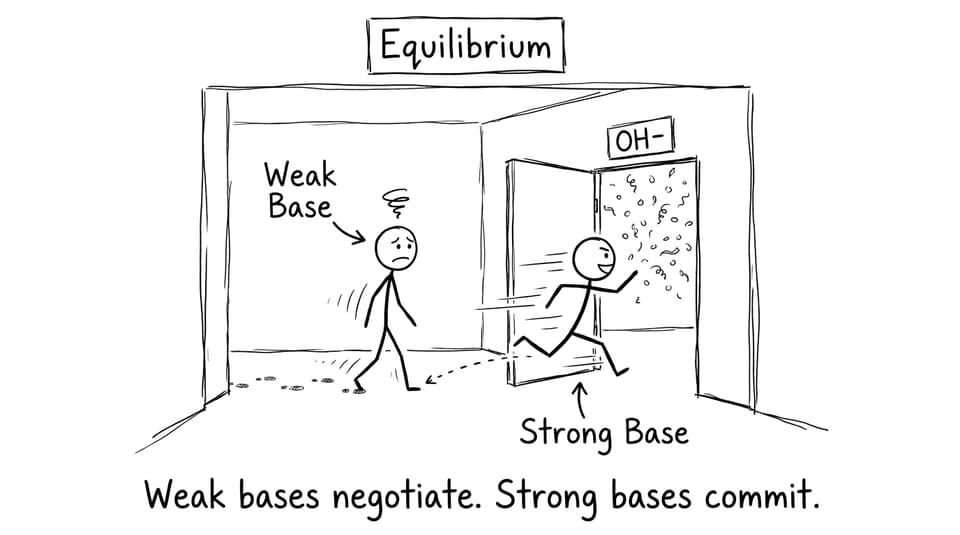
A weak base only partially reacts with water to form ions. So the solution contains a mixture of the base molecules and the ions they produce.
A core IB Chemistry example is ammonia:
That reversible arrow is not decoration. It’s the whole story: a weak base sets up an equilibrium, and the position of that equilibrium is described by Kb.
To connect this to broader acid-base structure, it helps to think in conjugate pairs. If that concept feels slippery, IB Chemistry: Conjugate Acid-Base Pairs Explained makes it much easier to spot BH⁺/B pairs in a hurry.
The core difference: dissociation (not concentration)
Here’s the sentence you want in your head when Paper 2 gets noisy:
-
Strength = degree of dissociation/ionisation in water.
-
Concentration = how many moles per dm³ you started with.
So in IB Chemistry, it is completely possible that:
-
a 0.10 mol dm⁻³ strong base produces more OH⁻ than
-
a 1.0 mol dm⁻³ weak base
because the strong base turns almost all of its formula units into ions, while the weak base does not.
RevisionDojo’s R3.1.6 Strong and weak acids and bases Notes reinforces this with the exact examiner-friendly language.
What changes in conductivity and pH
In IB Chemistry, strong bases create many ions in solution. More ions means higher electrical conductivity.
Weak bases create fewer ions (most particles remain molecular), so conductivity is noticeably lower.
The same logic explains pH:
-
Strong base: () is large and straightforward, so pH is high.
-
Weak base: () is smaller because equilibrium lies left, so pH is lower at the same concentration.
If you’re moving into constants, R3.1.10 Acid and base strength and constants (HL) Notes connects Kb to what “weak” really means.
Titration curves: where strong vs weak bases leave fingerprints
Titration curves are basically stories about how quickly the solution’s dominant species changes.
-
Strong base titrated by strong acid: sharper vertical region near equivalence, because free OH⁻ is abundant until it suddenly isn’t.
-
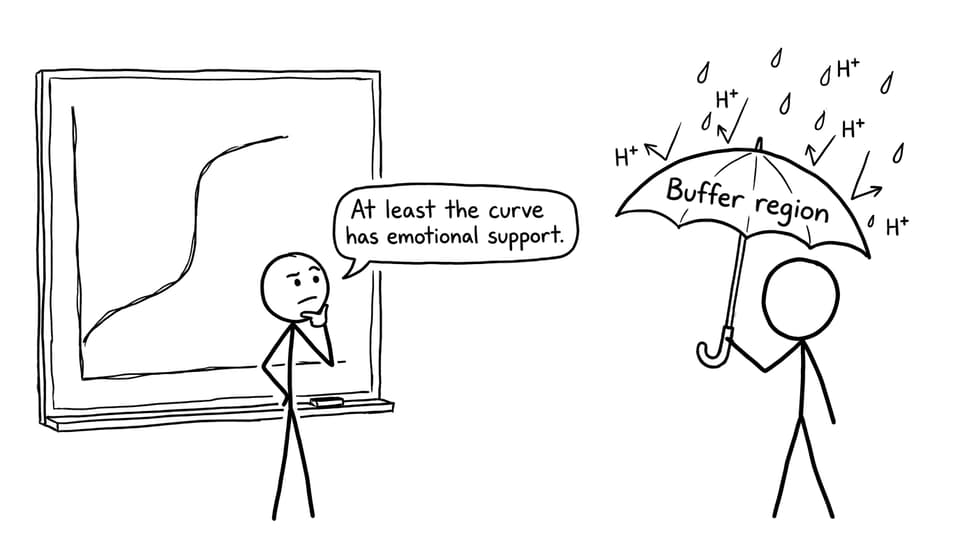
Weak base titrated by strong acid: gentler change, plus a buffer region because you temporarily have a weak base and its conjugate acid together.
To build curve intuition, pair R3.1.8 pH curves for neutralization Notes with R3.1.13 pH curves of Acid-Base combinations (HL) Notes. Then test yourself using the pH curves Questionbank.
Closing: the calm way to score on strong vs weak bases
The difference between strong and weak bases in IB Chemistry is not about “how much base” you have. It’s about how completely it forms ions in water. That one idea explains conductivity trends, pH differences, and why titration curves look the way they do.
When you’re ready to make this automatic, RevisionDojo is built for it: start with the linked Study Notes, lock it in using Flashcards, then sharpen exam instincts with the Questionbank and Grading tools. If you get stuck mid-problem, AI Chat can walk you through the equilibrium setup step-by-step, and Mock Exams plus Predicted Papers help you rehearse timing and accuracy under pressure. That’s how IB Chemistry stops being a set of topics and becomes a skill you can trust on exam day.