

In IB Chemistry, there’s a particular kind of exam panic that feels oddly familiar: you know the reaction is simple, you know the Data Booklet is trying to help, and yet your answer is drifting because one detail (a state symbol, a coefficient, a sneaky “standard” condition) slipped past you. Standard enthalpy of formation is where that happens most often. Not because it’s hard, but because it’s precise.
Get it right, though, and energetics starts to feel like a calm set of rules rather than a guessing game. This article breaks down the definition, the logic, and the exam moves you’ll need for IB Chemistry.

A quick checklist before you touch any numbers
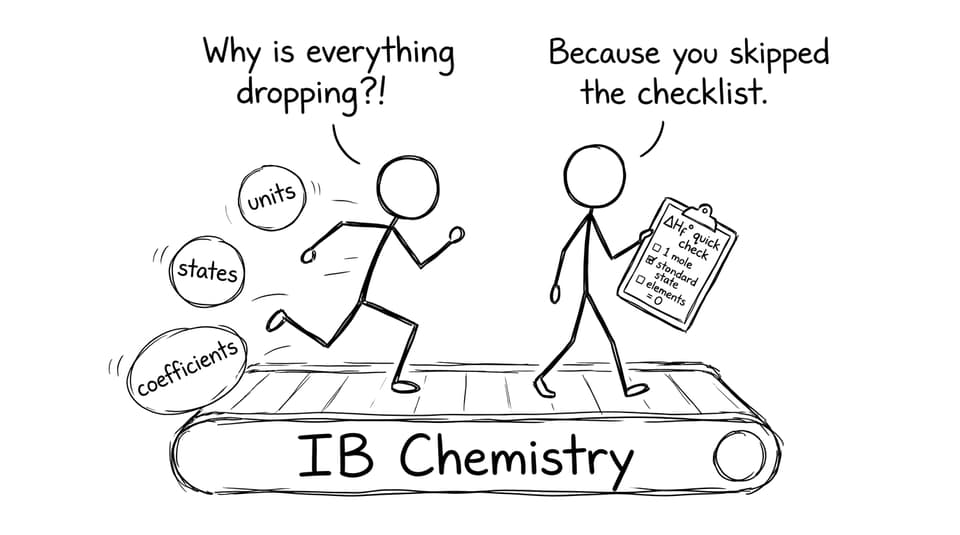
Use this 15-second scan every time IB Chemistry gives you ΔHf° data:
-
Are you forming exactly 1 mole of the compound?
-
Are the elements written in their standard states?
-
Are you under standard conditions (298 K, 100 kPa, and 1.0 mol dm⁻³ for solutions)?
-
Did you remember: ΔHf° of a pure element in its standard state = 0?
-
Are your states (s, l, g, aq) consistent with standard states?
If you want a broader refresher on ΔH itself, pair this with Enthalpy Change Explained for IB Chemistry.
What is standard enthalpy of formation (ΔHf°)?
Standard enthalpy of formation (ΔHf°) is the enthalpy change when one mole of a compound is formed from its elements in their standard states under standard conditions.
In IB Chemistry, standard conditions mean:
-
298 K
-
100 kPa
-
For solutions: 1.0 mol dm⁻³
That little degree sign (°) matters. It’s your reminder that states and conditions are part of the definition, not decoration.
For syllabus-aligned notes on where this sits in energetics, see Energetics and Thermochemistry and the companion Energetics and Thermochemistry Notes.
The three rules examiners quietly test
One mole of product, even if fractions appear
Formation equations must produce 1 mol of the compound. That often forces fractional coefficients, and fractions are allowed in IB Chemistry.
Example (water):
H₂(g) + ½O₂(g) → H₂O(l)
It feels “messy,” but it’s correct because the definition demands one mole.
Elements must be in their standard states
Standard state means the most stable physical form at 298 K and 100 kPa.
Common IB Chemistry examples:
-
H₂(g), O₂(g), N₂(g)
-
C(s, graphite) (not diamond)
-
Br₂(l) (because bromine is liquid at 298 K)
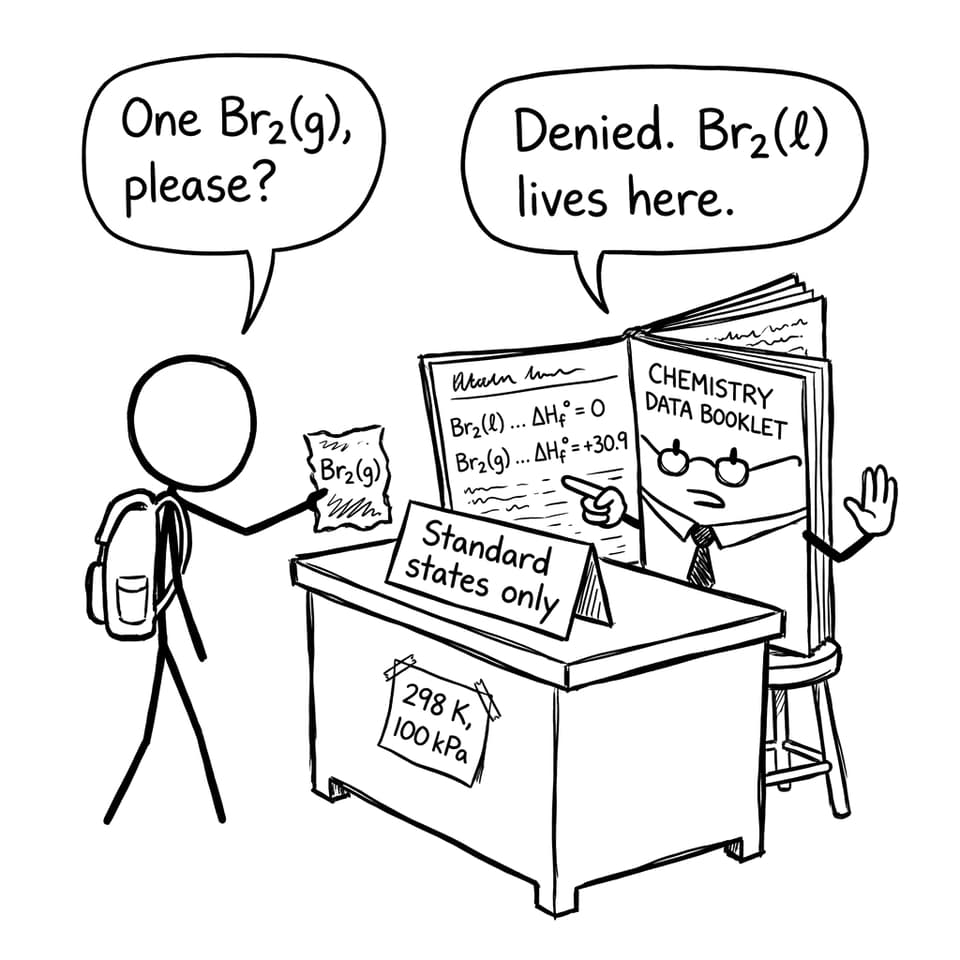
ΔHf° of elements in their standard state is zero
This is the reference point that makes Hess cycles work.
So:
-
ΔHf°(O₂(g)) = 0
-
ΔHf°(N₂(g)) = 0
-
ΔHf°(C(s, graphite)) = 0
But notice the wording: in their standard state. If an element is not written in its standard state, you cannot automatically treat it as zero.
Why ΔHf° shows up everywhere in IB Chemistry
ΔHf° values are most useful because they let you calculate the enthalpy change of reactions you can’t (or shouldn’t) measure directly.
The key relationship is:
ΔH°reaction = ΣΔHf°(products) − ΣΔHf°(reactants)
This is a core move in IB Chemistry Hess’s law questions. If Hess’s law still feels slippery, revise it alongside IB Chemistry: Hess's Law Explained Simply and the syllabus notes 5.2 Hess’s Law.
To drill the skill under exam timing, use IB Chemistry Energetics and Thermochemistry Questionbank or go topic-specific with R1.2 Energy cycles in reactions Questionbank.
Worked IB-style example (formation data method)
Calculate ΔH° for:
2CO(g) + O₂(g) → 2CO₂(g)
Given:
-
ΔHf°(CO₂(g)) = −393 kJ mol⁻¹
-
ΔHf°(CO(g)) = −110 kJ mol⁻¹
-
ΔHf°(O₂(g)) = 0 kJ mol⁻¹
Step 1: Sum products
2 × (−393) = −786 kJ
Step 2: Sum reactants
2 × (−110) + 0 = −220 kJ
Step 3: Products minus reactants
ΔH°reaction = −786 − (−220) = −566 kJ
That’s the full structure examiners want in IB Chemistry: clear sums, correct coefficients, and the element baseline handled properly.
Common mistakes (and how to avoid them)
-
Making more than 1 mol in a formation equation (definition violation)
-
Using the wrong state symbol (especially H₂O(l) vs H₂O(g), Br₂(l) vs Br₂(g))
-
Forgetting O₂, N₂, etc. are zero only in standard states
-
Dropping coefficients when applying ΣΔHf°
-
Mixing up ΔHf° with combustion ideas (if you need that contrast, see IB Chemistry: Enthalpy of Combustion Explained)
Closing: make ΔHf° your easy marks
Standard enthalpy of formation is one of those IB Chemistry ideas that rewards calm precision: one mole, correct standard states, standard conditions, and elements set to zero. Once those anchors are in place, Hess’s law and reaction enthalpy calculations stop feeling like clever tricks and start feeling like bookkeeping.
If you want to turn this into reliable exam performance, build a tight loop on RevisionDojo: learn with the Study Notes, lock definitions with Flashcards, practise with the Questionbank, and use AI Chat plus Grading tools to spot exactly where your method slips. When you’re ready to rehearse under pressure, use Predicted Papers and Mock Exams, and if you want personal feedback on your working, RevisionDojo Tutors can help you sharpen it fast.