
When being watched suddenly makes you faster (or worse)
You know that weird moment in IB revision where you answer a definition perfectly… only when someone is sitting near you? Then the next day, with the same “audience,” you freeze on a harder question and feel like your brain has turned into static. That swing isn’t random. It has a name: social facilitation.
In psychology, social facilitation describes how the presence of other people can change your performance. For IB students, it matters because exams are basically “maximum audience energy” (invigilators, silent rooms, time pressure), and your performance can shift depending on whether the task is automatic or still fragile.
Social facilitation (definition you can write in an exam)
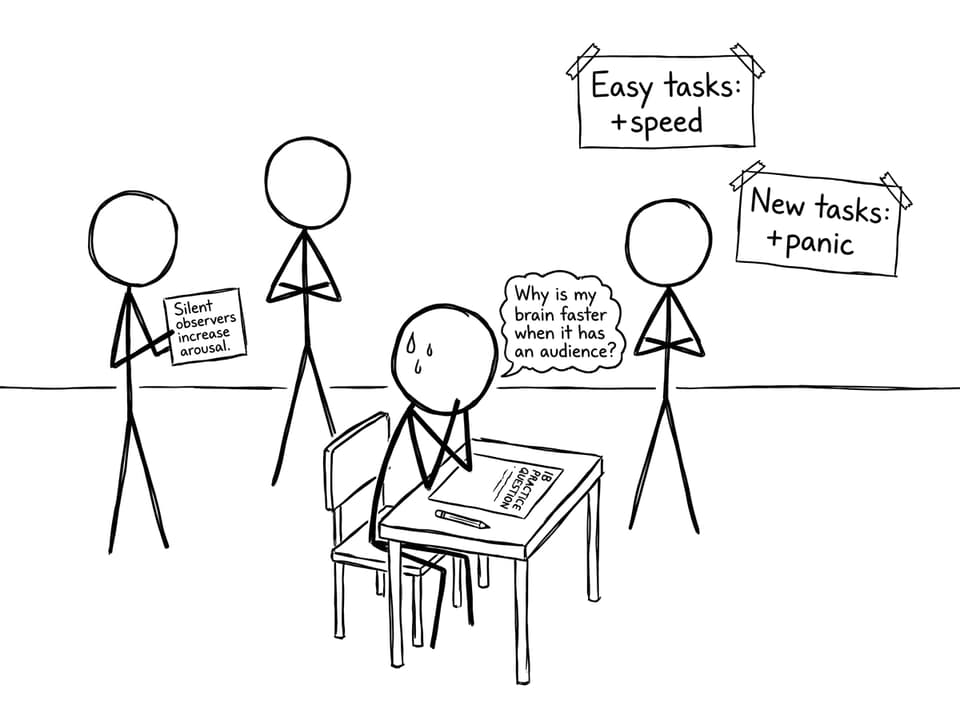
Social facilitation is the tendency for an individual’s performance to be influenced by the presence of others (real, imagined, or implied observers). In general:
-
If a task is easy or well-practised, performance often improves when others are watching.
-
If a task is hard, new, or complex, performance often gets worse when others are watching.
A clean way to remember it for IB writing is: others -> arousal -> dominant response. When you’re more aroused (alert, stressed, energized), your default response shows up faster. If your default response is correct, you look brilliant. If it’s shaky, you feel exposed.
A quick IB-friendly checklist: will an audience help or hurt?
Use this before group study, oral practice, or timed sessions:
-
Have I done this skill enough times that it’s almost automatic?
-
Is my “first instinct” usually correct here?
-
Am I practising speed + accuracy (good for audiences) or deep thinking (riskier with audiences)?
-
Should I start alone, then add observers later?
If you want a structured place to practise both recall and performance, start from the IB Psychology Resources hub and build a short weekly loop.
Social facilitation examples IB students actually live
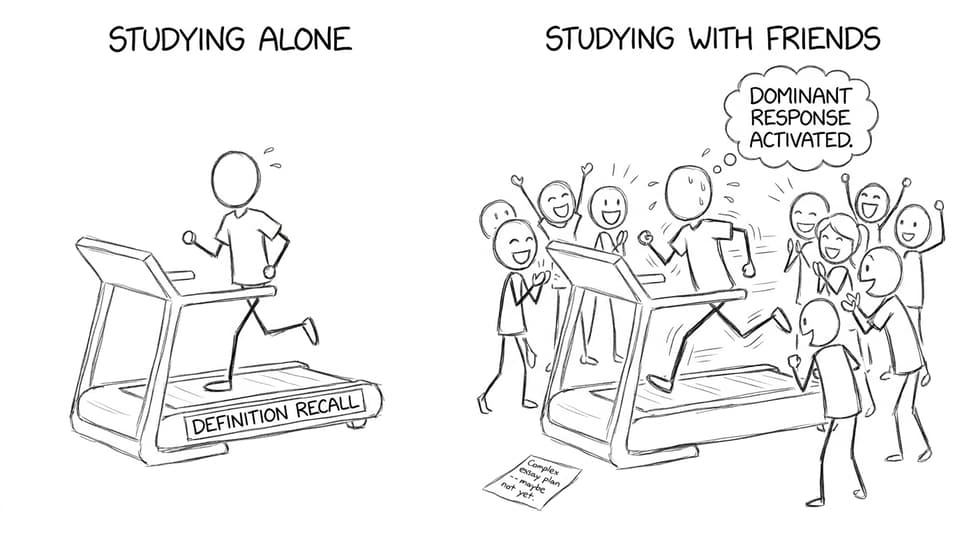
Faster recall in a study group
In a group, you might define terms more quickly because you feel “on.” That’s social facilitation helping with well-learned basics. You can tighten this effect using short retrieval drills via IB Flashcards with spaced repetition.
Worse performance on new essay planning
If you’re still learning how to structure evaluation or link studies, being watched can make you rush. The dominant response becomes “write something” instead of “write the right thing.” That’s where targeted practice helps: use a topic page like Group Behaviour notes and then apply it with exam-style questions.
Performing better in timed mini-sprints
A timer plus a quiet observer (even a friend) can sharpen simple tasks: key definitions, short explanations, quick identification of concepts. Build those sets from the IB Psychology Sociocultural Approach Questionbank or the broader Psychology (First Exam 2027) Questionbank view.
Impact on performance: how to use social facilitation during IB revision
Social facilitation becomes a tool when you treat pressure like a dial, not a switch.
-
First build accuracy privately. Use concise explanations from IB Psychology Revision Notes (SL/HL) or a specific concept page like Social Learning Theory (SLT).
-
Then add light observation. Do short Questionbank sets while someone is nearby.
-
Then simulate exam conditions. Use RevisionDojo’s Mock Exams and Predicted Papers features to rehearse pacing and stamina, and use Grading tools to see where marks leak.
-
Close the loop fast. Ask AI Chat one precise question (not ten vague ones), fix the gap, then reattempt.
If your whole routine feels messy, the strategy in How to Study for IB Exams: Step-by-Step Guide can help you turn “pressure practice” into something repeatable.
A closing thought for IB exam week
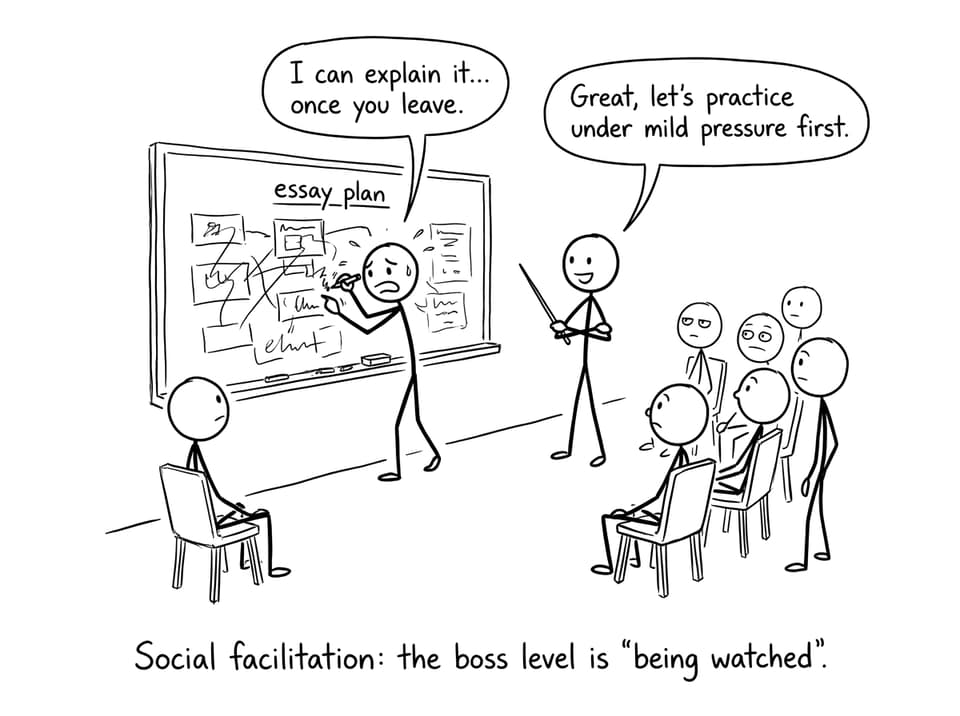
Social facilitation is a quiet reminder that performance is contextual. You’re not the same student alone at your desk as you are in a timed room with people nearby. In IB exams, the goal is to make your best responses the easiest responses.
If you want one system that helps you do that, RevisionDojo brings everything into a single loop: Study Notes for clarity, Flashcards for recall, Questionbank practice for application, AI Chat when you’re stuck, Grading tools for honest feedback, plus Predicted Papers and Mock Exams to rehearse pressure on purpose. Build the skill, then practise it with an audience before the exam does it for you.