
When someone asks, “Are you doing the IB?” it can feel like they’re really asking something bigger: Who are you trying to become?
And if your honest answer is “I don’t know,” you’re not behind. You’re paying attention.
The IB can be a brilliant, stretching two years. It can also be a heavy backpack you didn’t mean to carry. This guide is built for students who are uncertain but serious, the kind of uncertainty that deserves a clear decision, not a rushed one.
What the IB actually asks of you (quick refresher)
The IB Diploma Programme is a two-year curriculum (ages 16-19) designed to build academic breadth, research skills, and exam performance.
In most schools, the IB includes:
-
Six subjects (usually a mix of languages, humanities, sciences, and math)
-
Extended Essay (EE): a 4,000-word research project
-
Theory of Knowledge (TOK): critical thinking about knowledge and evidence
-
Creativity, Activity, Service (CAS): long-term engagement outside academics
If you’re already in exam-prep mode, it helps to remember: the IB isn’t only content. It’s systems: deadlines, criteria, and stamina.
If you want a clear view of what resources exist across subjects, start with International Baccalaureate (IB) resources.
The 60-second IB decision checklist
Use this as your fast self-assessment. Count how many feel true.
-
I can tolerate long projects without perfect motivation.
-
I’m willing to practice under time pressure (not just “study”).
-
I’m okay being a beginner in at least one subject.
-
I can ask for help early instead of hiding.
-
I want a curriculum that keeps options open.
If you tick 4-5, the IB is likely a fit. If you tick 2-3, it can still work, but your support system matters more than your “talent.” If you tick 0-1, pause and investigate alternatives before committing.
Why students hesitate about the IB (and what that hesitation means)
Uncertainty is not a weakness. It’s often a signal.
The IB workload feels scary
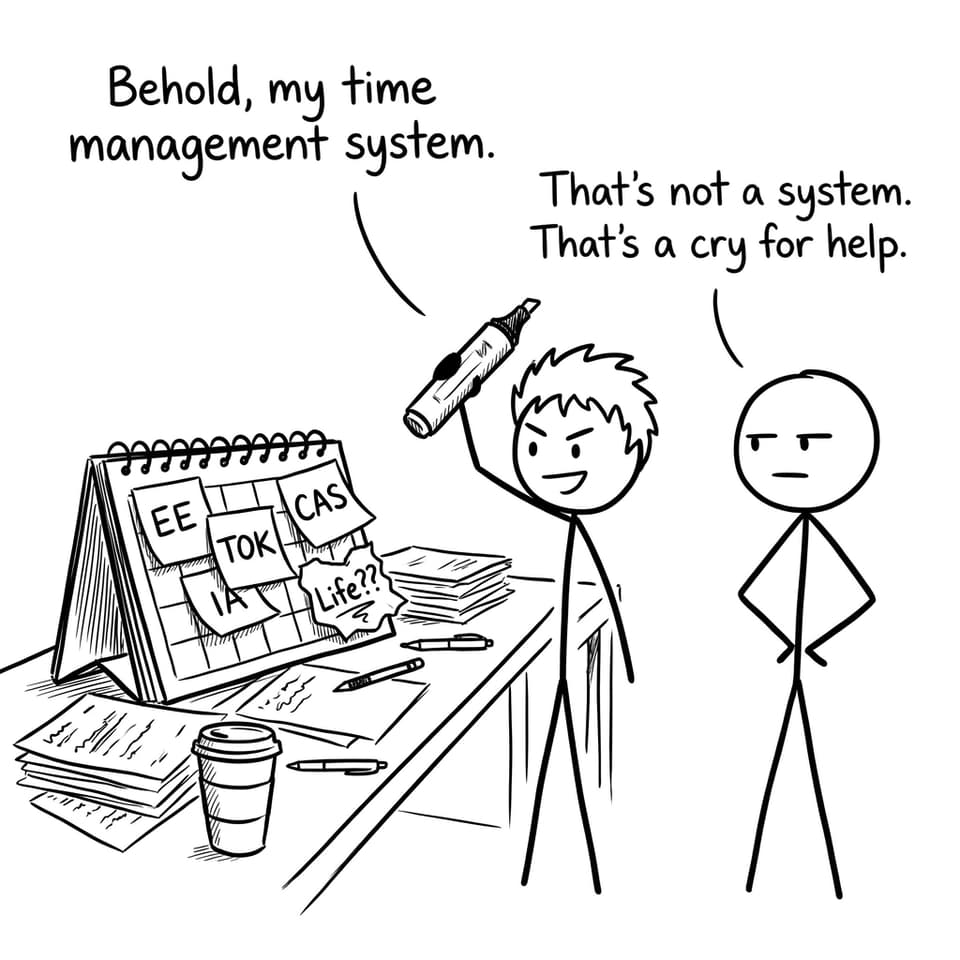
This is the most common fear because it’s partially true: the IB stacks tasks. The danger isn’t difficulty. It’s overlap. EE drafts collide with IA deadlines, while exams keep approaching like a moving train.
What helps is having one platform that turns chaos into a routine: learn, recall, apply, review. RevisionDojo is built around that loop through Study Notes, Flashcards, and the Questionbank.
To see what high performers do differently, read How 45-Point IB Students Prepare for Exams.
You don’t know what you want to study yet
Ironically, this can be a reason to choose the IB. Breadth forces you to keep doors open longer. You discover what you like by doing real work, not by guessing.
If you’re undecided, a practical trial is to act like an IB student for a week: do timed questions, write one short reflection, and test your attention span on a difficult topic.
You’ve heard mixed opinions
Both extremes are real. Some students feel the IB gave them structure and confidence. Others experience burnout because they tried to brute-force it alone.
The question isn’t “Is the IB good?” It’s “Is my setup good?” That includes teachers, school timelines, and tools.
Signs the IB might be right for you
You like challenge that has structure
The IB rewards students who can repeat a process: understand the markscheme logic, practice like the exam, and improve from feedback.
That’s why an IB workflow matters. If you want a clean example, RevisionDojo App: The Smarter Way to Prep for IB Exams explains how students combine Study Notes, Flashcards, AI Chat, Mock Exams, and Predicted Papers into one routine.
You want variety without closing doors
Unlike pathways that narrow early, the IB keeps you fluent in multiple disciplines. For many students, that’s not “extra.” It’s insurance.
You’re willing to practice, not just read
Exam success in the IB comes from application. A great entry point is the free Questionbank feature, which lets you drill topics, see patterns in mistakes, and build confidence through volume.
Signs you might want an alternative (or a different IB approach)
Time management is already a daily fight
The IB can still be possible, but only with support. If your school doesn’t provide timelines or consistent feedback, the same workload becomes twice as heavy.
RevisionDojo can reduce that load through Grading tools, rubric-aligned feedback, and the Coursework Library (especially when TOK/EE/IA expectations feel vague).
For coursework support, explore IB Coursework Exemplars: IA, EE and TOK.
You are certain you want to specialize early
If you know you want a narrow academic path and your university targets don’t value breadth, another curriculum might fit better. That’s not quitting. That’s alignment.
Your school’s IB support is weak
This matters more than students admit. The IB is hard enough with good scaffolding. Without it, you end up doing project management instead of learning.
Try-before-you-commit: a low-risk IB test week
Here’s a simple trial that mimics real IB demands without locking you in:
-
Day 1: Pick one subject and learn one topic using RevisionDojo Study Notes.
-
Day 2: Do a short daily set in the Comprehensive IB Question Bank.
-
Day 3: Use IB Flashcards with Spaced Repetition for 10 minutes.
-
Day 4: Ask one “stuck” question in AI Chat and rewrite your explanation.
-
Day 5: Do one timed section and review mistakes.
This doesn’t tell you whether you’ll love the IB. It tells you whether you can run the process.
Can you leave the IB if it isn’t right?
In many schools, yes, especially early in Year 1. But transitions affect subject choices, credits, and timelines. If you’re considering it, treat it like a plan, not a feeling: talk to your IB coordinator, check transcript implications, and map what replaces each course.
A useful mindset: trying the IB is not a life sentence, but switching should be deliberate.
Closing: decide like an IB student
If you’re unsure about the IB, don’t look for certainty. Look for evidence: can you run the workload with support, can you learn from feedback, and can you practice under time?
And if you choose the IB, don’t do it with willpower alone. Build a loop you can repeat: Study Notes for clarity, Flashcards for recall, Questionbank for application, AI Chat when you’re stuck, and Mock Exams plus Predicted Papers for stamina. That’s what RevisionDojo is designed to make simple.
Explore RevisionDojo for IB and set up your next week of revision like it actually counts, because in the IB, it does.