
When you first meet redox in IB Chemistry, it can feel like a logic puzzle written by someone who enjoys watching students squint at charges.
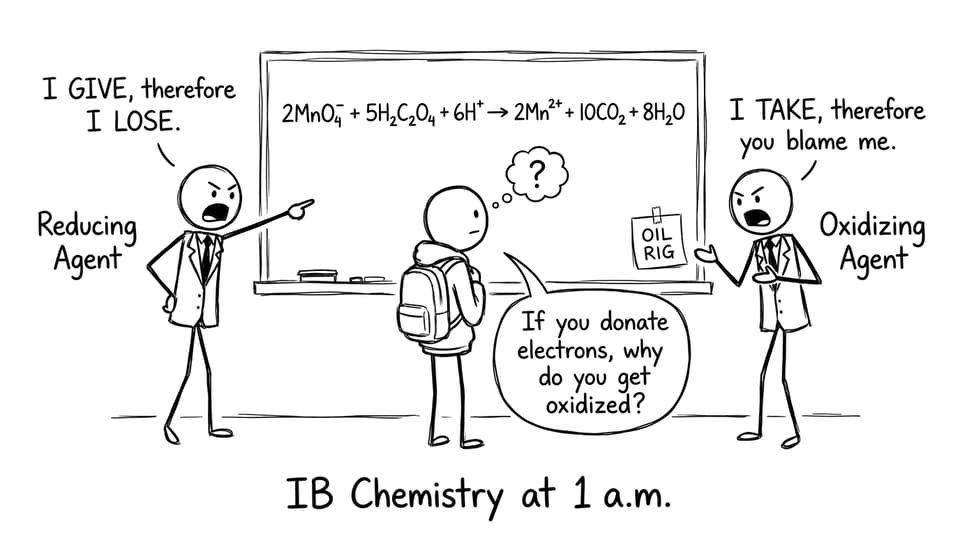
A reducing agent reduces something else… yet it gets oxidized. The oxidizing agent oxidizes something else… yet it gets reduced. If your brain briefly refuses to accept this, you’re not alone. But once you learn one calm rule and practice applying it, reducing agents stop being a “memorize-and-hope” topic and become one of the easiest marks in IB Chemistry.
The one definition you need for IB Chemistry
A reducing agent is a species that donates electrons to another species and is oxidized in the process.
In IB Chemistry exam language, that means:
-
It loses electrons
-
Its oxidation state increases
-
It causes reduction (because the other species gains those electrons)
If you want a tight foundation before you drill questions, pair this with RevisionDojo’s redox basics: Oxidation and Reduction Explained for IB Chemistry and Redox Reactions Explained for IB Chemistry.
The 20-second checklist to spot a reducing agent
Use this whenever IB Chemistry gives you an unfamiliar equation:
-
Write or imagine the half-equations
-
Find what loses electrons (or whose oxidation state goes up)
-
That species is the reducing agent
-
Confirm the other species gains the same number of electrons
Half-equations are the fastest way to stay calm under time pressure. RevisionDojo’s walkthrough is excellent: IB Chemistry: Half-Equations Explained Simply.
How reducing agents behave in redox reactions
Redox is always a paired deal: electrons don’t disappear; they relocate. So in IB Chemistry, a reducing agent is simply the “electron donor” in that transfer.
A classic example:
Zn + Cu²⁺ → Zn²⁺ + Cu
-
Oxidation half-equation: Zn → Zn²⁺ + 2e⁻
-
Reduction half-equation: Cu²⁺ + 2e⁻ → Cu
So Zn is the reducing agent because it produces electrons. A useful pattern: in an oxidation half-equation, the reducing agent sits on the left.
If you ever catch yourself thinking “reducing agents get reduced,” read this once and reset your brain: Why Do Oxidizing Agents Cause Oxidation While Reducing Agents Cause Reduction.
Identifying reducing agents using half-equations (exam-friendly)
In IB Chemistry, you’ll commonly see oxidation written like this:
Red → Ox + e⁻
The species labelled Red (on the left) is the reducing agent.
Three quick examples:
-
Fe²⁺ → Fe³⁺ + e⁻
Fe²⁺ is the reducing agent. -
2I⁻ → I₂ + 2e⁻
I⁻ is the reducing agent. -
H₂ → 2H⁺ + 2e⁻
H₂ is the reducing agent.
Notice the oxidation state trend: the reducing agent’s oxidation state increases.
Common reducing agents you should recognize in IB Chemistry
IB Chemistry questions recycle the same families of reducing agents because they’re chemically reasonable and easy to test.
Metals (in elemental form)
Metals like Mg, Zn, Fe are often reducing agents because they lose electrons relatively easily.
Ions in lower oxidation states
Examples: Fe²⁺, Sn²⁺. They are “comfortable” being oxidized to higher oxidation states.
Hydrogen gas and iodide
H₂ shows up in both industrial contexts and electrochemistry. I⁻ appears often in redox titration logic.
Carbon and carbon monoxide
In metallurgy contexts, C or CO can remove oxygen from metal oxides (a reduction), making them reducing agents.
Standard electrode potentials (E°): turning confusion into a ranking
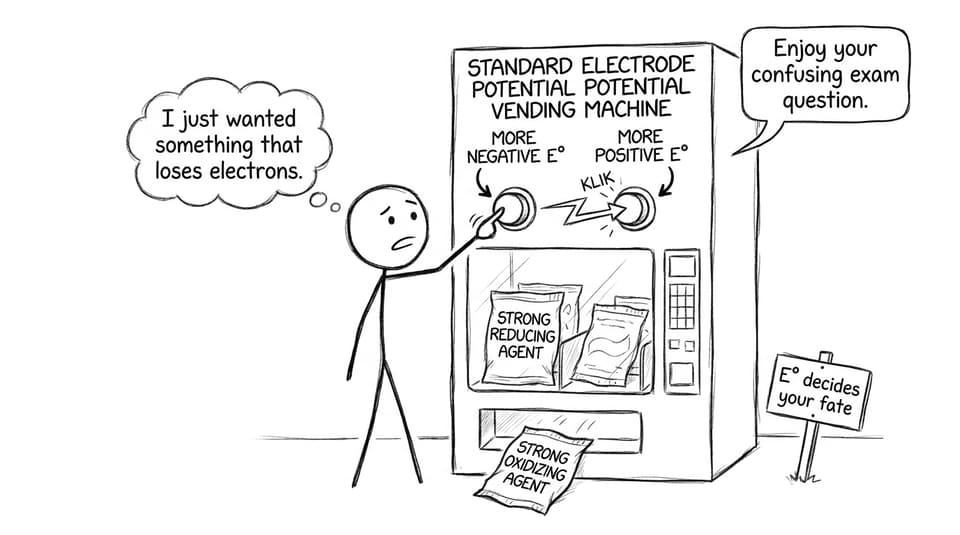
E° tables in IB Chemistry are secretly a ranking tool. A simple rule works reliably:
- More negative E° (for a reduction half-equation) means the species is less willing to be reduced, so in the reverse direction it’s more willing to be oxidized -- therefore it’s a stronger reducing agent.
RevisionDojo’s deep explanation is here: Standard Electrode Potential Explained.
If you also want the “why” behind the trend (not just the rule), read: IB Chemistry: Why Some Elements Are Better Redox Agents.
Reducing agents in organic chemistry (NaBH4 vs LiAlH4)
In IB Chemistry organic questions, “reduction” often means adding hydrogen or removing oxygen from a functional group. Two names appear again and again:
-
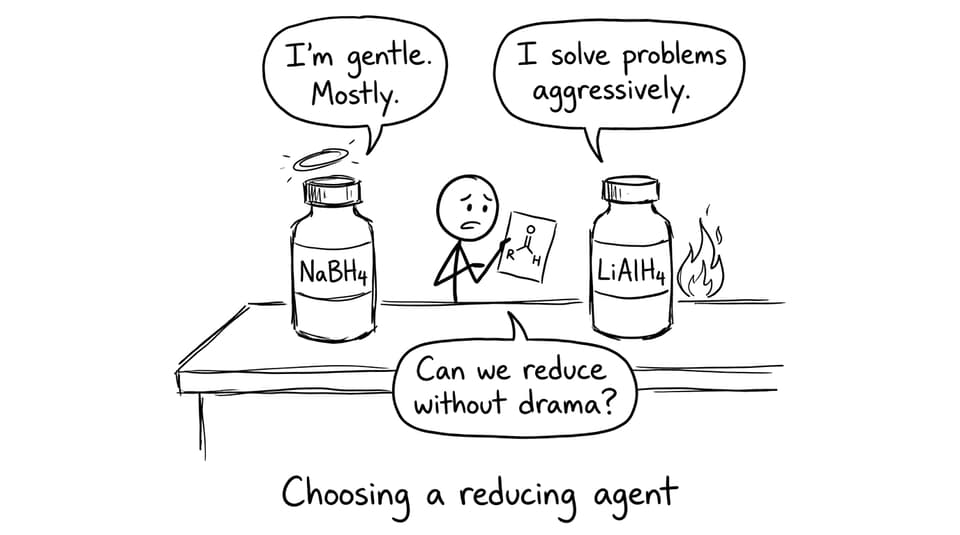
NaBH₄: milder, commonly used for aldehydes and ketones
-
LiAlH₄: stronger, used for more challenging reductions (often beyond what NaBH₄ can do)
For the syllabus framing, use: Reduction of Functional Groups (IB) Notes and 20.1 Types of Organic Reactions Notes.
Reducing agents in electrochemical cells
In a galvanic (voltaic) cell, the key IB Chemistry map is:
-
Anode = oxidation
-
The species being oxidized is the reducing agent
-
Electrons flow from anode to cathode through the wire
If you want the cell logic in a single clean explanation, see: Galvanic Cells Explained Simply and the syllabus notes: Electrochemical Cells: Oxidation and Reduction Notes.
Final takeaway: make reducing agents easy marks
Reducing agents in IB Chemistry are not a separate topic you memorize -- they’re the natural outcome of electron transfer. If a species donates electrons, it is oxidized, its oxidation state rises, and it becomes the reducing agent. Tie that to half-equations and E° trends, and you’ll handle redox, cells, and organic reductions with far less stress.
To lock it in, use RevisionDojo the way top students do: read the IB Chemistry 9.1 Oxidation and Reduction Notes, then drill targeted sets in the IB Chemistry Questionbank. Add Flashcards for definitions, use AI Chat to check your half-equations step-by-step, and finish with Mock Exams, Predicted Papers, and Grading tools when you want timed, exam-like feedback. If you’re stuck, the Tutors and Coursework Library are there for the moments when one confusing line in a markscheme blocks everything else.


