
If you have ever stared at a redox question and felt your confidence drain away, it is usually because of one weird sentence you half-remember: the oxidizing agent gets reduced. In IB Chemistry, that single twist shows up everywhere, in half-equations, electrochemical cells, titration logic, and organic oxidation. The good news is that once you stop trying to memorize and start following the electrons, oxidizing agents become one of the most predictable marks in the paper.
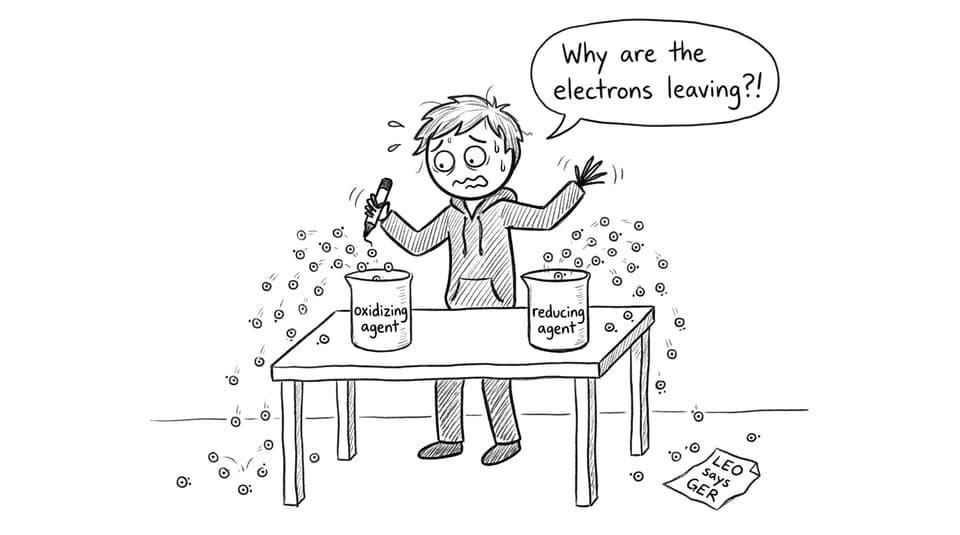
The 20-second IB Chemistry checklist for oxidizing agents
When you are under exam time pressure, use this quick set of checks:
-
An oxidizing agent makes something else oxidize.
-
So the oxidizing agent must accept electrons.
-
If it accepts electrons, it is reduced.
-
In oxidation states, the oxidizing agent’s oxidation number decreases.
-
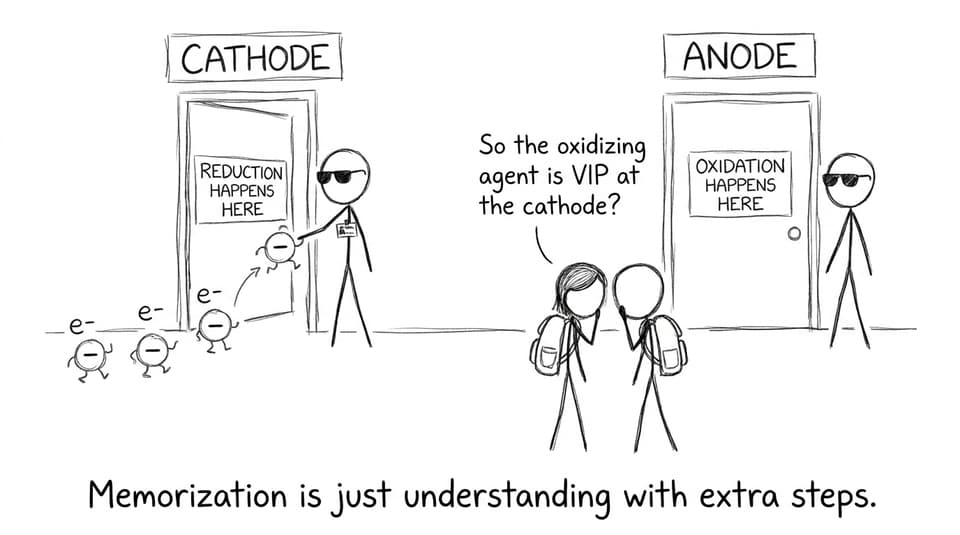
In electrochemical cells, the oxidizing agent is reduced at the cathode.
If you need to reset the basics before applying them, pair this with Oxidation and Reduction Explained for IB Chemistry and What’s a Redox Reaction? IB Chemistry Explained.
What is an oxidizing agent in IB Chemistry?
An oxidizing agent is a species that causes oxidation by taking electrons, and is therefore reduced itself.
Students often get tricked by everyday language: “oxidizing” sounds like “adding oxygen.” But in IB Chemistry, the definition you can always trust is electron transfer.
A simple reaction shows it cleanly:
-
(\text{Cu}^{2+}) gains electrons to become Cu(s), so it is reduced, and it is the oxidizing agent.
-
Zn(s) loses electrons to become (\text{Zn}^{2+}), so it is oxidized, and it is the reducing agent.
That “who gains electrons?” question is the fastest route to accuracy.
For extra intuition on why some species are stronger electron-acceptors than others, read IB Chemistry: Why Some Elements Are Better Redox Agents.
How to spot oxidizing agents in half-equations
Half-equations are where IB Chemistry stops being philosophical and becomes mechanical.
In a reduction half-equation, electrons are on the left:
Because (\text{MnO}_4^-) is accepting electrons, it is being reduced, so (\text{MnO}_4^-) is the oxidizing agent.
If you want more practice turning this into a repeatable method, RevisionDojo’s IB Chemistry 9.1 Oxidation and Reduction Notes are built for quick scanning, then drilling with questions.
Common oxidizing agents you keep meeting in IB Chemistry
Certain oxidizing agents appear so often that they start to feel like recurring characters:
Acidified potassium permanganate (KMnO4)
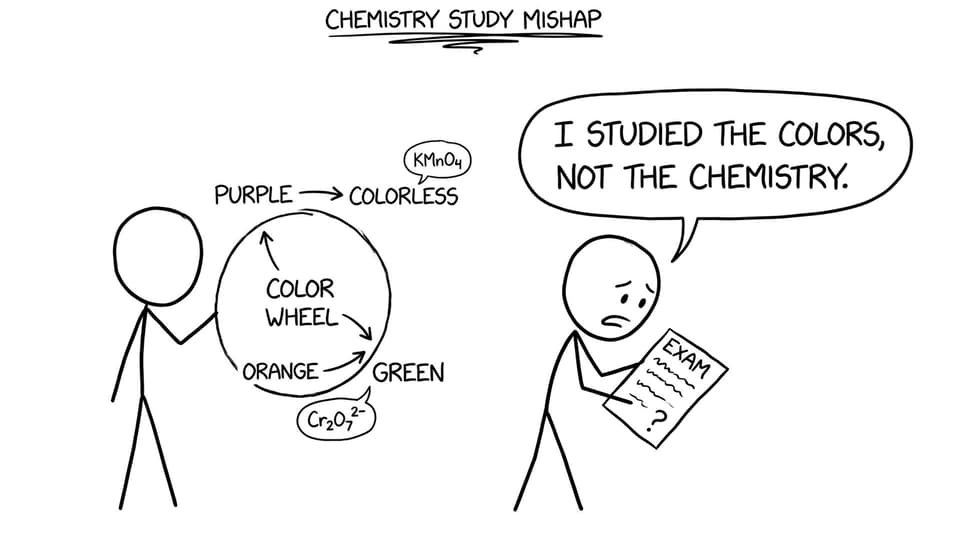
A strong oxidizer used in redox contexts. In acidic solution, it is reduced from purple (\text{MnO}_4^-) to nearly colorless (\text{Mn}^{2+}).
Acidified dichromate (K2Cr2O7)
Another classic oxidizer. It shifts from orange (\text{Cr}_2\text{O}_7^{2-}) to green (\text{Cr}^{3+}) when reduced.
Hydrogen peroxide (H2O2)
A sneaky one because it can act as either an oxidizing agent or reducing agent depending on the reaction.
Halogens (Cl2, Br2)
Halogens readily accept electrons to form halide ions, making them familiar oxidizers in displacement and redox questions.
Concentrated nitric acid (HNO3)
Often behaves as a strong oxidizer in more advanced inorganic contexts.
Using E° to rank oxidizing agents (the exam-friendly shortcut)
Standard electrode potentials (E°) are basically a score for how much a species “wants” to be reduced.
Rule for IB Chemistry:
- More positive E° = stronger oxidizing agent (more willing to gain electrons).
So if you are comparing oxidizing strength, you are usually comparing how easily each species is reduced. For a full walkthrough (and how the standard hydrogen electrode fits in), use Standard Electrode Potential Explained alongside the Chemistry Data Booklet.
Want a syllabus-aligned path into electrochemistry? The Electron Transfer Reactions Learn page connects concepts, examples, and practice in one place.
Oxidizing agents in organic chemistry: functional groups, not just electrons
In IB Chemistry organic questions, oxidizing agents quietly translate into functional group change.
-
Primary alcohols can be oxidized to aldehydes, then further to carboxylic acids.
-
Secondary alcohols oxidize to ketones.
RevisionDojo’s R3.2.9 Oxidation of Organic Compounds Notes are especially useful here because they tie reagents to outcomes, which is how exam questions are phrased.
Oxidizing agents in electrochemical cells: “VIP at the cathode”
In galvanic cells, reduction happens at the cathode. So the oxidizing agent is the species being reduced there.
If cells feel abstract, the story becomes clearer when you connect it to batteries you already use. Read IB Chemistry: How Batteries Work (Explained Simply) and then practice calculations in R3.2.6 Primary (Voltaic) Cells Notes.
Closing: make IB Chemistry redox feel inevitable
Oxidizing agents stop being intimidating when you treat them like predictable electron collectors: they accept electrons, get reduced, and make someone else oxidize. In IB Chemistry, that idea threads through half-equations, E° comparisons, organic oxidation, and electrochemical cells.
If you want this to feel calm under time pressure, build the habit the same way you build any reliable skill: short notes, active recall, then targeted questions. RevisionDojo brings that workflow together with Study Notes, Flashcards, AI Chat, Grading tools, Predicted Papers, Mock Exams, and a high-signal Questionbank, plus Tutors when you want a human to check your reasoning. Keep the electrons in view, and the marks follow.