
Nucleophilic substitution is the kind of IB Chemistry topic that feels obvious in a textbook and slippery in an exam. You read “a nucleophile replaces a leaving group,” you nod, and then a question asks for the mechanism, the rate law, the stereochemistry, and the solvent effect, and suddenly your arrows look like they’re trying to escape the page.
The good news is that nucleophilic substitution is predictable. Not because it’s simple, but because it follows a small set of rules that show up again and again in IB Chemistry.
Nucleophilic substitution in IB Chemistry (quick checklist)
Use this checklist when you’re deciding what mechanism to draw in IB Chemistry:
-
Identify the substrate: primary, secondary, or tertiary halogenoalkane?
-
Check the nucleophile: strong (e.g., OH⁻, CN⁻) or neutral/weaker (e.g., NH₃)?
-
Look at the solvent: polar protic (often helps SN1) or polar aprotic (often helps SN2)?
-
Decide SN1 vs SN2: one-step backside attack or two-step carbocation route?
-
Write the correct rate law: depends on one species (SN1) or two (SN2)?
For targeted practice, the fastest way to make this automatic is doing exam-style sets like R3.4.2 Nucleophilic substitution reactions Questionbank.
What nucleophilic substitution actually means
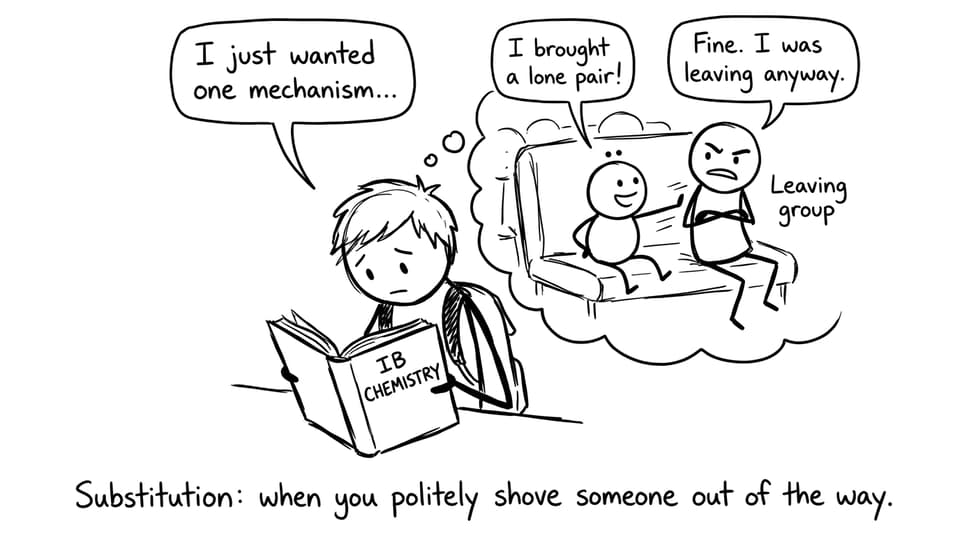
In IB Chemistry, nucleophilic substitution is a reaction where a nucleophile (electron-rich) replaces a leaving group (takes the bonding pair and departs).
Most exam questions place this on halogenoalkanes because the C-X bond is polar:
-
Carbon becomes δ+ (electrophilic)
-
Halogen becomes δ- and can leave as X⁻
That polarity is the invitation: the nucleophile brings a lone pair, attacks the δ+ carbon, and the leaving group exits with electrons.
If you want the syllabus-aligned wording and examples in one place, pair this post with Notes for R3.4.2 Nucleophilic substitution reactions.
SN2 in IB Chemistry: one step, tight logic
SN2 stands for bimolecular nucleophilic substitution. In IB Chemistry, the story is “one decisive moment”:
-
One-step mechanism (single transition state)
-
Favoured by primary halogenoalkanes (low steric hindrance)
-
Backside attack leads to inversion of configuration
-
Rate depends on both reactants
Rate law (SN2):
Rate = k[halogenoalkane][nucleophile]
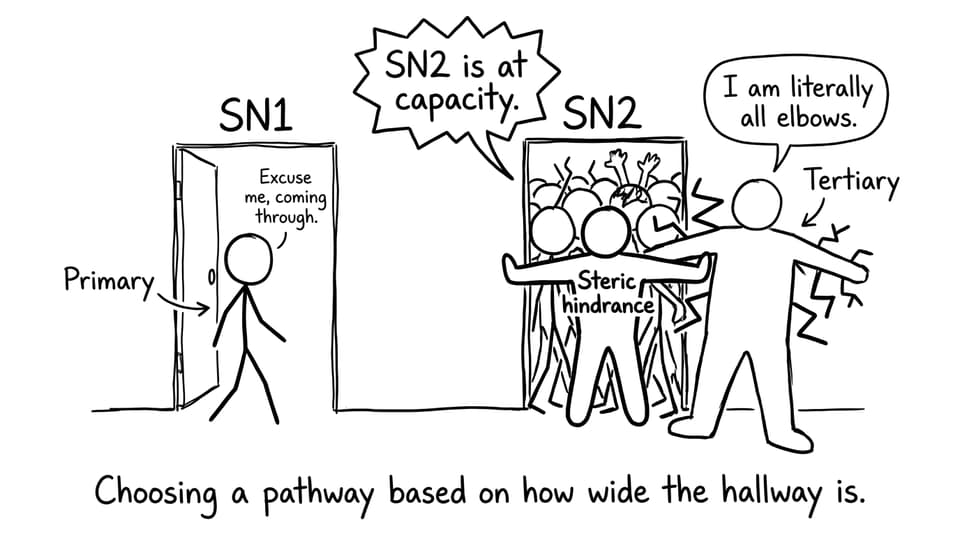
The key phrase to remember for IB Chemistry is steric hindrance. If the carbon is crowded, the nucleophile can’t reach the reactive centre easily, so SN2 becomes less likely.
For HL mechanism detail and stereochemistry, see IB Chemistry R3.4.9 SN1 and SN2 Mechanisms Notes.
SN1 in IB Chemistry: two steps, a risky intermediate
SN1 is unimolecular nucleophilic substitution. It’s slower to explain but sometimes easier to spot:
-
Two-step mechanism
-
First step forms a carbocation intermediate
-
Favoured by tertiary halogenoalkanes (more stable carbocations)
-
Nucleophile can attack from either side of the planar carbocation
-
Rate depends on one species
Rate law (SN1):
Rate = k[halogenoalkane]
The exam takeaway in IB Chemistry is that carbocation stability and steric hindrance point in the same direction: tertiary substrates resist SN2 and support SN1.
You can consolidate the whole “mechanisms of chemical change” unit using IB Chemistry R3.4 Electron-pair Sharing Reactions.
Solvents: the quiet factor that changes everything
Solvent choice is a classic IB Chemistry lever because it changes what gets stabilised.
-
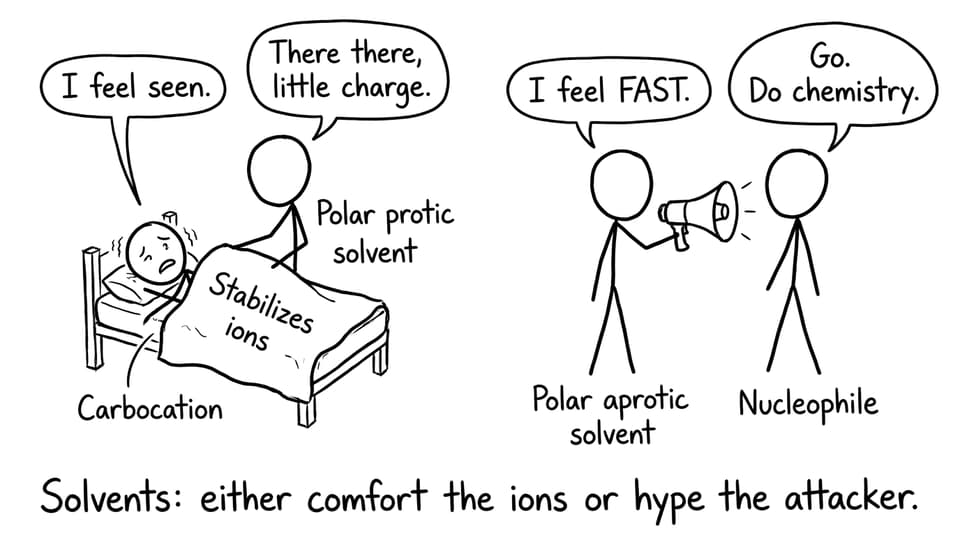
Polar protic solvents (like water, alcohols) stabilise ions well and can stabilise the carbocation and leaving group, often favouring SN1.
-
Polar aprotic solvents (like acetone, DMSO) don’t hydrogen-bond strongly to anions, so nucleophiles stay “naked” and reactive, often favouring SN2.
In other words: some solvents comfort charges; others hype the attacker.
To connect substitution to the wider organic toolkit, scan 20.1 Types of organic reactions Notes.
How to revise nucleophilic substitution with RevisionDojo
The fastest improvement in IB Chemistry usually comes from turning “I understand it” into “I can do it under time pressure.” RevisionDojo is built for that:
-
Use the Questionbank for mechanism and rate-law drills: R3.4.2 Questionbank and Reactivity 3 Questionbank.
-
Lock in definitions and triggers with Flashcards: Reactivity 3 Flashcards.
-
Rewatch mechanisms until they feel boring (that’s when they stick) with Videos: R3.4.2 Videos and R3.4.9 Videos.
-
Zoom out with the full topic hub: IB Chemistry Organic Chemistry.
If you get stuck mid-mechanism, RevisionDojo’s AI Chat can walk through your arrow pushing step-by-step, and the Grading tools help you spot what examiners actually reward. When exams get close, Predicted Papers, Mock Exams, and support from Tutors can turn weak topics into reliable marks.
Closing: make IB Chemistry substitution feel inevitable
Once you see nucleophilic substitution as a choice between “one crowded step” (SN2) and “two steps with a carbocation pause” (SN1), IB Chemistry questions stop feeling like surprises. They become decisions you can justify.
If you want that confidence on exam day, build repetition with RevisionDojo: start with the nucleophilic substitution Questionbank, reinforce with R3.4.2 notes, and tighten your timing with the wider Reactivity 3 practice. IB Chemistry rewards the student who can stay calm, choose a pathway, and draw it cleanly, and RevisionDojo is built to train exactly that.