

If you’ve just heard, “I want to drop IB,” your mind probably jumped ahead a year or two.
Not to tomorrow’s homework, but to University. To deadlines. To doors that might close. To the fear that one emotional sentence could rewrite your child’s future.
But here’s the quieter truth most families only learn after the panic passes: students rarely want to drop the IB because they suddenly hate learning. They want to drop it because the system they’re using to survive the workload has broken. Fix the system first. Then decide.
Below is a clear look at what changes -- academically, emotionally, and in University planning -- if your child leaves the IB Diploma, plus what you can do this week to slow things down and get leverage.
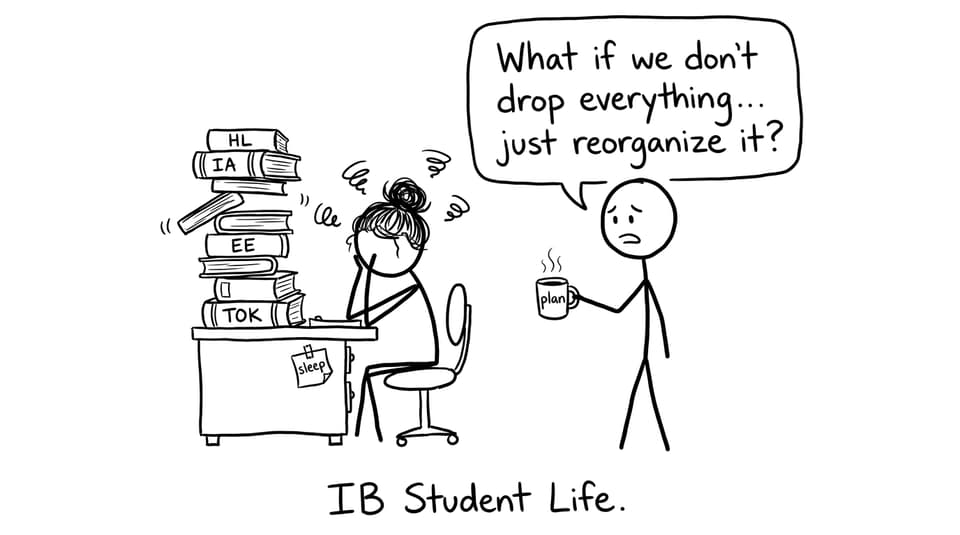
A quick consequences checklist (read this before any decision)
Use this as your “calm in a screenshot” list:
-
Confirm when they want to drop (DP1 vs DP2 changes everything).
-
Ask the school what the alternate pathway actually is (certificates, school diploma, national curriculum, AP, A-Levels).
-
Identify what’s driving the request (one subject, one teacher, one IA, sleep debt, anxiety).
-
Map the University impact (target countries, entry requirements, conditional offers).
-
Explore a “reduce load without quitting” option (HL to SL, subject support, revised timetable).
-
Create a 14-day stabilization plan (sleep, structure, small wins, realistic practice).
RevisionDojo can help on the stabilization side quickly: Study Notes for clarity, Flashcards for daily recall, Questionbank for targeted practice, AI Chat for stuck moments, and Grading tools to reduce uncertainty in written work.
Why students think about dropping IB (and what they usually mean)
Students often say “drop IB” when they mean one of these:
They’re drowning in invisible tasks
The IB workload isn’t just studying. It’s the constant switching: HL depth, Internal Assessments, Extended Essay milestones, TOK tasks, plus keeping up with six subjects. When switching costs pile up, motivation gets mislabeled as laziness.
A practical read for structure is How to Study for IB Exams: Step-by-Step Guide -- it shows the repeatable loop that turns stress into a plan.
They’re stuck in one “identity threat” subject
One HL (often Math, Chemistry, Physics, or a writing-heavy humanities) can dominate a teenager’s self-image: “If I can’t do this, I’m not smart.” In that moment, dropping feels like self-protection.
They’re exhausted, not incapable
Sleep debt can make a capable student look like they’ve lost ability. Before making a long-term decision, treat exhaustion like a variable you can change.
For burnout patterns, see How to Study for IB Exams Without Burning Out.
What happens if a student drops IB?
The consequences depend on what “dropping” means at your school. Families often assume there’s only one exit. There usually isn’t.
Switching to another program (the logistics consequence)
Many schools offer an alternative diploma or national pathway. The risk is not the alternative itself. The risk is timing and fit.
-
In DP1, switching can be cleaner.
-
In DP2, switching can be disruptive because coursework, grading policies, and subject sequences may not align.
This is where your child’s counselor or IB coordinator matters: you’re not asking, “Can we leave?” You’re asking, “What exactly do we enter, and what evidence does that create for University admissions?”
Moving from the full diploma to certificates (the credential consequence)
Some students shift from the full IB Diploma to taking individual IB courses. That can protect wellbeing while still preserving rigorous subject results.
A useful deep dive is What If My Teen Wants to Drop from Full IB to Certificates?.
University options can narrow (the strategy consequence)
This is the part parents feel in their chest.
Many University systems value the IB Diploma as a standardized signal of breadth and rigor. If your child leaves the diploma, some University options may:
-
become less straightforward (different requirements)
-
require additional documentation (school transcripts, alternate testing)
-
shift from “meets standard entry” to “admissions discretion”
It doesn’t mean your child can’t go to University. It means you need a clearer story and a clearer map.
For how offers and outcomes can change, these are helpful:
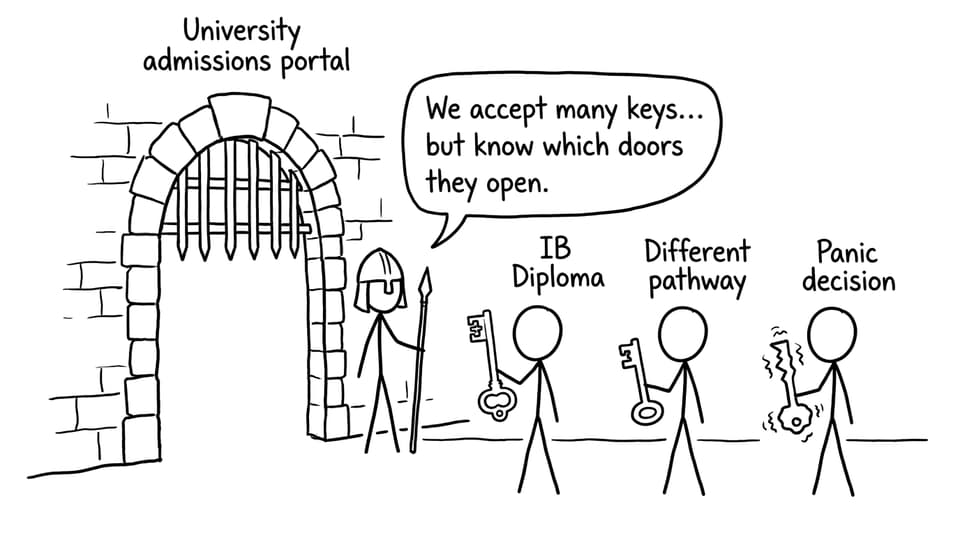
Motivation can rebound or collapse (the emotional consequence)
Dropping IB often feels like relief on Day 1.
But later, a student may ask:
-
“Did I quit too early?”
-
“Will my friends think I couldn’t handle it?”
-
“Did I damage my University chances?”
Your job is to prevent the decision becoming a story about identity. It should be a strategy choice, made with information.
When dropping IB might actually be the right choice
There are situations where leaving is sensible and responsible:
Health has become the main subject
If anxiety, depression, or chronic stress is worsening, the first priority is stabilization. A different academic pathway may be healthier.
The current program doesn’t match the University plan
If your child’s realistic University pathway is better served by another qualification in your country, the IB Diploma might be unnecessary friction.
The mismatch is broad, not local
If the struggle is across almost all subjects despite support, sleep, and tutoring, it may be a genuine fit issue.
Still, even in these cases, it’s worth exploring whether a smaller change achieves the same goal (switching levels, adding support, adjusting workload) without losing the IB structure your child has already built.
What parents can do in the next 7 days (a calm, practical plan)
Listen for the specific pain, not the dramatic headline
Ask: “If we didn’t drop IB, what would we need to change for the next two weeks to feel possible?”
Students will often name something concrete: one teacher, one IA draft, one topic, one deadline cluster.
Do a quick academic triage with evidence
This is where RevisionDojo can remove guesswork. In one week, your child can:
-
Use the Questionbank feature to target the exact topic they’re bleeding marks on.
-
Use IB Question Bank: How to Use It Effectively to build a smarter practice loop.
-
Use AI Chat to clarify misconceptions fast (instead of waiting days for help).
-
Use Flashcards for daily recall so confidence returns through repetition.
Evidence changes emotions. A short set of focused questions marked accurately is more calming than an hour of worried conversation.
Replace vague revision with a realistic schedule
A schedule shouldn’t be motivational. It should be executable.
Two good references:
Add one “rehearsal” per week
Students panic when the exam feels like a mysterious event.
RevisionDojo’s Mock Exams and Predicted Papers reduce that mystery by making timed practice normal.
Start here: IB Predicted Papers by IB Examiners (Free).
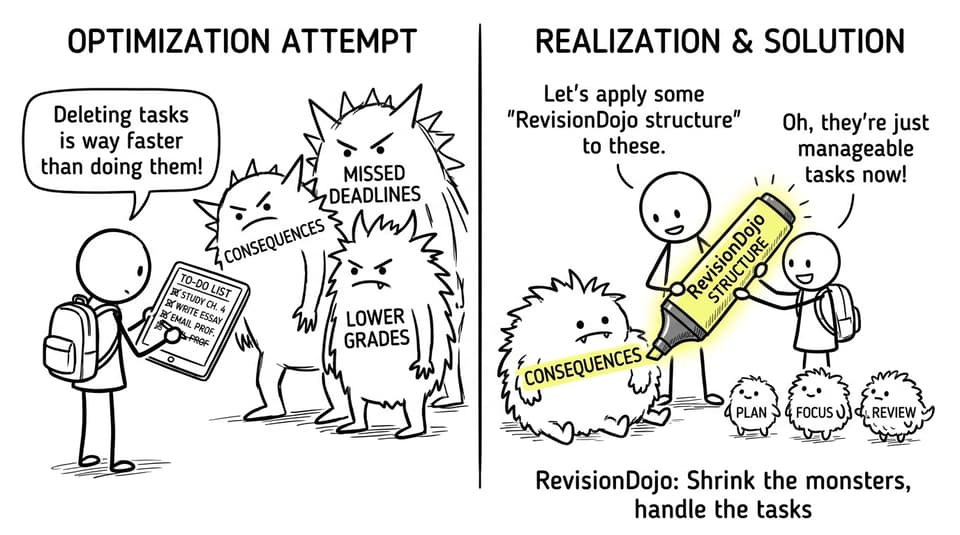
Closing: protect wellbeing, but don’t trade it for panic
When your child says they want to drop IB, it can feel like the ground moved under your family. But the decision is rarely “IB or nothing.” It’s usually “panic or plan.”
If you slow the conversation down and build a two-week structure, you can often protect both wellbeing and University options. That structure is exactly what RevisionDojo is built to provide: a focused Questionbank, clear Study Notes, fast AI Chat, daily Flashcards, examiner-aligned Grading tools, plus Predicted Papers, Mock Exams, a Coursework Library, and Tutors when you need human strategy.
If your next step is simple, make it this: choose one subject causing the most stress, run a targeted Questionbank set tonight, and let your child see proof that the problem is specific, solvable, and not the same thing as their future University path.