

A spectrophotometer is the kind of machine that looks calm until you sit an IB Chemistry exam and suddenly realise it’s been quietly judging your unit conversions all year.
You place a cuvette in, close the lid, and get a number: absorbance. It feels objective, almost comforting. But that number is only meaningful because of one stubborn constant that sits in the middle of your calculations: molar absorptivity.
In IB Chemistry, molar absorptivity (ε) is where light meets quantity. Understand it, and Beer--Lambert questions stop being “formula roulette” and start becoming predictable.
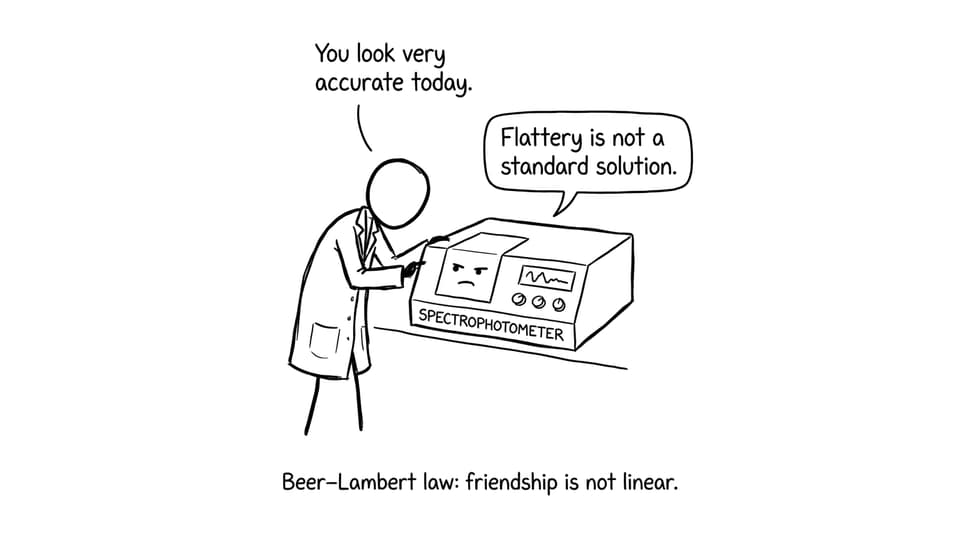
Molar absorptivity in IB Chemistry (your quick checklist)
Before you do any maths, keep this IB Chemistry checklist in mind:
-
Beer--Lambert law: (A = \varepsilon c l)
-
Absorbance (A) is unitless
-
Path length (l) is usually 1 cm (standard cuvette)
-
ε depends on wavelength (so use λmax when told)
-
ε can shift with pH, solvent, and temperature
If you want extra practice for the exact style of questions that test this, the IB Chemistry Questionbank is built for rapid repetition under exam conditions.
What is molar absorptivity (ε)?
Molar absorptivity (ε) is a constant that tells you how strongly a substance absorbs light at a specific wavelength. In IB Chemistry, it appears most often in spectrophotometry and calibration-curve problems.
It sits inside Beer--Lambert law:
[
A = \varepsilon c l
]
Where:
-
A = absorbance
-
ε = molar absorptivity
-
c = concentration (mol L⁻¹)
-
l = path length (cm)
Conceptually, ε is like the “attention-grabbing power” of a molecule at that wavelength. A larger ε means the molecule blocks more light even when the solution is dilute.
For a broader refresher on the whole relationship, read IB Chemistry: Beer--Lambert Law, Explained Simply.
Units of molar absorptivity (and why they look weird)
In IB Chemistry, you’ll typically see:
ε units = L mol⁻¹ cm⁻¹
This is not random. It’s what makes the equation work:
-
(c) is in mol L⁻¹
-
(l) is in cm
-
(A) is unitless
So ε must “cancel” those concentration and length units.
If you ever feel unsure about units, the IB Chemistry glossary is a quick way to reset the basics without losing time.
What molar absorptivity tells you (the three exam meanings)
Sensitivity: how strong the absorption is
High ε means:
-
strong absorption at that wavelength
-
small concentration changes produce noticeable absorbance changes
Low ε means:
-
weak absorption
-
you may need higher concentrations to get measurable absorbance
That’s why two solutions with the same concentration can look completely different in colour intensity. In IB Chemistry, examiners love this because it tests whether you understand ε is part of the story, not just c.
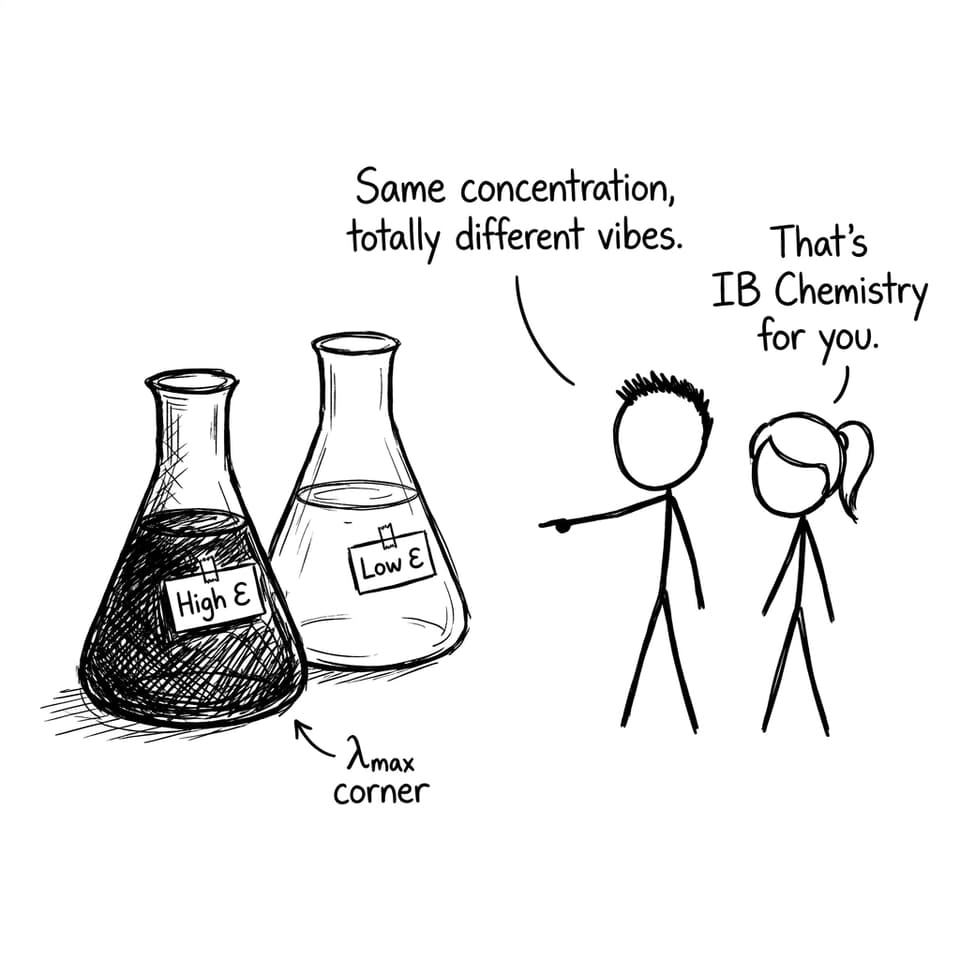
Wavelength choice: why λmax matters
Each substance has a wavelength where absorption peaks: λmax.
At λmax:
-
ε is at its maximum
-
measurements become more sensitive
-
uncertainty tends to matter less because the signal is stronger
So when an IB Chemistry question mentions scanning wavelengths or selecting a filter, the quiet goal is usually: measure at λmax.
Practical analysability: whether spectrophotometry is a good method
Compounds with high ε values are easier to analyse quantitatively. Low ε values may push you toward:
-
using a different wavelength
-
forming a coloured complex (ligand/complexing agent)
-
using more sensitive instrumentation
Why ε matters inside Beer--Lambert law
Beer--Lambert law is a proportionality promise: under the right conditions, absorbance increases linearly with concentration.
But in IB Chemistry, ε is what decides the steepness of that relationship.
If two substances have different ε values, their calibration curves have different gradients. So “high absorbance” does not automatically mean “high concentration” unless ε and l are controlled.
When you’re writing evaluation points, it helps to mention method control like calibration. This pairs well with IB Chemistry: Why Calibration Improves Accuracy.
Factors that change molar absorptivity (yes, it’s a ‘constant’ with conditions)
In exam language, ε is treated as constant for a fixed wavelength and defined conditions. But conceptually, it can change when:
-
Wavelength changes (the biggest factor)
-
pH changes (protonation can alter electronic structure and shift λmax)
-
Solvent polarity changes (affects electronic transitions)
-
Temperature changes (usually smaller, but not zero)
The pH angle shows up in lab-based questions and coursework. If you’re doing anything involving pH-dependent colour changes, the IB Chemistry Acids and Bases hub is an efficient way to connect the theory.
Using molar absorptivity in calculations (fast exam workflow)
Finding concentration
Rearrange:
[
c = \frac{A}{\varepsilon l}
]
If (l = 1,\text{cm}), then:
[
c = \frac{A}{\varepsilon}
]
This is a classic IB Chemistry move: spot the standard cuvette and simplify cleanly.
Predicting absorbance
[
A = \varepsilon c l
]
Useful for checking whether a value is sensible, or for sketching what a calibration curve should look like.

Common IB Chemistry misunderstandings
-
“ε is the same at all wavelengths.” No. ε is tied to wavelength, which is why λmax is emphasised.
-
“High absorbance means high concentration.” Only if ε and l are constant and the method stays in the linear range.
-
“Absorbance has units.” Absorbance is unitless; ε carries the units.
-
“ε depends on path length.” Absorbance depends on path length. ε is a property of the substance at that wavelength.
Bringing it home: make ε your advantage
Molar absorptivity is not just another constant to memorise for IB Chemistry. It’s the reason spectrophotometry can turn light into concentration, and the reason exam questions sometimes feel tricky when they quietly swap wavelength or conditions.
If you want this to feel automatic, build a short loop: learn the idea in notes, drill it in questions, then check your reasoning against mark-scheme language. RevisionDojo makes that loop simple with Study Notes, Flashcards, the Questionbank, AI Chat for fast clarification, and Grading tools to tighten exam phrasing. When you’re ready to pressure-test the skill, use Mock Exams and Predicted Papers (and if you need personal guidance, RevisionDojo’s Tutors and Coursework Library help you connect the maths to real lab thinking).
For a deeper read on this exact topic, you can also review Molar Absorptivity Explained and keep reinforcing the Beer--Lambert foundation in IB Chemistry as exam day gets closer.