

If you have ever put a cuvette into a colorimeter and felt your brain quietly power down, you are not alone. In IB Chemistry, the Beer--Lambert law is one of those ideas that looks like a neat one-line equation but behaves like a whole topic once exam questions start adding graphs, uncertainties, and “explain why” prompts.
Here is the calm truth: the Beer--Lambert law is simply a promise about proportionality. When the conditions are right, you can turn light into concentration. That is why it sits at the heart of quantitative analysis in IB Chemistry.
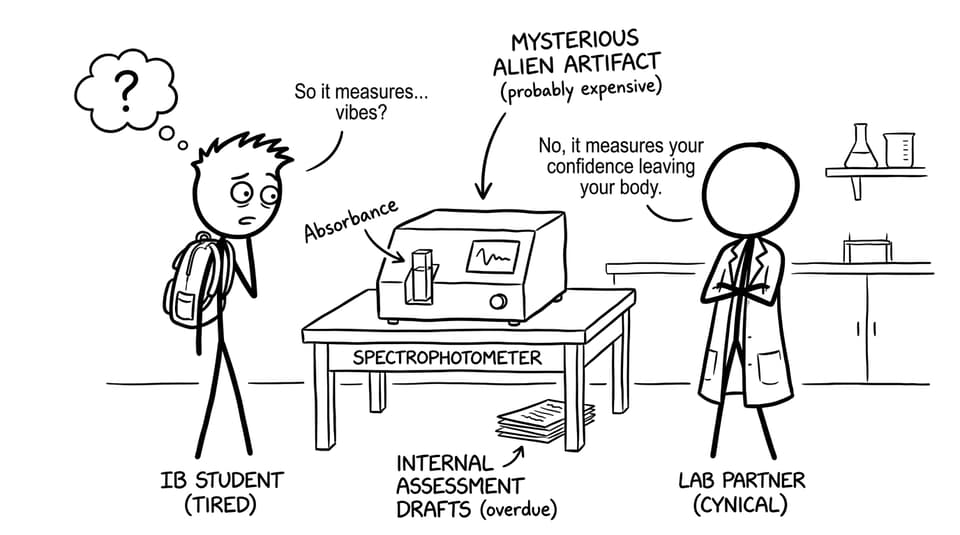
Beer--Lambert Law in IB Chemistry (the one equation that pays rent)
The Beer--Lambert law links how much light a solution absorbs to how concentrated it is and how far the light travels through it:
A = εcl
Where:
-
A = absorbance (unitless)
-
ε = molar absorptivity (L mol⁻¹ cm⁻¹)
-
c = concentration (mol L⁻¹)
-
l = path length (cm)
In IB Chemistry, that equation is basically a translation tool: darker (higher absorbance) usually means more particles in the way (higher concentration), assuming you keep the setup consistent.
If you want a full hub of syllabus-aligned support, start at IB Chemistry Resources.
Quick checklist: what to remember under exam pressure
-
Absorbance is unitless (it comes from a log ratio).
-
Beer--Lambert gives a linear relationship between A and c in suitable conditions.
-
Path length is usually fixed (commonly 1 cm cuvettes), so many questions treat A ∝ c.
-
ε depends on wavelength, so measurements should be taken at λmax.
-
Calibration curves are your bridge from absorbance to unknown concentration.
For the data-processing side of IB Chemistry, RevisionDojo’s 2.2 Data analysis guidance helps you present graphs and uncertainty work in a way examiners actually reward.
What absorbance actually means (and why it is unitless)
Absorbance measures how much light is removed from the beam as it passes through a sample. Conceptually, it compares incident intensity (I₀) to transmitted intensity (I). Because that comparison uses a logarithm, absorbance has no units.
In practical IB Chemistry labs, you do not need to derive the log relationship. You do need to interpret what absorbance values imply:
-
A = 0 means essentially no absorption (very clear at that wavelength).
-
Larger A means more absorption (solution appears more strongly colored at that wavelength).
Why the Beer--Lambert law works (two simple ideas)
The law is a combination of two intuitions that feel almost obvious once stated:
Concentration: more particles, more chances to absorb
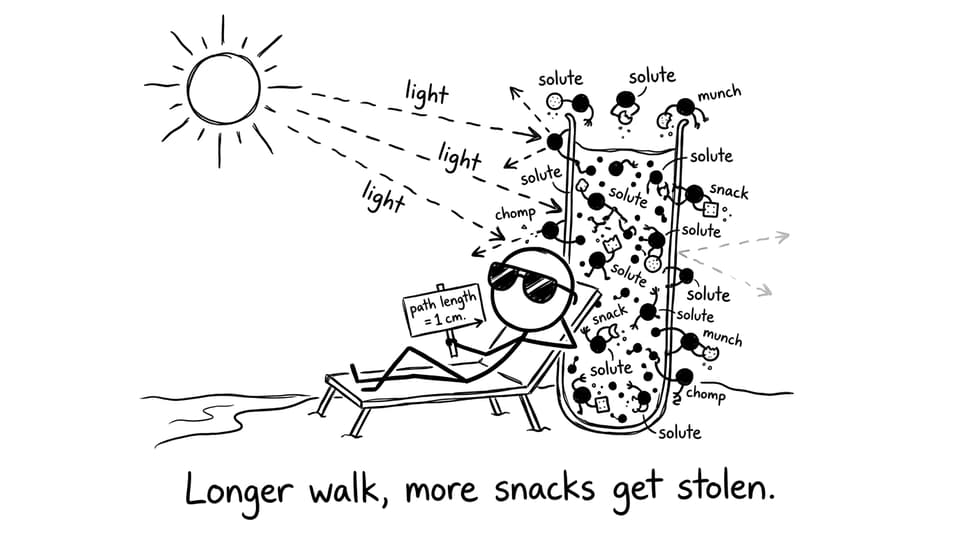
If you double the concentration, you double the number of absorbing particles in the beam path. More absorbers means more light removed.
Path length: longer distance, more opportunities for absorption
If light travels through a longer path, it encounters more particles along the way (assuming the solution is uniform). That increases absorbance.
Molar absorptivity (ε): the “how strongly does it drink light?” constant
In IB Chemistry, ε is the constant that tells you how strongly a specific substance absorbs at a specific wavelength.
-
High ε: even small concentrations give noticeable absorbance.
-
Low ε: you need a higher concentration to get the same absorbance.
Because ε changes with wavelength, you choose λmax (the wavelength of maximum absorbance) to make the method more sensitive and reduce relative uncertainty.
A useful companion resource for formulas and constants is the Chemistry Data Booklet.
How IB Chemistry uses Beer--Lambert: calibration curves and unknowns
Most exam and IA-style applications follow the same rhythm:
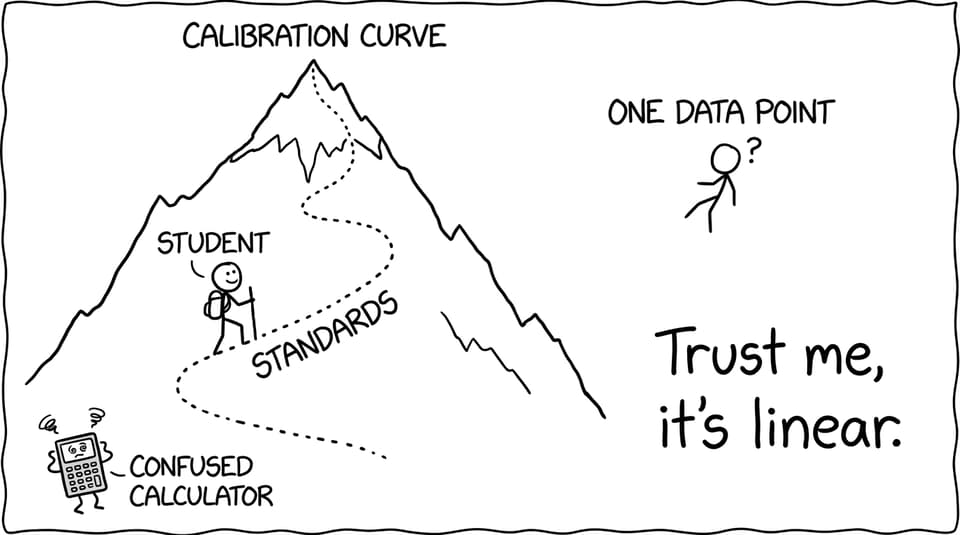
Build a calibration curve
-
Make several standard solutions with known concentrations.
-
Measure absorbance at λmax.
-
Plot absorbance (y) vs concentration (x).
-
Draw a best-fit line (often linear in the valid range).
Then, for an unknown:
-
Measure its absorbance.
-
Read across to the line and down to find concentration (or use the line equation).
This is also why calibration matters beyond just “good lab practice.” If you want the bigger measurement logic, read Why Do Chemists Use Calibration To Improve Measurement Accuracy.
And if your graphing and tables are losing marks, 10 Best Practices to Write Up Data and Results in Your IB IA is a practical reset.
Limitations examiners love to test
Beer--Lambert behaves beautifully until it does not. Common reasons it fails (and common IB Chemistry markscheme points):
-
Too concentrated: particles interact; the relationship stops being linear.
-
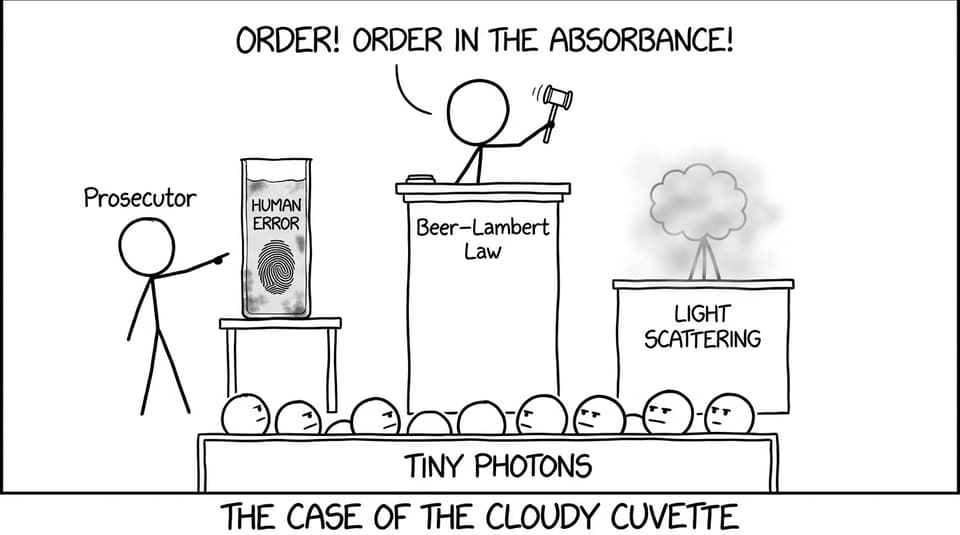
Cloudy samples: light scattering fakes extra “absorbance.”
-
Wrong wavelength: not using λmax reduces sensitivity and can distort linearity.
-
Dirty cuvettes: fingerprints/scratches absorb or scatter light.
-
Instrument instability: drifting intensity changes readings.
For uncertainty language that matches IB expectations, see 11.1 Uncertainties and errors in measurement and results and the explainer Why Do Chemists Use Significant Figures To Report Measurements.
Closing: turn light into marks with RevisionDojo
Beer--Lambert is one of those IB Chemistry ideas that rewards clarity: keep the wavelength consistent, respect the linear range, and treat your calibration curve like a piece of evidence, not decoration. Once that clicks, concentration questions stop feeling like guesswork and start feeling like translation.
When you are ready to practise it properly, RevisionDojo is built for this exact moment: use the Study Notes to lock the concept, the Flashcards for quick recall, and the Questionbank (with AI Chat explanations) to drill the common traps. Then level up with Mock Exams, Predicted Papers, and Grading tools to see how examiners reward your method and phrasing. If you are working on lab write-ups, the Coursework Library and Tutors make the “data processing” part of IB Chemistry feel far less mysterious.
Keep the law simple: A = εcl. Then use practice to make it automatic.