London dispersion forces have an unfair reputation. They sound like an optional detail, the kind of thing you skim because it’s “weak” and your brain is saving energy for enthalpy cycles.
But in IB Chemistry, London dispersion forces are the quiet rule that keeps showing up in the loudest places: boiling point trends, why iodine is solid, why noble gases can become liquids, and why branched molecules act like they’re allergic to sticking together.
If you’re preparing for exams, this is one of those topics where a simple, precise explanation scores marks quickly. And once it clicks, you’ll see London dispersion forces everywhere.
London dispersion forces in IB Chemistry: a fast checklist
Use this checklist to keep your IB Chemistry explanation tight:
-
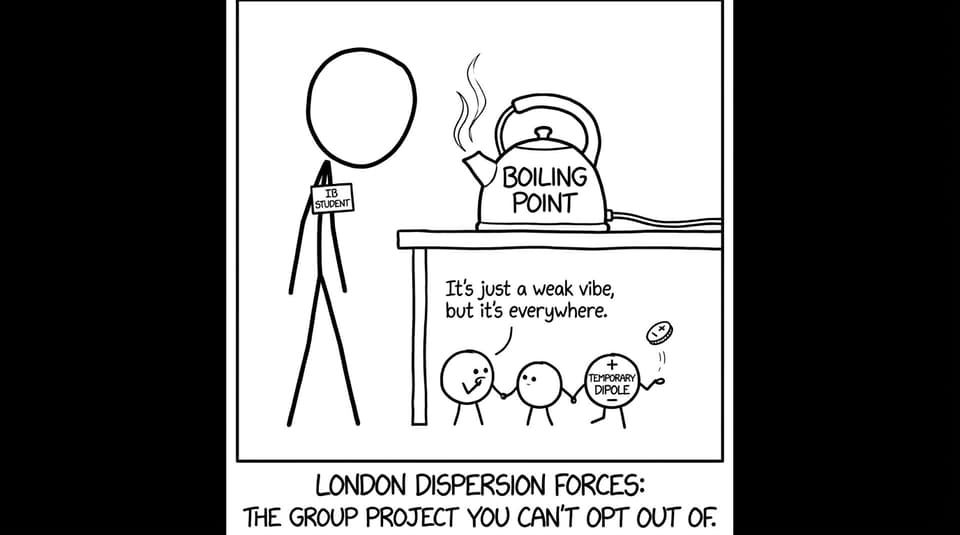
London dispersion forces (LDFs) come from temporary dipoles.
-
Temporary dipoles form because electrons move randomly.
-
LDFs exist in all particles (atoms and molecules), including nonpolar ones.
-
Strength increases with more electrons and more polarizable electron clouds.
-
Strength also increases with greater surface area contact (less branching, more linear shapes).
-
LDFs mainly explain physical properties (boiling point, melting point, volatility, viscosity), not chemical reactivity.
For the broader picture, pair this with RevisionDojo’s overview: Intermolecular Forces Explained.
What are London dispersion forces?
In IB Chemistry, London dispersion forces are defined as weak intermolecular attractions caused by momentary fluctuations in electron density that create temporary dipoles.
Here’s the mental movie:
Electrons never sit still. For an instant, they can be slightly more concentrated on one side of an atom or molecule. That uneven distribution creates a temporary dipole: one side is a little more negative, the other a little more positive. A nearby particle “feels” that imbalance, its electrons shift in response (an induced dipole), and the two attract for a moment.
Then it disappears. Then it happens again. Constantly.
This is why London dispersion forces are universal in IB Chemistry: even perfectly nonpolar molecules still have moving electrons.
If you want exam-ready phrasing, RevisionDojo’s terminology helps: IB Chemistry Key Definitions.
How London dispersion forces form (without overcomplicating it)
A strong IB Chemistry answer usually includes three steps:
Random electron movement creates a temporary dipole
At any instant, an electron cloud can be asymmetrical.
A neighboring particle becomes polarized
The first temporary dipole induces a dipole in the nearby atom or molecule.
A short-lived attraction forms
Opposite partial charges attract briefly, then the pattern breaks and reforms.
That’s it. The mechanism is simple; the exam questions are about applying it.
Why London dispersion forces matter in IB Chemistry
It’s tempting to treat LDFs as “the weak one” compared with dipole-dipole forces and hydrogen bonding. Yet in IB Chemistry, they often do the heavy lifting because:
-
They are the only intermolecular force for many nonpolar substances (like alkanes, O_2, N_2).
-
They explain why boiling points increase with molar mass in many series.
-
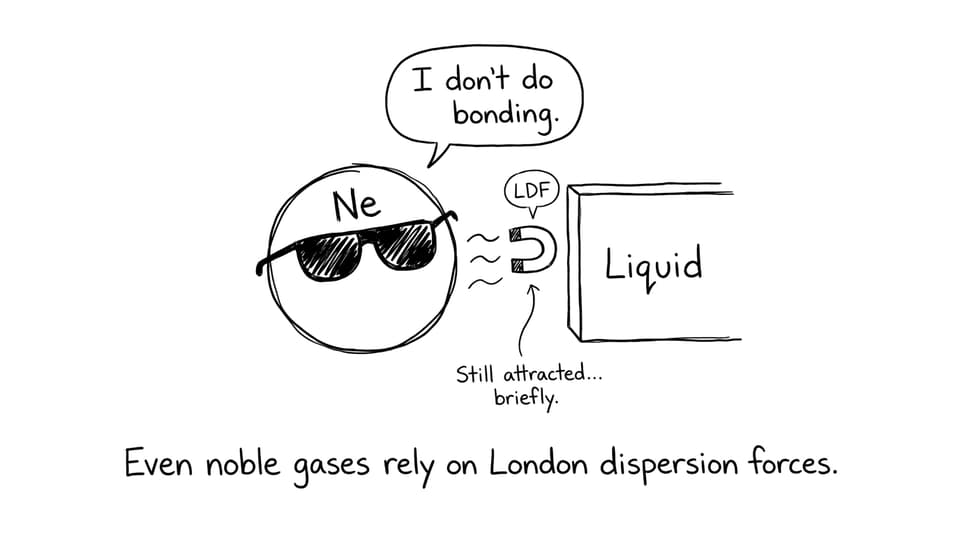
They explain why noble gases can condense (no permanent dipoles, no hydrogen bonding, yet still attractions).
If you struggle to connect forces to properties, this article clarifies the link: Why Intermolecular Forces Affect Physical Properties.
What affects the strength of London dispersion forces?
This is where IB Chemistry questions usually aim: compare substances and justify a trend.
More electrons (higher molar mass) usually means stronger London dispersion forces
More electrons create a larger, more deformable electron cloud. Polarizability increases, so temporary dipoles are more likely and more intense.
Classic examples you can mention:
-
He has extremely weak LDFs, so it stays a gas unless very cold.
-
I_2 has many electrons and strong LDFs, so it’s a solid at room temperature.
Bigger, more polarizable electron clouds strengthen London dispersion forces
“Polarizable” means the electron cloud is easier to distort. In IB Chemistry, that word often appears in markschemes.
Molecular shape matters: surface area contact
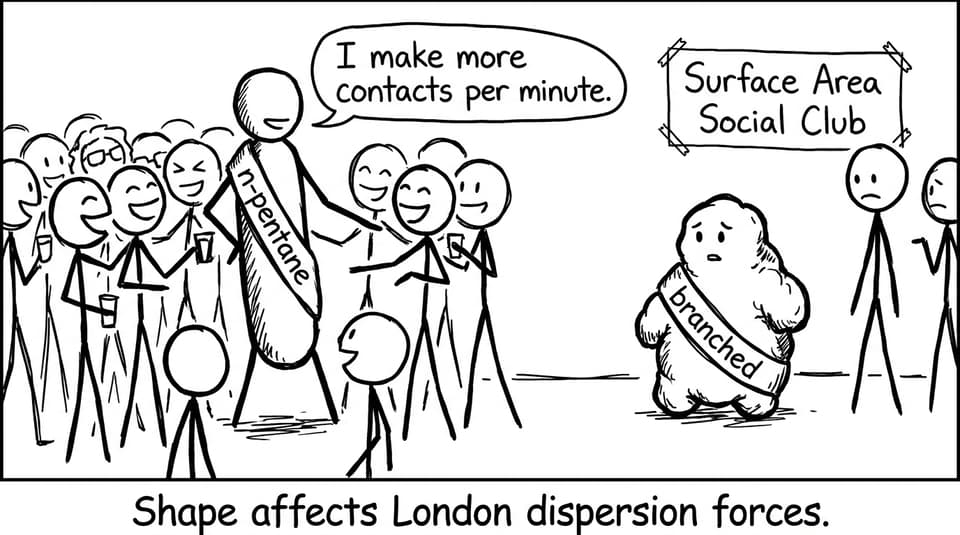
Two molecules can have the same formula but different boiling points because they touch differently.
Long, less-branched molecules have greater surface area contact between molecules, allowing stronger London dispersion forces overall.
If you want a syllabus-aligned place to revise shape trends, RevisionDojo connects it directly to organic trends: Physical Trends in Homologous Series Notes.
Quick comparisons: London dispersion vs other intermolecular forces
In IB Chemistry, comparisons earn marks when they’re specific:
-
London dispersion forces vs dipole-dipole: LDFs rely on temporary dipoles; dipole-dipole relies on permanent dipoles.
-
London dispersion forces vs hydrogen bonding: hydrogen bonding is a strong, specific case requiring H bonded to N, O, or F.
-
Intermolecular vs intramolecular: LDFs are between particles; covalent/ionic/metallic bonds are within structures and are far stronger.
Exam tactics: how London dispersion forces show up
If you’re revising IB Chemistry, train yourself to spot these prompts:
-
“Explain the trend in boiling points down a group” (more electrons = stronger London dispersion forces).
-
“Which isomer has the higher boiling point?” (less branched = more surface area = stronger London dispersion forces).
-
“Identify the intermolecular forces present” (even polar molecules still have London dispersion forces).
For targeted practice, use RevisionDojo’s syllabus topic hub: S2.2.8 Intermolecular Forces. Then reinforce recall with Intermolecular Forces Flashcards.
Wrap-up: make London dispersion forces your easy marks
London dispersion forces may be the weakest intermolecular force, but in IB Chemistry they are the most unavoidable. They explain why nonpolar molecules still attract, why boiling points climb with size, and why molecular shape can quietly flip a data trend.
If you want to turn this into exam performance, RevisionDojo is built for that: revise the theory with Topic 4.4 Intermolecular Forces, drill it using the Questionbank and Mock Exams, lock in definitions with Flashcards and Study Notes, and use AI Chat and Grading tools to fix weak explanations before they cost you marks. When you’re ready for full exam rehearsal, RevisionDojo’s Chemistry Predicted Papers help you practise under realistic conditions.
In other words: learn London dispersion forces once, then let them pay you back across the syllabus.



