
The question every tired student asks: is IB basically college?
There is a particular moment in the IB where the question stops being academic.
It is 11:43 p.m. You are toggling between a lab write-up, a TOK prompt you swear was designed to cause existential doubt, and an essay plan that keeps growing teeth. You look at your calendar and realize the next deadline is not the last deadline. It is simply the next wave.
So you ask the most reasonable question you have asked all week: is the IB equivalent to college?
The honest answer is: IB is not college. But parts of IB can feel like college-level learning, especially in HL subjects and in the Core. If you understand why it feels that way, you can prepare more calmly and score higher.
Quick checklist: how IB compares to college
Use this snapshot when you are trying to get your bearings:
-
IB is a high school diploma programme (typically ages 16-19), not a university degree.
-
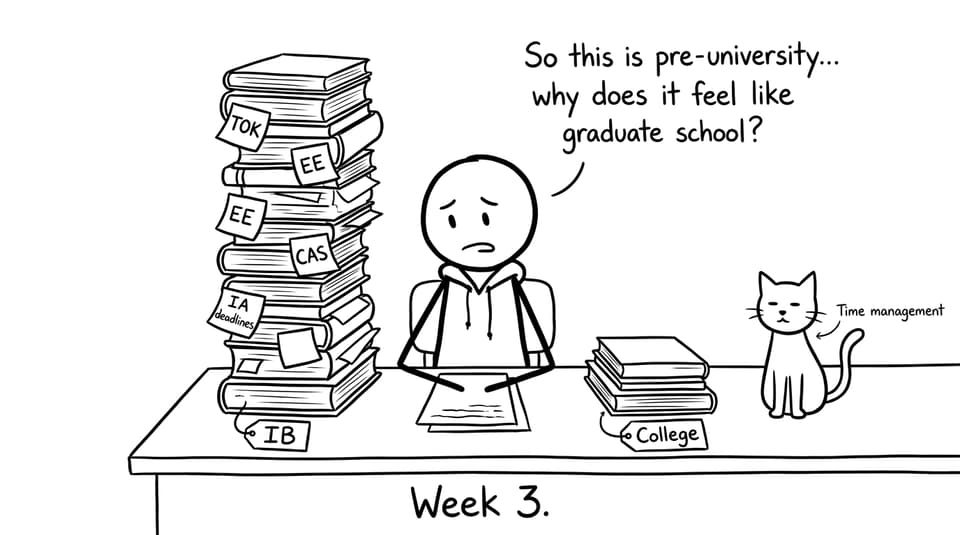
IB workload can rival first-year college, because many tasks run in parallel (IAs, Core, topic tests, exam prep).
-
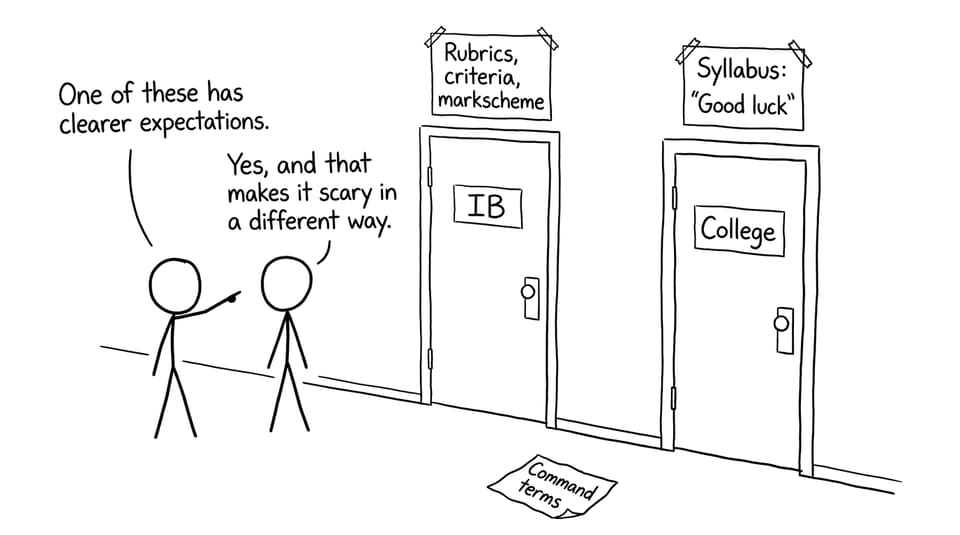
IB grading is standardized with clear criteria, while college grading varies by course and professor.
-
IB builds college-ready skills: research, argumentation, time management, and independent study.
-
IB can earn university credit or advanced standing at many institutions, usually based on HL scores (policies vary).
If you want a single hub that organizes everything you do next, start with RevisionDojo for IB.
What the IB actually is (and why it feels bigger than “just school”)
The International Baccalaureate (IB) Diploma Programme is a two-year, pre-university curriculum. The key word is pre-university, and it is designed to bridge the gap between high school structure and university expectations.
What makes IB emotionally intense is not one hard chapter. It is the combination of depth, breadth, and simultaneous responsibility.
The Core: TOK, EE, CAS (the hidden reason IB feels like college)
Most students expect HL difficulty. Fewer expect the Core to change how they think.
-
TOK trains you to argue about knowledge itself, the way a college seminar expects you to speak, not just answer.
-
EE teaches research independence: choosing a question, finding sources, building a line of reasoning, and staying honest with citations.
-
CAS builds reflection and initiative, the kind universities love to talk about but rarely teach explicitly.
Those pieces are why the IB can feel like you are living three academic lives at once.
Academic comparison: where IB matches college (and where it doesn’t)
Rigor and thinking style
In many subjects, IB rewards college-style thinking: analyzing evidence, evaluating claims, and writing with precision. HL courses, in particular, often resemble the intellectual expectations of introductory university courses.
But there is a twist. College often tests fewer things at once, while IB tests many things simultaneously. That means IB can feel harder, even if the content is not always more advanced.
If you want to turn that rigor into marks, build practice around exam-style questions early via the RevisionDojo Questionbank and pair it with targeted concept refreshers from Study Notes.
Breadth vs specialization
College tends to narrow toward a major after general requirements. IB does the opposite: it forces breadth while demanding depth in selected HL subjects.
This breadth is not a personality test. It is training. In college, the hardest part is often switching contexts: economics to writing to lab to discussion section. IB makes that switching normal.
Workload and deadlines
The classic college workload has fewer checkpoints but higher autonomy. The classic IB workload has more checkpoints and more overlap.
Many students say the IB workload matches or exceeds first-year college because:
-
IAs are running while content is still being taught
-
EE and TOK have long lead times
-
final exam prep needs repetition, not cramming
To avoid feeling constantly behind, borrow a strategy top scorers use: a weekly loop of short recall + targeted practice + timed exposure. You can see that rhythm clearly in How to Study for IB Exams: Step-by-Step Guide.
University credit: can IB “count” as college?
The simplest way to say it: IB can translate into credit, placement, or advanced standing, but it does not replace a degree.
Many universities worldwide recognize IB results, often giving credit for strong HL scores (commonly 5+), though every institution sets its own rules. Some schools grant credit that lets you skip introductory courses; others grant elective credit; some grant neither but still value IB for admissions.
Two important reality checks:
-
Policies vary dramatically by country, university, and department.
-
Credit is not always exemption: sometimes you get units, but still need a prerequisite for your major.
Treat university credit like a bonus. Your main win is what IB makes you capable of doing under pressure.
Preparation tips: how to make IB feel less like survival
The goal is not to study “harder.” The goal is to study in a way that matches how IB awards marks.
Use the “understand, then recall, then perform” loop
Most IB stress comes from confusing familiarity with performance. The loop below fixes that.
-
Understand with RevisionDojo Study Notes
-
Recall daily with IB Flashcards (SRS) or the Flashcards feature
-
Perform using the Questionbank, then review mistakes like data
If you only change one habit, change this: stop ending study sessions with reading. End them with retrieval.
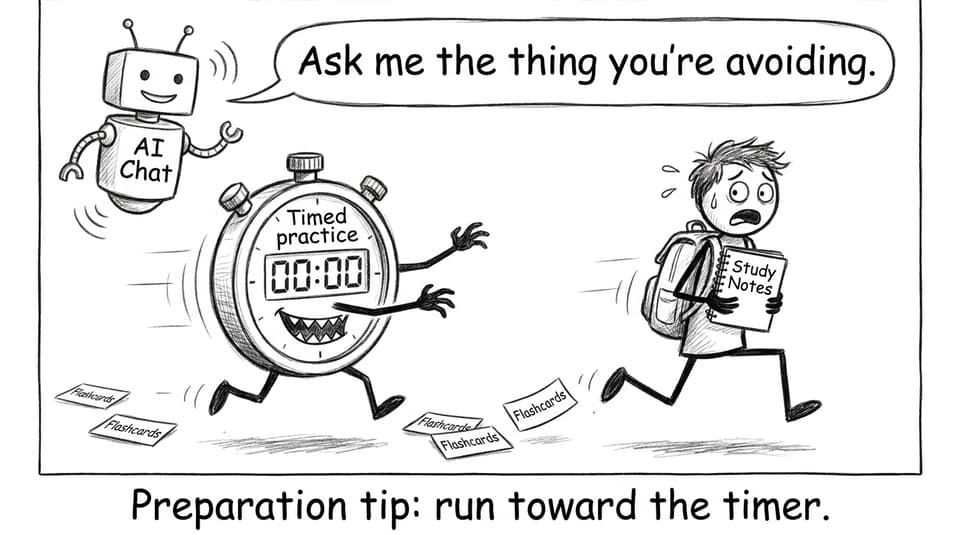
Start timed practice earlier than you want to
College exams often punish poor pacing. IB does too, but it also punishes answers that ignore command terms. Timed practice is where you learn both.
To add realism, schedule weekly full-paper simulations with IB Predicted Papers. If you are unsure how to use them strategically, the best explanation is IB Predicted vs Specimen Papers: What They Mean.
Build feedback into the same day
In college, you might wait weeks for feedback. In IB, improvement is faster when feedback is immediate and specific.
RevisionDojo supports that with AI Chat, Grading tools, and progress tracking, so your practice actually changes what you do next. And when your motivation dips, reading how others structured their training helps: How 45-Point IB Students Prepare for Exams.
Protect exam-season energy like it is part of the syllabus
Your brain is a battery. IB revision is long. If you treat sleep as optional, your accuracy drops first, then your confidence.
For a calm, realistic structure across the final stretch, keep this bookmarked: IB Exam Week-by-Week Survival Guide.
Closing: IB isn’t college, but it is college preparation done on purpose
If you are asking whether IB is equivalent to college, you are noticing something real: the programme trains you to think, write, and manage your time like a university student. IB is not a degree, but it is a rehearsal for one, and rehearsals can be intense when you take them seriously.
The good news is that IB becomes dramatically more manageable when your prep is structured: daily Flashcards, targeted Questionbank sessions, fast concept patching with Study Notes, and weekly timed practice using Predicted Papers and Mock Exams. RevisionDojo was built to keep that entire loop in one place, with AI Chat, Grading tools, a Coursework Library, and Tutors when you need a human guide.
If you want your next month of IB prep to feel calmer and more effective, start here: RevisionDojo for IB.