
If you’ve ever stared at a deadline calendar packed with IA drafts, TOK paragraphs, and revision targets and thought, “Is the IB a scam?”, you’re not alone.
It’s a strangely rational question when you’re tired. When you’ve paid exam fees. When you’ve watched friends in other systems finish their homework while you’re still untangling command terms and trying to remember whether you promised CAS hours to your future self.
But the word “scam” is doing a lot of emotional heavy lifting. Most of the time, what students mean is simpler: Is this much effort fair? Is the payoff real? Or am I being sold a story? This post gives you an honest breakdown of the myths, the facts, and the student truths about the IB, especially if you’re an IB student preparing for exams.
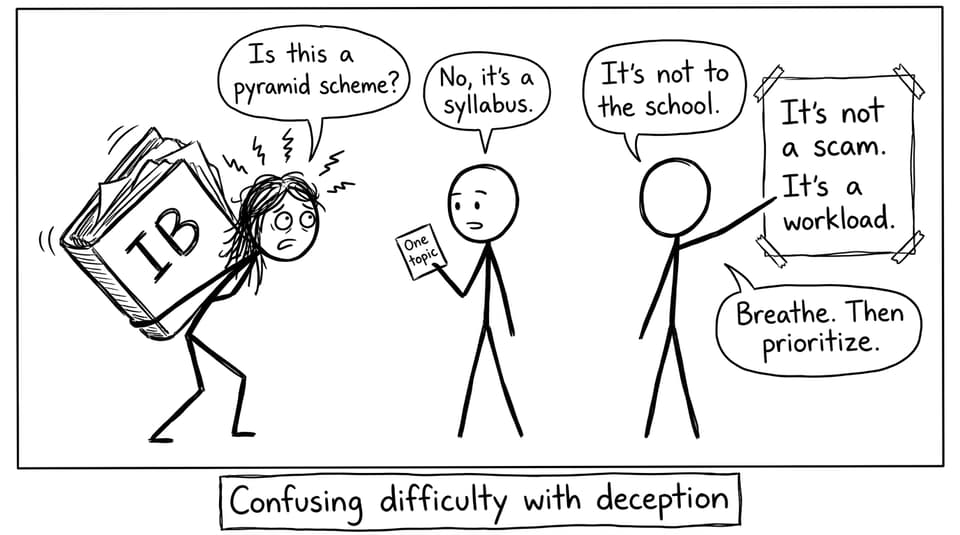
The quick checklist: scam or just hard?
Before we go deeper, here’s a fast way to sanity-check the “IB is a scam” feeling:
-
Are you overwhelmed because the workload is real, or because your system is missing?
-
Do you understand how marks are awarded, or are you revising without feedback?
-
Are you comparing your stress to someone doing a different program with different goals?
-
Are you using resources that match how the IB actually examines?
If those questions sting a little, good. That sting usually means the problem is solvable.
What the IB actually is (and what it isn’t)
The IB (International Baccalaureate) is a nonprofit educational foundation founded in 1968. Its flagship is the Diploma Programme for ages 16-19, built around six subjects plus the core: Extended Essay (EE), Theory of Knowledge (TOK), and CAS.
Whatever you think of the experience, the IB isn’t a shady pop-up qualification. It’s taught in thousands of schools globally and is widely recognized by universities, ministries of education, and scholarship programs. That recognition doesn’t mean every policy is perfect or every student experience is healthy. It means the structure is real, consistent, and externally assessed.
If you want to zoom out on what RevisionDojo covers across the IB, start at the RevisionDojo IB hub or the broader RevisionDojo for IB landing page.
Why people call the IB a “scam” (the honest reasons)
Students don’t invent the scam narrative for fun. The feeling usually comes from three real frictions.
The workload is heavy (and it stacks)
The IB is not hard because every individual task is impossible. It’s hard because everything arrives at once, and the program rewards consistency more than heroics.
Six subjects means six streams of content. Add coursework deadlines, then add the core, and suddenly you’re not just learning; you’re producing.
The scam feeling appears when you treat this like a normal school schedule where you can “try harder later.” In the IB, later has interest.
Credit recognition can feel inconsistent
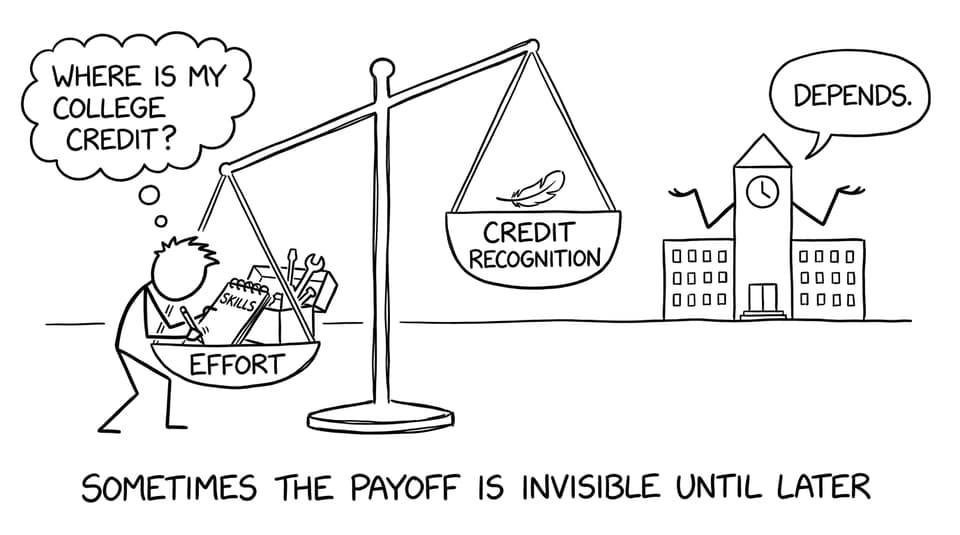
Some universities grant credit or advanced standing for Higher Level scores. Others are conservative, especially depending on country, faculty, and course alignment. So a student may grind through HL content and still sit introductory university classes.
That mismatch creates resentment: I paid in effort. Where’s my receipt?
The cost can be real
Schools pay authorization costs and training fees to offer the IB, and students often pay exam registration fees. In regions without strong funding, IB can feel less accessible, and that can understandably read as elitist.
The uncomfortable truth: something can be legitimate and still be expensive. Both can be true.
Myths vs facts: where the scam story breaks
Myth: “IB is only for elite schools”
Fact: The IB exists in private and public systems worldwide. The distribution isn’t perfectly equal (few education systems are), but it’s not a private-club curriculum by design.
The stronger argument is not “elite,” but “resource-dependent.” A well-run IB school has trained teachers, aligned assessment practices, and support structures. A poorly run IB school can make the exact same program feel chaotic.
Myth: “IB is all suffering, no reward”
Fact: The IB can build genuine, transferable skills: academic writing, argument structure, time management, and the ability to perform under pressure.
Those sound like boring promises until you reach university and realize many students are learning those skills for the first time.
Myth: “IB doesn’t help with admissions”
Fact: Many admissions teams understand the demands of the IB, especially in holistic review systems. What matters is how you translate your experience into results: scores, subject fit, and evidence that you can handle first-year intensity.
The student truth nobody says out loud: the IB punishes vague effort
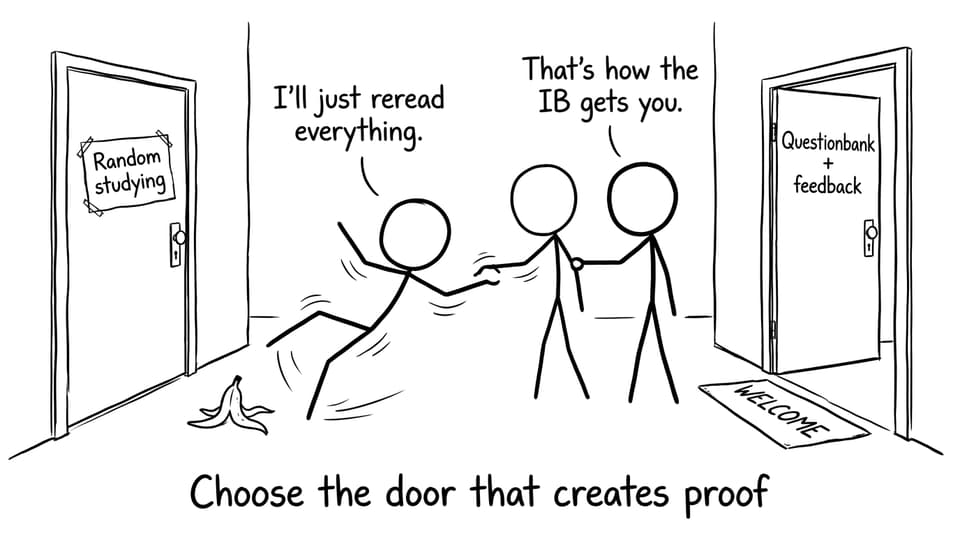
A lot of IB stress comes from doing “a lot of work” that doesn’t convert into marks.
Rewriting notes feels productive. Reading a chapter feels productive. Highlighting feels productive.
But the IB grades outputs: structured answers, correct method, relevant evidence, and command-term precision.
That’s why exam prep tends to improve when your revision loop becomes:
-
Learn the concept quickly
-
Test it immediately
-
Get feedback aligned to how the IB marks
-
Fix one repeat error
-
Repeat
RevisionDojo was built around that loop. If you’re stuck in low-return study habits, start with IB revision notes that support quick review before exams, then switch into the RevisionDojo Questionbank so your effort turns into proof.
A practical exam strategy that makes the IB feel less like a scam
When the IB feels unfair, it usually means you don’t have control. Control comes from data: timed attempts, error patterns, targeted re-drills.
Here’s a simple plan many IB students can sustain in the final stretch:
Build clarity (2 sessions/week)
Use syllabus-aligned explanations, not endless textbooks. RevisionDojo’s subject collections help you study by topic, not by chapter: IB Subject Note Collections.
Build marks (3 sessions/week)
Do exam-style practice by topic and review markscheme logic. If you need a guide to doing this properly, read IB Question Bank: How to Use It Effectively or the deeper overview IB Question Bank: Thousands of Practice Questions.
Build stamina (1 session/week)
Run a realistic timed sitting. Use IB Predicted Papers by IB Examiners when you need fresh exam-form practice written to mirror current patterns. Then do a short post-mortem: 5 mistakes max, one fix each.
If your mocks went badly, you’re still not done. The most calming read for that moment is Failed Mock Exams? You Can Still Pass IB.
The core components that trigger the most “scam” feelings
Extended Essay: it’s long, but it’s bounded
The EE is capped at 4,000 words. Words beyond that aren’t read or graded, which is both terrifying and oddly merciful.
If you’re in that final-edit spiral, use Mastering the IB Extended Essay Word Count and How to Format Your EE According to IB Guidelines to stop guessing and start complying.
TOK: it feels vague until you learn the pattern
TOK isn’t rewarded for sounding philosophical. It’s rewarded for clear claims, real examples, evaluation, and reflection.
To lock in that pattern, use IB Theory of Knowledge (TOK) Requirements Explained and the tactical breakdown How to Evaluate Different Points of View in TOK.
Conclusion: is the IB a scam?
The IB is not a scam. It’s a demanding, globally recognized program that can absolutely be mismanaged by schools, misunderstood by students, and made miserable by bad systems.
But there’s a quieter truth: once you treat the IB like a skill-based game with rules you can learn, it stops feeling like deception and starts feeling like training.
If you want that calmer, more controlled version of IB prep, build your loop inside RevisionDojo: Study Notes to get clear, Flashcards to retain, Questionbank to apply, AI Chat to unblock confusion, Grading tools to match rubric language, and Mock Exams plus Predicted Papers to rehearse reality. When you stop guessing, the scam feeling fades.