Join 650k+ students breezing through the IBReady to breeze through the IB?
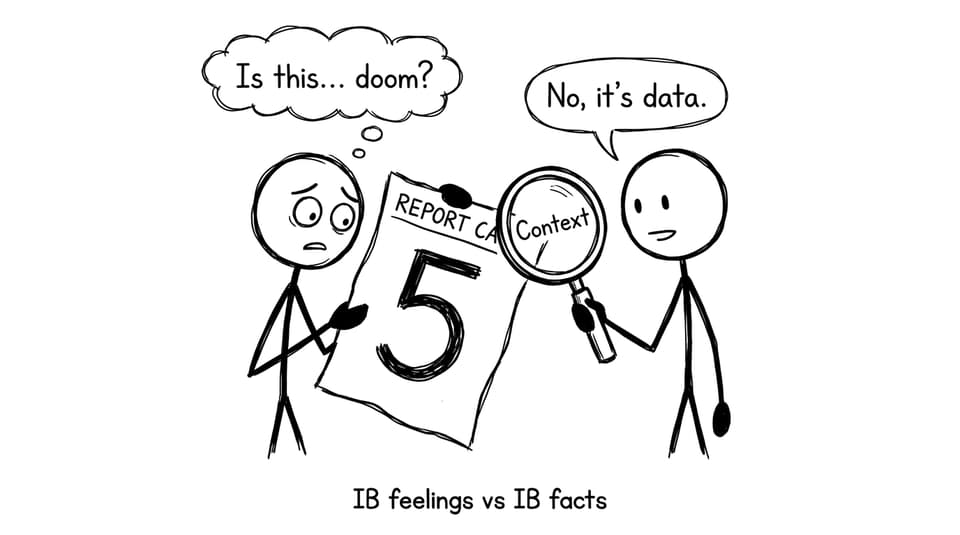
If you just got a 5 in IB, your brain probably did something unhelpful: it turned a single number into a personality trait.
A 5 can feel like “almost great” on a good day and “not enough” on a stressed day. But IB grades only make sense when you put them back into context: the 1-7 descriptors, the exam components, the subject level (HL vs SL), and what your university actually asks for.
Here’s the honest student guide: what a 5 in IB DP really means, when it’s genuinely strong, and how to turn a 5 into a 6 or 7 without burning your life down.
Student staring at a 5 while friend holds a magnifying glass labeled Context
Quick checklist: is a 5 in IB “good” for you?
Use this fast filter before you panic:
Diploma progress: A 5 supports a healthy IB total and is comfortably above “just passing.”
Global perspective: A 5 is often around the global average range (varies by subject and session).
University relevance: Is this subject central to your intended major? If yes, expectations might be higher.
HL vs SL: A 5 at HL can represent a different difficulty curve than a 5 at SL.
min read
min read
min read
min read
Your trend: Are you improving (3-4-5) or plateauing (5-5-5)?
If you want to map practice marks to likely outcomes, use the IB Grade Calculator and compare where you sit against boundaries.
Understanding the IB 1-7 grading (so the 5 stops feeling vague)
In the IB Diploma Programme, each subject is graded from 1 (lowest) to 7 (highest), based on a blend of:
external exams (papers)
internal assessments (IAs)
coursework or oral/practical components, depending on the subject
You take six subjects, so you can earn up to 42 points from subjects, plus up to 3 more from TOK and the EE, for a maximum of 45.
If you need a clean refresher on how the scale works, keep these bookmarked:
A key mindset shift for IB: your grade is not a “percentage of knowledge.” It’s a measure of how well you met criteria under timed conditions.
Is a 5 in IB a good score?
Yes, most of the time, a 5 in IB is a good score.
The official descriptor for a 5 is essentially “good performance.” And in a system designed to be demanding across many subjects at once, “good” is not faint praise.
It also often places you near (or above) typical global subject averages, depending on the year and course. That means your 5 isn’t “mediocre” in an absolute sense; it’s a solid result in a globally standardized program.
A 5 can be less competitive in three common scenarios:
The subject is tied to your future course
If you’re aiming for medicine, engineering, or a highly quantitative path, universities may prefer 6s and 7s in relevant HL subjects. Not because a 5 is “bad,” but because the applicant pool is full of students who also chose the hard option and then scored at the top.
Your overall target is very high
If you’re building toward scholarships or extremely selective offers, a profile with multiple 6s/7s often matters.
Your paper skills are leaking marks
Sometimes a 5 is not a content ceiling. It’s a performance ceiling: timing, command terms, weak structure, or missing “easy marks.” In IB, those small losses add up.
How to move from a 5 to a 6 or 7 in IB (without doing “more hours”)
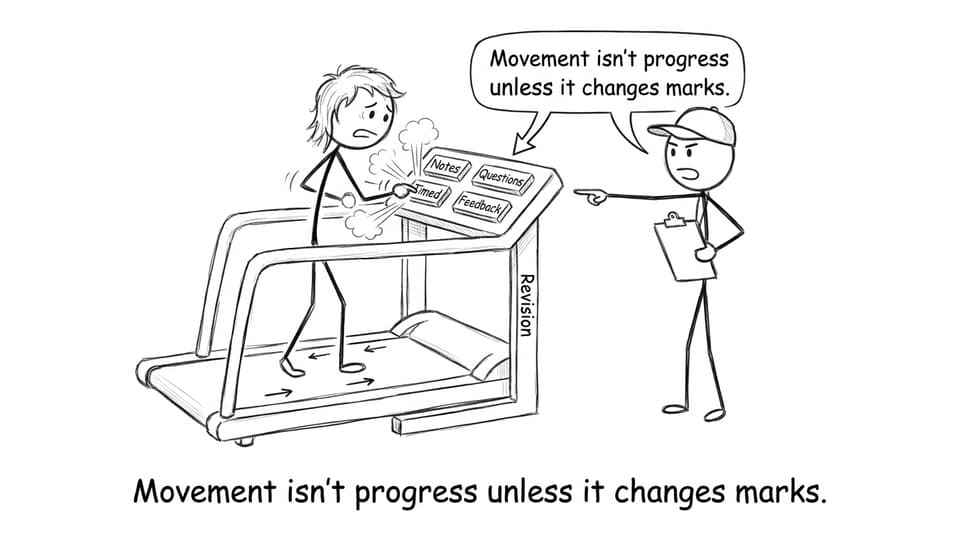
Most jumps from 5 to 6 happen when you stop treating revision like reading, and start treating it like training.
Treadmill labeled Revision where pressing Notes goes nowhere
Use this 3-part IB upgrade loop
Patch one weakness fast
Use concise notes to clear confusion, then close them.
Closing: treat your 5 like information, not a verdict
A 5 in IB is a good score. It’s proof you can handle a rigorous course, meet criteria, and perform under pressure. If you need more, the path is usually smaller than you think: fix a few mistake patterns, practice in the right format, and retest under time.
RevisionDojo exists for exactly that loop: Study Notes for fast clarity, Flashcards for daily recall, Questionbank for targeted marks, AI Chat and Grading tools for feedback, plus Predicted Papers, Mock Exams, a Coursework Library, and Tutors when you need precision help.
If you want the simplest next step, pick one subject and do 20 minutes today: 5 minutes notes, 10 minutes Questionbank, 5 minutes error log. In IB, consistency compounds faster than motivation.