

Introduction: the quiet booklet that decides loud exams
In the IB, the smallest objects can have the biggest consequences.
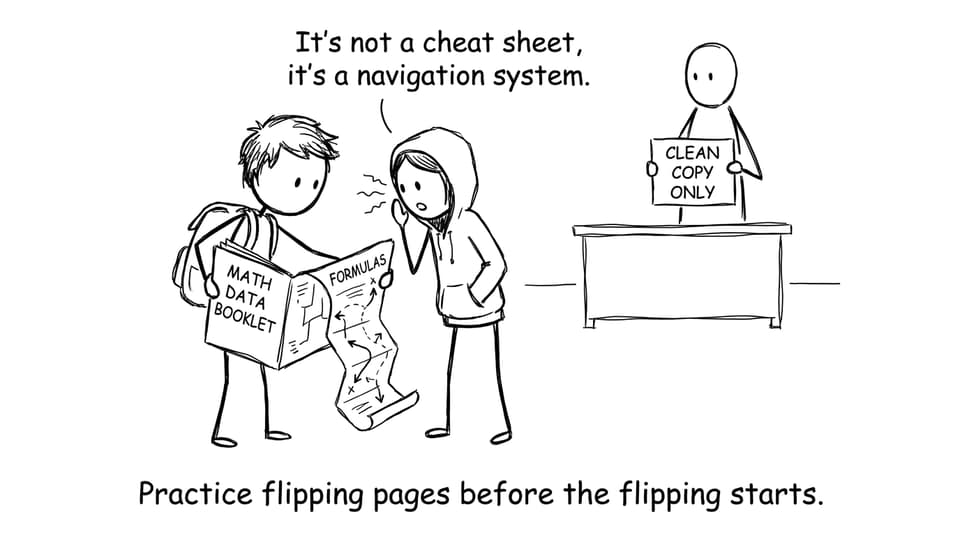
A clean, stapled IB Math data booklet (often called the formula booklet) looks harmless. It feels like a safety net. But on exam day, it behaves more like a map: it helps only if you already know how to read it under pressure.
The students who score well rarely use the booklet because they forgot everything. They use it because they’re efficient. They offload low-value memory work so their brain can spend its energy where the IB actually awards marks: method, reasoning, and communication.
If you’re taking Math AA or Math AI, this guide explains what the IB Math data booklet is, what’s inside, what’s missing, and how to train with it so it becomes automatic.
Quick checklist: how to use the IB Math data booklet effectively
Use this short setup before your next revision session. It works for any IB Math level (AA/AI, SL/HL):
-
Download or open the correct booklet version for your course (AA vs AI, SL vs HL).
-
Print a personal copy and mark it up while revising (you cannot bring annotations into the IB exam).
-
Make a “high-frequency formulas” list for your weakest topics.
-
Practice locating formulas quickly, not just reading them.
-
Pair booklet practice with timed questions so your navigation improves under stress.
If you want an exam-ready booklet view immediately, start with RevisionDojo’s aligned versions for IB Math AA Data Booklet and IB Math AI Data Booklet.
What is the IB Math data booklet, really?
The IB Math data booklet is the formula reference provided during the exams (notably the calculator papers). It includes many of the standard results you need across algebra, functions, trigonometry, calculus, vectors, and statistics.
But it is not a step-by-step guide. The IB will still ask you to decide:
-
which model fits a situation,
-
which formula applies,
-
what conditions are required,
-
and how to present reasoning clearly for method marks.
That distinction matters. The IB isn’t testing whether you can locate a derivative rule. It’s testing whether you can recognize the structure of a problem, choose a method, and execute it accurately.
A helpful mental model: the data booklet reduces lookup friction (facts and notation), but it does not reduce thinking friction (choices and interpretation).
What’s inside the IB Math data booklet (and how to think about it)
Most students try to memorize the booklet’s content as a list. A better approach in the IB is to treat it as a set of “toolboxes” that show up repeatedly.
Algebra and functions
Expect core identities and relationships that support manipulation and modeling. In Math AA, this often feeds symbolic work. In Math AI, it often feeds interpretation and technology-backed solutions.
Trigonometry and geometry
You’ll see common identities and rules (for example, the cosine rule is a frequent friend). The danger here isn’t forgetting the formula; it’s mixing similar-looking forms in a timed setting.
A focused read that pairs well with booklet practice is IB Math: Cosine Rule & Trigonometric Identities.
Calculus
Differentiation and integration tables are classic booklet territory. The important IB skill is knowing what the question is asking for (rate of change, optimization, area, accumulation) and then finding the right entry fast.
If calculus is your stress point, train it with targeted practice from the IB Math AA Calculus hub.
Statistics and probability
This is where the booklet becomes a language guide as much as a formula guide: symbols, distribution parameters, and definitions.
For AI students, this connects directly to interpretation, assumptions, and calculator outputs. Revision can be anchored with the Math AI Statistics and Probability hub or the Math AI Statistics and Probability Questionbank.
Math AA vs Math AI: how the same IB booklet feels different
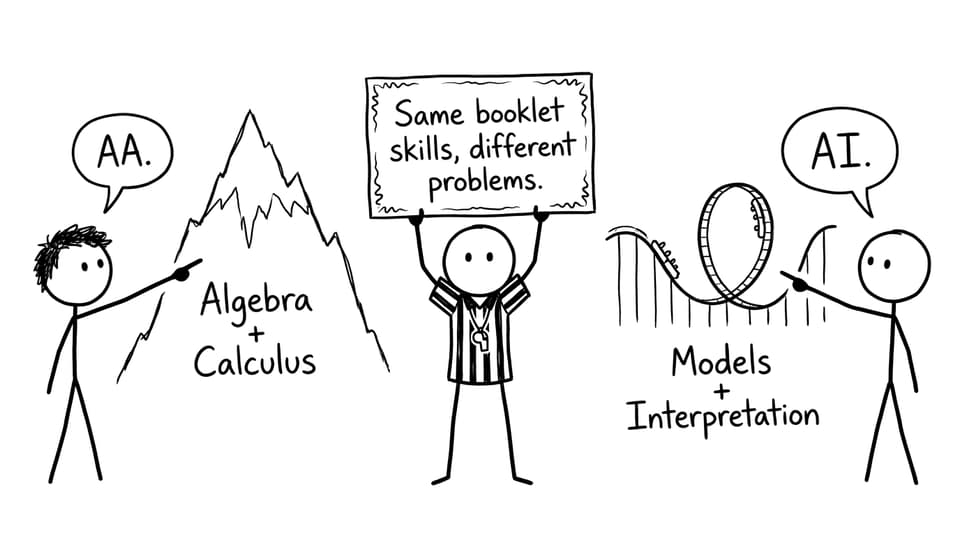
The same IB booklet skill (find, substitute, use correctly) shows up in two different styles of problems.
-
Math AA tends to reward algebraic precision and structured reasoning. You use the booklet to move quickly through standard results so you can spend time on proof-like steps and clean method.
-
Math AI tends to reward modeling and interpretation. You use the booklet to confirm definitions, parameters, and standard forms so your explanation stays accurate and your conclusions match the context.
If you’re still deciding which track fits you, compare course demands in IB Math Demystified: A Complete Guide to AA and AI for Students and the practical decision lens in Which IB Math Is Easier: AA SL or AI SL? Honest Comparison.
What the IB Math data booklet does NOT do for you
This is where many IB students lose marks in a surprisingly predictable way.
The data booklet usually won’t:
-
tell you why a formula works,
-
warn you about common traps,
-
show you which method earns the cleanest method marks,
-
or remind you of prerequisite conditions (domain restrictions, parameter meaning, model assumptions).
So when people say, “You don’t need to memorize anything, the booklet is provided,” they’re describing the wrong challenge. The exam challenge is decision-making under time pressure.
Common mistakes IB students make with the data booklet
Treating it like a rescue boat
If your first serious practice with the IB booklet is in a timed paper, you’ll waste minutes flipping and second-guessing. Those minutes are expensive.
Misreading notation
In probability and statistics, a single symbol mix-up can poison an entire solution. The booklet is precise; your memory under stress is not.
Assuming the booklet replaces fluency
The booklet can give you a formula, but it can’t give you rhythm. You still need speed with high-frequency steps.
Not linking formulas to question types
IB questions are patterned. When you connect “this style of prompt” to “that booklet section,” you reduce your cognitive load.
A practical training plan: make IB booklet navigation automatic
The simplest way to get better is also the least dramatic: repeat a tight loop.
Build a two-column “trigger list”
For each topic, write:
-
Left column: common question triggers (e.g., “find maximum,” “estimate parameter,” “interpret r,” “show that”).
-
Right column: the booklet page/section you typically need.
Do this while practicing, not as a separate project.
Practice with real exam-style questions
This is where RevisionDojo becomes the calm advantage. The IB doesn’t reward reading about formulas; it rewards applying them.
Use:
-
The IB Math AA Resources hub to stay syllabus-aligned.
-
The strategy guide How to Use the Questionbank for Targeted Math Revision to practice with intent.
On RevisionDojo, you can combine Study Notes (to understand the method), the Questionbank (to drill it), AI Chat (to clarify confusion in markscheme language), Flashcards (to keep high-frequency knowledge quick), and Grading tools (to see where marks disappear). When you’re ready for realism, use Mock Exams and Predicted Papers to simulate timing without guessing what to do next.

Do “booklet-only” drills once a week
Choose 10 short questions and force yourself to locate the relevant formula before you start solving. Even if you already know it. This trains the physical habit.
Keep an error log with one extra column
Add a column called “Booklet mistake?” and mark:
-
wrong formula,
-
right formula but wrong substitution,
-
right formula but wrong interpretation.
Over time, you’ll see patterns, and those patterns are exactly what the IB tests.
Conclusion: treat the IB data booklet like a map you’ve already walked
The IB Math data booklet is not a cheat sheet and not a miracle. It’s a shared reference that rewards the students who practice using it before the stakes are real.
If you’re in Math AA or Math AI, your job is simple: learn what’s inside, notice what’s missing, and train navigation until it costs you almost no time. Pair that with smart practice, and the booklet becomes what it was meant to be: a way to protect your accuracy while you focus on reasoning.
Build that system on RevisionDojo: start with the right data booklet (AA or AI), use Study Notes to understand methods, drill with the Questionbank, lock in speed with Flashcards, ask AI Chat when something doesn’t click, and pressure-test everything with Mock Exams and Predicted Papers. The more deliberate your practice, the calmer your IB exam day becomes.