Most IB students remember their best practice session like a highlight reel. The problem is that exams aren’t scored on highlights. They’re scored on consistency.
That’s why IB test revision history matters. Not as a fancy dashboard, but as a simple idea: if you can see your practice evolution over time, you stop guessing and start steering. You stop saying “I think I’m better at this topic” and start saying “I’ve improved 18% in three weeks, but my timing still collapses in the last third.”
And once you can say that, your next study session becomes obvious.
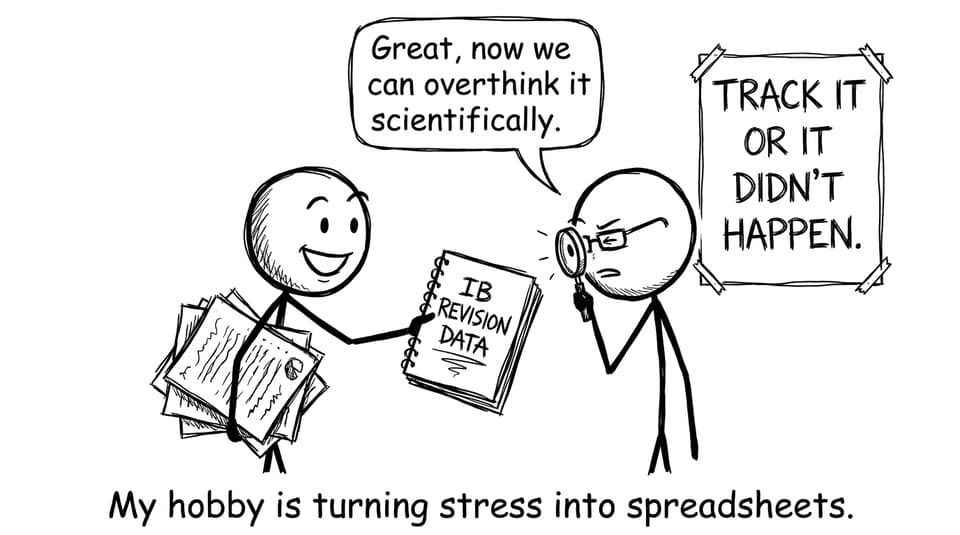
Student turns stress into spreadsheets
A quick IB checklist for tracking practice evolution
If you want your IB revision history to actually help, track these after every timed set or mock:
Score/accuracy (overall and by topic)
Time spent (total and per question type)
Top 3 mistakes (what they were, not just that they happened)
One fix you’ll test within 48 hours
Next drill (exact topic, exact skill)
On RevisionDojo, this loop becomes easier because your practice can connect naturally through Questionbank, Flashcards, , , , and .
4.4
X
Share on WhatsApp
Share on LinkedIn
Share on Facebook
AI Chat
Grading tools
Mock Exams
Predicted Papers
What IB test revision history actually reveals (beyond scores)
A score is a photo. IB test revision history is a film.
When you review multiple attempts, three useful truths show up.
Accuracy trends that tell you what’s sticking
If your accuracy climbs steadily in one topic, your method is working. If it spikes and drops week after week, you don’t need “more practice” in general. You need a different kind of practice: clearer understanding, tighter feedback, or better recall.
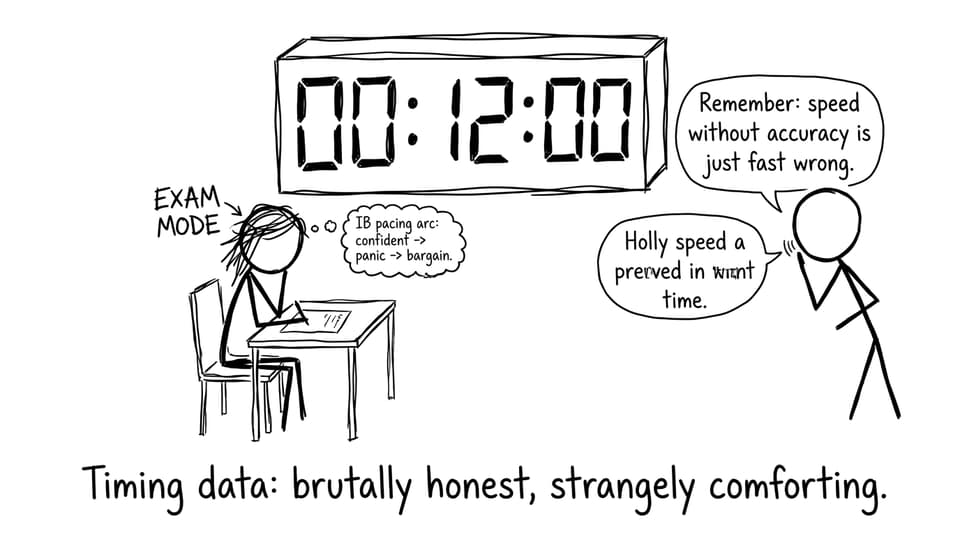
Timing and pacing patterns you can’t “feel” accurately
Many IB students are surprised by their own pacing. You might feel calm, but your data shows you’re spending 6 minutes on early questions and rushing the highest-mark section.
The most expensive mistakes in IB are often repeat mistakes: misreading command terms, skipping a justification step, using the right idea with the wrong structure.
Why IB revision history boosts motivation (without fake confidence)
Motivation usually disappears when effort feels unlinked from results.
IB test revision history reconnects them. You might still have a bad day, but you’ll see the larger trend: fewer repeated mistakes, slightly faster pacing, higher accuracy in one stubborn unit.
That kind of confidence is quiet. It doesn’t depend on one lucky score. It’s built from evidence.
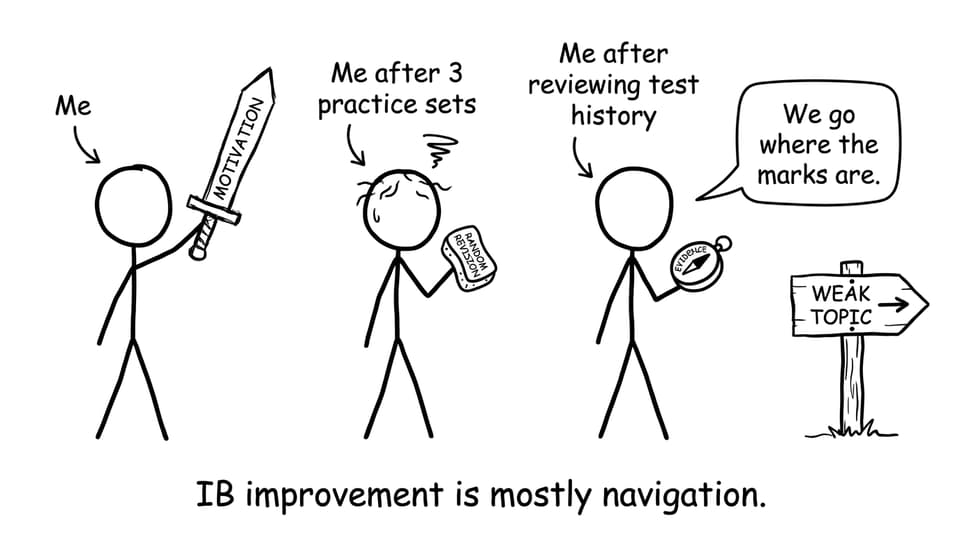
IB improvement is mostly navigation
Common mistakes when students don’t track IB practice
Doing the same comfortable question types repeatedly
Avoiding weak topics because they feel slow
Confusing “reviewed notes” with “can perform under time”
Retesting too late, when you’ve already forgotten the mistake
If you’ve ever felt like you’re working hard but not moving, that’s usually not a character flaw. It’s a tracking problem.
FAQ
Can IB test revision history really show improvement if my scores fluctuate?
Yes, and fluctuations are exactly why IB test revision history is useful. One practice set can be harder, or you can be tired, or you can misjudge pacing early. Over multiple attempts, randomness smooths out and patterns become visible. You’ll notice whether accuracy is trending up by topic, whether timing is stabilising, and whether specific mistakes are repeating. That’s the difference between a snapshot and a trendline. Once you see trendlines, you can change strategy based on evidence instead of emotion.
Is tracking history more useful than reviewing answers right away?
They serve different purposes, and IB students need both. Immediate review teaches you why an answer is right, and what the mark scheme expects. Historical review teaches you what to prioritise next week and what to stop wasting time on. Immediate review improves understanding; revision history improves decision-making. Together, they create a loop: attempt, learn, retest, confirm improvement. If you want that loop to feel seamless, RevisionDojo connects practice in Questionbank and Mock Exams with tools like Flashcards and AI Chat.
How often should I review my IB test revision history?
Weekly is the sweet spot for most IB students. Daily reviews can make you overreact to noise, like one unusually tough set. Weekly reviews are long enough to show trends but short enough to adjust course before habits harden. A good weekly review takes 15--20 minutes: scan accuracy by topic, check timing patterns, list repeat mistakes, and choose one priority fix. Then schedule one targeted retest session within 48 hours. Consistency matters more than perfection here.
Track your IB practice evolution, then make it count
The goal of IB revision isn’t to do more. It’s to learn from what you’ve already done.
When you treat IB test revision history as your compass, your study plan gets calmer and sharper. You know what’s improving, what’s stuck, and what to do next.
If you want everything in one place, RevisionDojo is built for this: Questionbank, Study Notes, Flashcards, AI Chat, Grading tools, Mock Exams, Predicted Papers, a Coursework Library, and Tutors that help turn data into decisions. Start one tracked session today, then let your next session be guided by evidence, not hope.
David holds a PhD in History from the University of Manchester and has taught IB History for 20 years. His focus is the IB History Paper 1 source questions, Paper 2 comparative essays, and Paper 3 depth study, teaching students to argue from evidence rather than narrate.