There’s a specific kind of silence right before you begin an IB oral. You’re holding notes that suddenly look too short. Your global issue feels too big. And your brain tries to solve everything at once: structure, language, timing, analysis, voice.
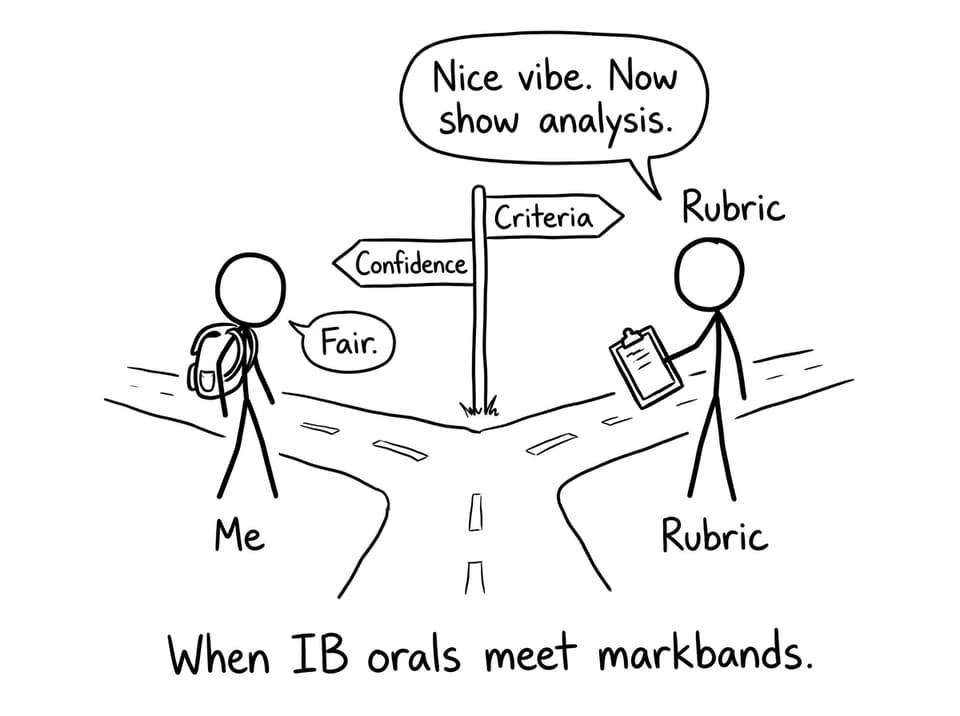
What most students discover (usually after a rough first attempt) is that IB speaking success isn’t “confidence.” It’s control. Control comes from practising the same way examiners evaluate: with criteria, evidence, and repeatable improvement loops.
This guide breaks down IB speaking skills assessment as a comprehensive oral evaluation: what gets rewarded, what gets flagged, and how to train efficiently using RevisionDojo.
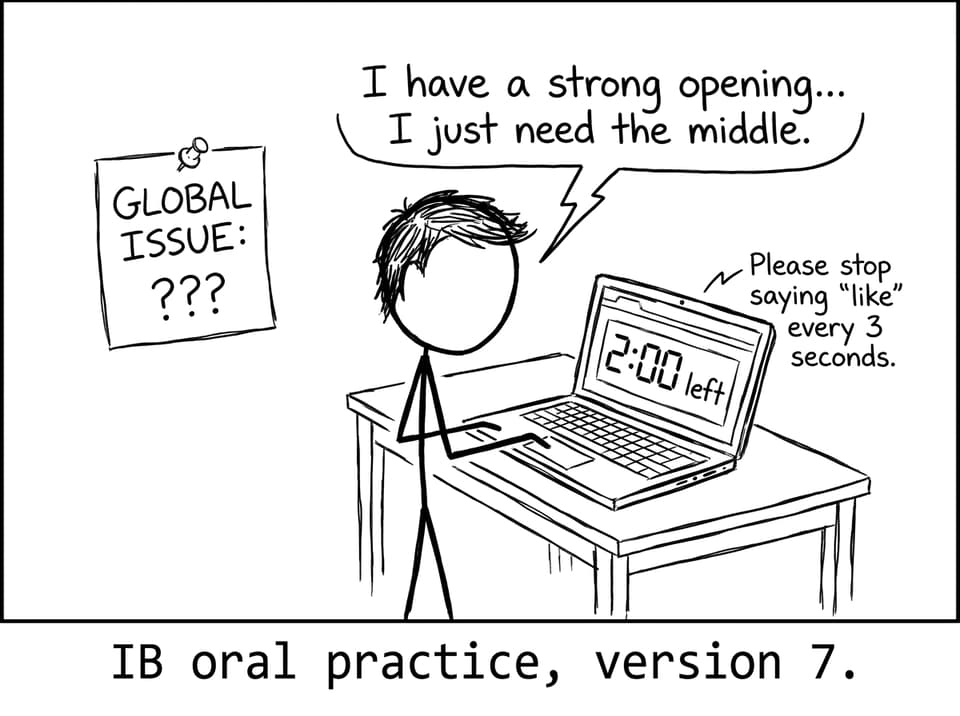
IB oral practice, version 7
A quick IB oral evaluation checklist (save this)
Before you record another practice, check these five things:
Task clarity: Do you know exactly which IB oral format you’re practising (Language A IO vs Language B oral vs TOK-style speaking in older materials)?
Argument spine: Can you state your global issue or central claim in one sentence?
Structure: Do you have a clear beginning, middle, and ending with purposeful transitions?
Evidence + analysis: Are you explaining how authorial choices or examples prove your point (not just describing)?
What “comprehensive oral evaluation” means in the IB
In the IB, speaking is assessed communication. That means your oral is graded on what you say and how reliably you can deliver it within constraints. In most formats, the best performances feel calm because they are built from decisions that match the rubric.
A comprehensive oral evaluation typically looks at:
Knowledge and interpretation: You understand the text(s), context, and implications.
Organization and development: You build a line of reasoning that can be followed.
Language: Accuracy, range, register, and academic phrasing.
Engagement with the big idea: A sustained global issue or argument, not a theme-word.
Timing, clarity, and the hidden cost of filler words
In an IB oral, timing is not a background detail. It changes the quality of your thinking.
When students run out of time, they usually sacrifice the same thing: evaluation. The final minute becomes summary, not insight. A comprehensive oral evaluation should therefore track:
sections that are rushed or overlong
clarity and coherence
repeated phrasing and filler words
whether transitions do real logical work
To make this measurable, practise with tools that turn speech into feedback. RevisionDojo’s oral workflows are built for exactly that, alongside its AI Chat for refining phrasing, Flashcards for theme language, and Study Notes for quick context refreshers.
Transcript-based iteration (progress you can actually see)
A strange truth: you often can’t hear your own vagueness until you see it.
When your spoken response becomes text, patterns become obvious:
repeated sentence starters (“This shows…”)
claims with no mechanism (“This creates tension” but how?)
global issues that stay abstract
If you want that visibility, practise with a transcript loop using IB Oral Transcript Generator: See Your Speech in Writing. Then rewrite only the weakest 20% and re-record. That’s how IB speaking improves fast: not by rewriting everything, but by fixing the bottlenecks.
Common IB oral mistakes a good assessment catches early
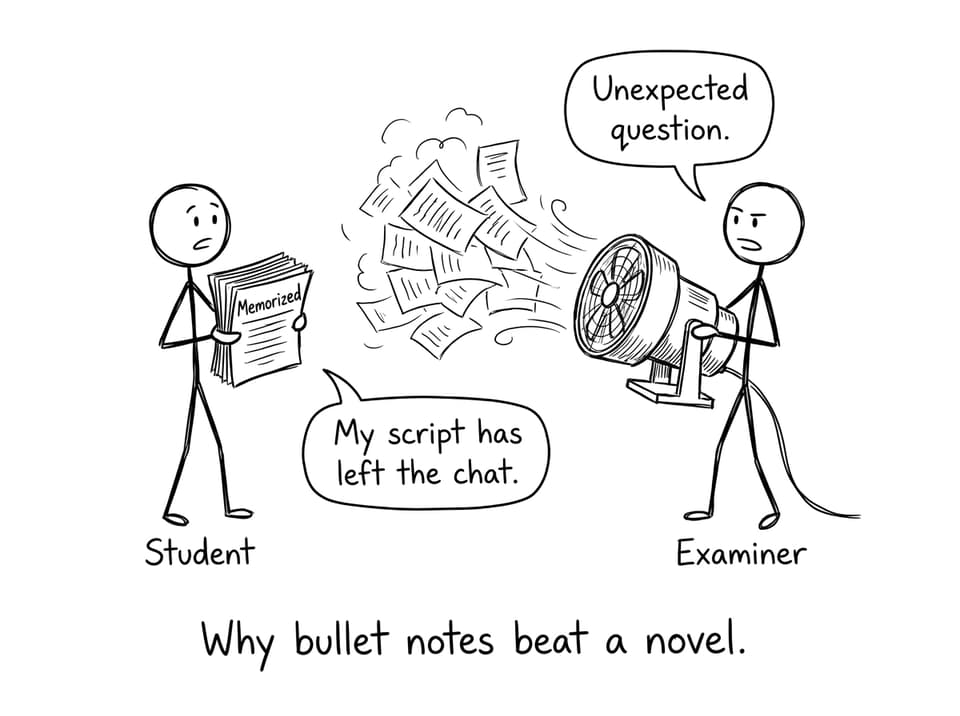
Memorisation often breaks the moment you’re interrupted, questioned, or slightly off pace. Bullet notes create flexibility without sacrificing structure.
Why bullet notes beat a novel
Descriptive commentary instead of analysis
If you keep retelling the plot or describing techniques without linking to meaning and purpose, your marks flatten. Use the simple chain: choice -> effect -> meaning -> global issue.
Inconsistent academic register
Your IB oral should sound like school-appropriate academic thinking: clear, precise, not casual, not robotic. RevisionDojo’s Grading tools and Tutors help here: the tools catch repeatable issues, and human feedback refines nuance.
A simple workflow for IB oral practice (15 minutes a day)
Day 1: Choose your extracts and define your global issue (one sentence).
Day 2: Build a 10-bullet plan. No full script.
Day 3: Record a timed run.
Day 4: Review transcript and fix only weak transitions.
Which IB speaking assessments does this approach help with?
This approach helps with any IB task where you must think aloud under constraints: Language A Individual Oral, Language B speaking formats, and any assessed presentation-style speaking your school uses for practice. The core skill is the same: build a claim, support it, and deliver it clearly within time. Even when the task details differ, the same evaluation pillars show up: structure, evidence, language control, and sustained focus. Students often improve fastest when they stop treating speaking as performance and start treating it as a trainable assessment skill. That is why comprehensive oral evaluation matters: it makes the invisible parts of speaking visible. If you are unsure about the IO format, start with IB English Individual Oral: Strategies + Practice Tools.
How do I know whether feedback is actually “IB-aligned”?
IB-aligned feedback sounds specific in the same way the rubric is specific. It does not just say “add more analysis,” it identifies where you became descriptive and what kind of link was missing. It does not just say “structure,” it points to transitions, pacing, or missing comparisons. It also respects constraints: timing, allowed notes, and the need to sustain a global issue rather than list themes. A good test is whether you can turn feedback into a single actionable change for your next recording. If you can, the feedback is usable. If you can’t, it is probably too vague.
Should I still get human feedback if I use RevisionDojo tools?
Yes, and this is the healthiest way to approach IB speaking: combine fast tool-based iteration with selective human coaching. RevisionDojo gives you the repeatable loop: record, transcript, rubric-aligned scoring, and targeted next steps. That saves time and removes guesswork, especially when you are practising frequently. Human feedback then becomes more valuable because it can focus on nuance: emphasis, audience awareness, natural engagement, and style. In RevisionDojo, you can reinforce this with Mock Exams, Predicted Papers for broader exam readiness (without relying on memorisation), and Tutors when you need a real-time sounding board. Tools build the foundation; humans sharpen the edge.
Build IB speaking confidence that is backed by evidence
The best IB speakers aren’t the ones who “never get nervous.” They’re the ones who trained their orals like an assessment: criteria first, structure second, delivery last. When you practise with comprehensive oral evaluation, you stop hoping your oral is good and start knowing which parts are strong.
If you want that kind of progress, use RevisionDojo as your practice home base: Questionbank to keep your thinking sharp, Study Notes to stay accurate, Flashcards to build language range, AI Chat to refine phrasing, and the platform’s Grading tools to turn every recording into a clear next step.
Your next IB oral doesn’t need more panic practice. It needs one clean loop, repeated until it works.
Li holds an MEd from the University of Hong Kong and has taught IB Chinese A and B for over 15 years. Her focus is IB Chinese character recognition and the higher-level essay, drawing on moderation experience to show what lifts a response into the top band.