


The IB Paper 1 moment you probably know too well
Your pencil is hovering. The timer feels louder than it should. And every option looks… kind of plausible.
That’s the strange truth of IB Paper 1 mock exams: they don’t just test what you know. They test how you decide under pressure. Multiple choice questions (MCQs) reward speed, accuracy, and calm judgment, andand the fastest way to build that judgment is to practice in conditions that feel real, then review like an analyst.
If you want a structured way to do that, RevisionDojo makes IB Paper 1 mock exams repeatable: Mock Exams for timed realism, Questionbank for targeted MCQ drilling, Study Notes and Flashcards to patch knowledge gaps, and AI Chat plus Grading tools to turn mistakes into rules you stop repeating.
Quick checklist for IB Paper 1 mock exams (save this)
-
Know your timing and question count (don’t improvise pacing)
-
Read the stem first, then options (reduce distraction)
-
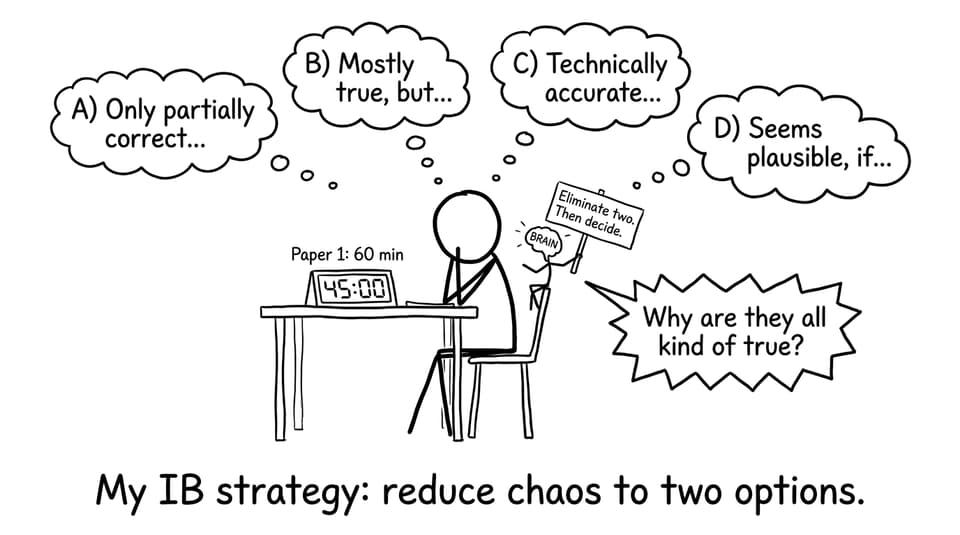
Eliminate 1-2 options fast (force probability in your favor)
-
Guess strategically if needed (no penalty for wrong answers)
-
Review the same day (this is where the score improves)
For a deeper MCQ-specific breakdown, keep this guide open: Group 4: Paper 1A MCQ Tips.
Understand the IB Paper 1 format before you train
In many IB sciences, Paper 1 is a no-calculator MCQ paper and can contribute up to 20% of the final score. Typical timing patterns you’ll see in Paper 1A include:
-
SL: 30 MCQs in 30 minutes
-
HL: 40 MCQs in 60 minutes
That math matters because it changes your behavior. You’re not proving you’re clever; you’re proving you can be reliably correct at speed.
If you’re training specifically for Chemistry, this is a strong companion: IB Chemistry Paper 1 MCQs: A Calm, Fast Approach.
The MCQ method that works in IB Paper 1 mock exams
Read like the question is trying to mislead you
In IB MCQs, wrong answers are often “true statements” that don’t answer this question. So train one habit: predict your answer before looking at options. Even a rough prediction makes traps easier to spot.
Eliminate before you calculate
Your first goal is not “find the right answer.” It’s “remove the wrong ones.” Eliminate the clearly incorrect options quickly, then spend your time comparing the remaining two.
Hunt qualifiers and hidden assumptions
Words like always, only, never, and most likely are where marks disappear. In IB MCQs, qualifiers are often the whole question.
Use educated guessing like a professional
If you’re stuck, choose the best remaining option, flag it mentally, and move on. In IB Paper 1, your enemy is not one hard question; it’sit’s losing four easy ones because you overinvested time.
For more on building a paper-by-paper routine, see: Custom IB Mock Exams: Build Practice Tests by Topic.
Practice IB Paper 1 mock exams under real conditions (then tighten the loop)
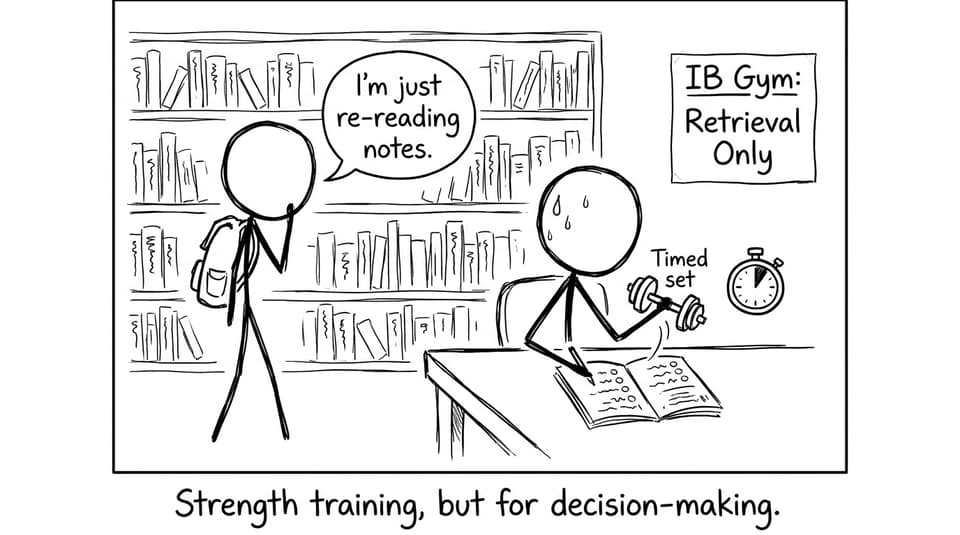
A good IB Paper 1 mock exam isn’t “a big practice.” It’s a controlled experiment:
-
Run a timed sitting using RevisionDojo Mock Exams
-
Build smaller drills in the Questionbank for weak topics
-
Patch knowledge with Study Notes
-
Keep recall warm with Flashcards
-
Ask AI Chat to explain why the right option is right (and why your choice was tempting)
-
Track patterns over time so you stop repeating the same error style
If you want a bigger-picture mock strategy, this helps: Why IB Mock Exams Matter for Diploma Success. And if you’re planning your weeks, use: IB Mock Exam Schedule: How Often Should You Practice?.
Review mistakes like an examiner, not like a disappointed student
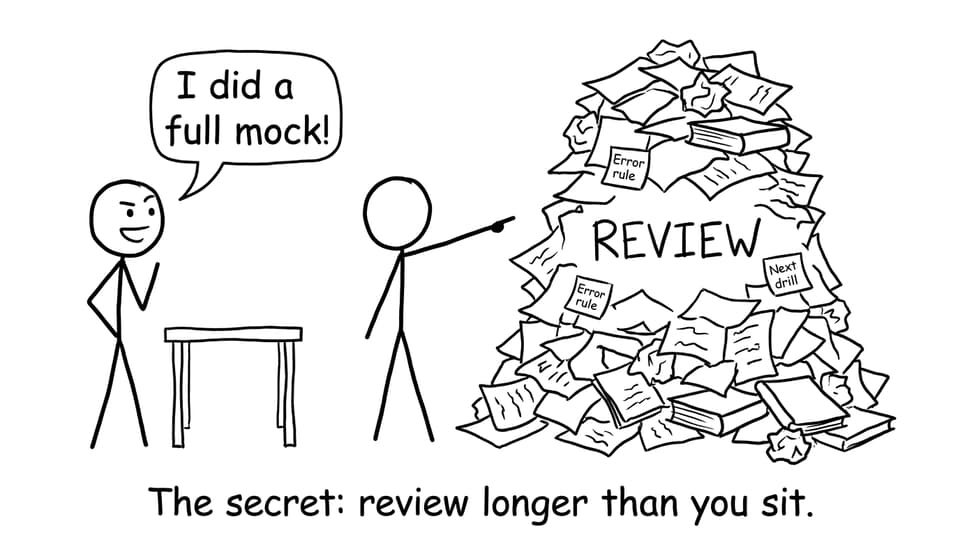
The highest-scoring IB students do something unglamorous: they turn every missed MCQ into a reusable rule.
Try this quick template after each Paper 1 mock:
-
Mistake type: content gap, misread, timing, trap option
-
Error rule: one sentence you can apply next time
-
Fix: 10 targeted questions in the RevisionDojo Questionbank + 3 Flashcards
If you want an all-in-one platform rhythm, see: Comprehensive IB Revision Made Easy. And for retrieval fundamentals that directly boost MCQs: Active Recall for IB: The Only Method You Need.
FAQ
How many IB Paper 1 mock exams should I do for MCQ improvement?
Enough to see patterns, not just scores. In IB MCQs, your first few sittings mainly reveal how you lose marks: misreading stems, falling for qualifiers, or getting stuck on calculations. Aim for one timed Paper 1 mock exam each week once you’re within the main revision window, then add shorter timed sets during the week. The key is spacing: frequent exposure to IB-style phrasing trains your instincts faster than occasional marathon sessions. Use RevisionDojo Mock Exams to simulate full pressure, and the Questionbank for targeted repair sessions. Over time, you should see fewer repeated error types and more stable timing.
What’s the best strategy when two MCQ options both seem correct in IB?
Treat it as a signal that the question is testing precision, not knowledge volume. In IB Paper 1 mock exams, the “two correct” feeling usually means one option answers a slightly different question than the stem. Go back to the stem and underline what is actually being asked: a relationship, a condition, a unit, a direction of change, or a definition boundary. Then test each remaining option against that exact requirement. If you still can’t split them, choose the option with fewer assumptions and move on to protect your time budget. After the mock, use RevisionDojo AI Chat to unpack why the correct option fits the stem more tightly so you don’t repeat the same confusion.
How should I review an IB Paper 1 mock exam so my score actually improves?
Review should be longer than the attempt, because that’s where your brain updates its rules. Start by sorting every wrong question into categories: content gap, misread, trap word, or time pressure. Then write one “error rule” per category, phrased like a habit you’ll use next time (for example: “Predict the answer before viewing options”). Next, patch the minimum knowledge needed using RevisionDojo Study Notes, and lock it in with Flashcards so it survives until exam day. Finally, run a short follow-up drill in the Questionbank focused only on that micro-topic or question style. This loop turns a single IB Paper 1 mock exam into a measurable change in your next one.
A final word: make IB Paper 1 feel familiar
The goal of IB Paper 1 mock exams isn’t to “see what you get.” It’s to make the test feel predictable: same pacing, same traps, same calm decisions, weekweek after week.
Build your routine inside RevisionDojo: drill with the Questionbank, sharpen memory with Flashcards, clarify with AI Chat, simulate pressure with Mock Exams, and boost confidence with Predicted Papers when you’re ready for realism. Then take one more timed set and prove to yourself that your IB score isn’t luck, it’sit’s a system.