



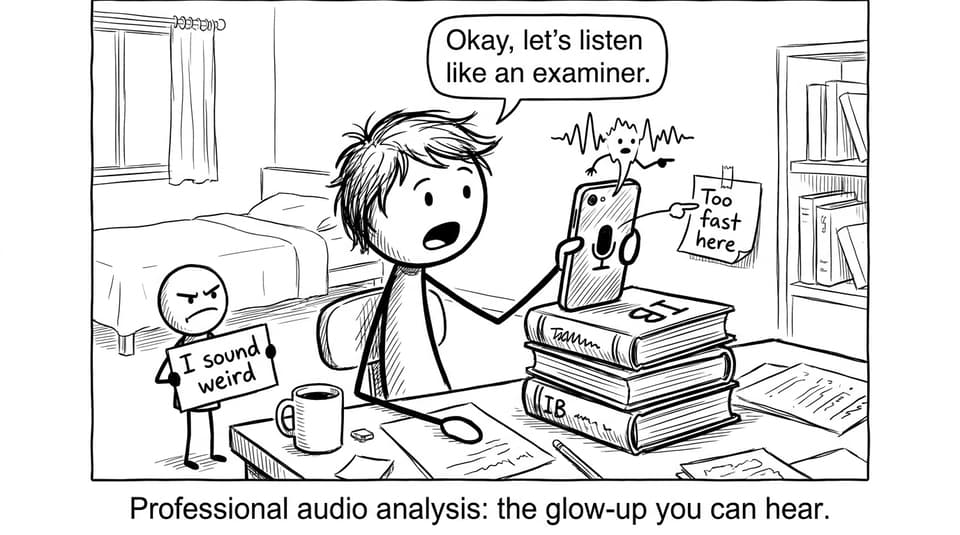
A weird thing happens the first time you listen back to your own voice.
You remember the good ideas you meant to say. You also hear the tiny leaks: the rushed sentence where your claim becomes a blur, the "um" that lands right before your key evidence, the conclusion that arrives breathless instead of sharp.
For an IB oral, those leaks matter. Not because you need to sound like a podcast host, but because the assessment rewards what is clear, structured, and easy to follow under time pressure. That is exactly why an IB oral recording platform with professional audio analysis can be a turning point: it turns practice from vibes into data.
IB oral practice checklist (keep it boring)
Use this quick checklist before every timed run. It keeps your IB rehearsal honest.
-
Record under real timing (no pausing, no restarting mid-sentence)
-
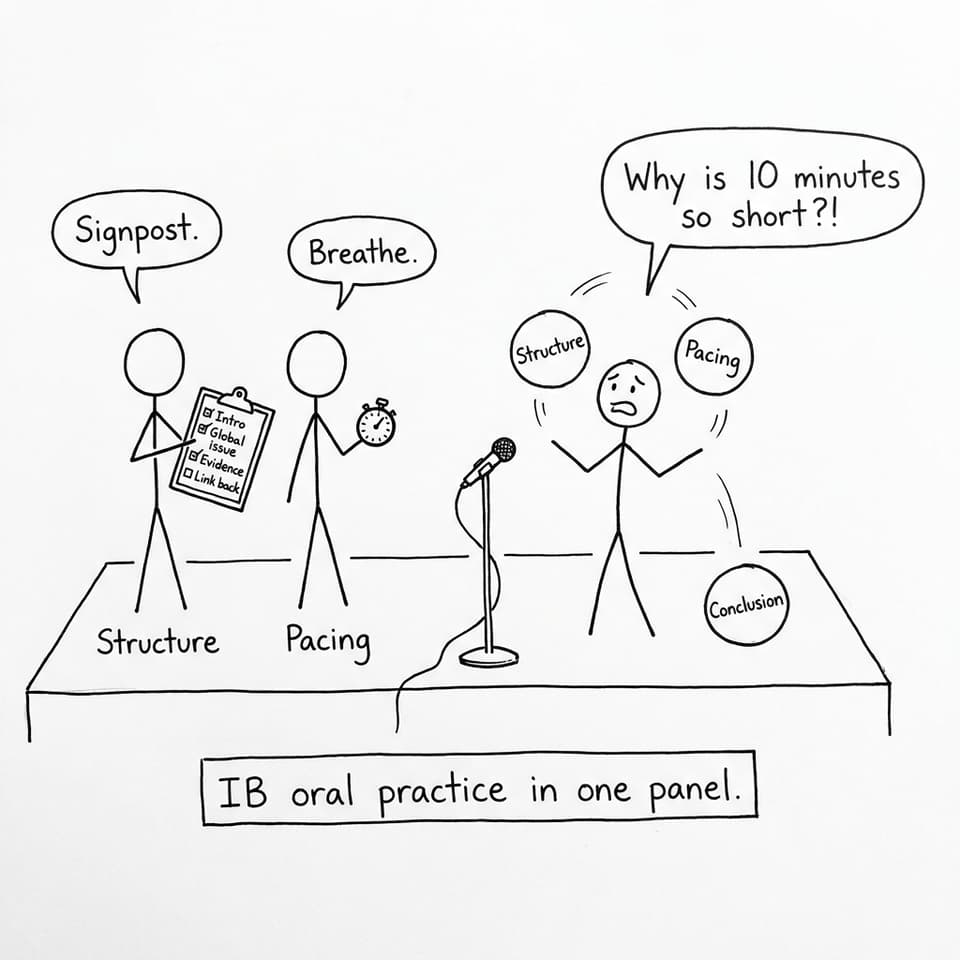
Follow a simple structure: intro, main points, link back, conclusion
-
Track pacing (too fast, too slow, long pauses)
-
Check evidence integration (quote or detail, then analysis, then global issue/theme link)
-
Re-record with one improvement target, not ten
If you want a clear map of what the IO expects, keep this open while you practise: Comprehensive Guide to the IB Individual Oral (IO).
Why an IB oral recording platform beats silent rehearsal
Silent rehearsal is comforting because it hides your weak spots. A recording does the opposite. It shows you what the examiner actually receives: your organisation, your clarity, your ability to sustain a line of argument without drifting into summary.
That is why RevisionDojo’s IB oral workflow is built around repeatable attempts. You record, you get feedback, you adjust one layer, you repeat. It feels less like "performing" and more like training.
If you are working specifically on Language A, pairing recordings with the right planning guidance matters. Start here: IB English Individual Oral: Strategies + Practice Tools.
IB-aligned audio analysis: what you should be measuring
A good IB oral recording platform should not just tell you "good job" or "speak clearly." It should point to what changed your score.
IB structure and organisation (what the listener can follow)
Most students do not lose marks because they have no ideas. They lose marks because the listener cannot track the ideas.
Professional audio analysis helps you hear whether your signposting is doing its job: clear topic sentences, clean transitions, and consistent linking back to your global issue or theme. If you want a structure template that transfers well to spoken delivery, this is useful: How to Structure an FOA for IB: A Step-by-Step Guide.
IB pacing and timing (the hidden mark booster)
Timing is a quiet superpower in IB orals. When you rush, analysis gets compressed. When you go too slow, you cut your best points.
RevisionDojo-style pacing insights help you catch patterns like:
-
Speeding up during analysis (the part that earns marks)
-
Long pauses before evidence
-
Awkward transitions that signal uncertainty
Want a repeatable weekly plan? Try: IB Oral Practice Schedule: Regular Speaking Skill Development.
IB clarity, coherence, and engagement (what your transcript would reveal)
One of the fastest ways to improve is to see your speaking as text. When your speech is transcribed, filler words, vague phrasing, and repeated sentence structures become obvious.
That is why many students pair recording with transcription: IB Oral Transcript Generator: See Your Speech in Writing.
How to use RevisionDojo for an IB oral improvement loop
A reliable IB routine is simple enough to repeat when you are tired.
Record (one take, exam conditions)
Use the tool to record your oral in one uninterrupted attempt. Then stop. No "just one more" halfway.
For students who want an analyser built specifically for IO performance, explore: IB IO Practice Tool: Perfect Your Individual Oral Skills with AI.
Review (one pass for structure, one pass for sound)
First listen for structure: could a stranger outline your argument?
Second listen for sound: pacing, pauses, and clarity.
Patch (tighten content using RevisionDojo resources)
This is where RevisionDojo becomes more than a recorder.
-
Use Study Notes to clarify the criterion expectations and terminology.
-
Use Flashcards for global issue phrasing, method/technique terms, and high-yield sentence stems.
-
Use AI Chat to pressure-test your line of inquiry with follow-up questions.
-
Use Grading tools to understand what "analysis" sounds like when it earns marks.
-
Use the Coursework Library for exemplars and calibration.
-
If you need a human check on delivery, book Tutors for targeted feedback.
Re-record (one goal per attempt)
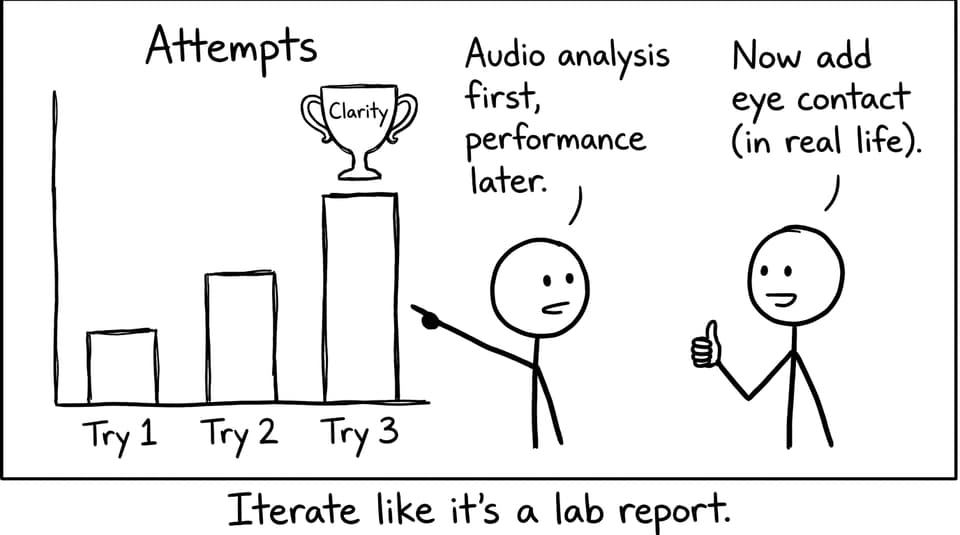
The best loop is small: one attempt improves transitions, the next improves evidence integration, the next improves pacing.
Best practices (and a realistic limitation)
Recorded audio analysis is powerful for IB criteria tied to speech: organisation, clarity, evidence, and timing.
But it cannot fully judge what a live room adds: posture, eye contact, gesture, and how you respond to a teacher’s presence. The balanced approach is to use the platform to perfect what can be measured, then run a live rehearsal with a teacher or peer to polish the human elements.
If you are worried about common oral mistakes, this is worth scanning: Top Mistakes in IB Language Oral Exams and How to Avoid Them.
FAQ
Which IB orals does an oral recording platform help with most?
An IB oral recording platform is most useful when your assessment rewards clarity, organisation, and sustained analysis. That includes Language A Individual Orals and Language B speaking components, where pacing and coherence are often the difference between a good idea and a high mark. It also helps with TOK-style spoken explanations, because the logic of your reasoning becomes easier to audit when you can replay it. Students often discover they have strong points but weak transitions, and transitions are exactly what recordings expose. Over time, the tool becomes less about "recording" and more about building a repeatable performance. If you want broader speaking support across courses, see Multi-language IB Oral Support.
How accurate is IB-aligned audio scoring and feedback?
Good IB feedback systems are accurate in the ways that matter for improvement: they are consistent about structure, pacing, clarity, and whether your analysis is sustained. The most helpful feedback is specific enough that you can act on it in the next attempt, not just nod and move on. RevisionDojo focuses on rubric-aligned categories and practical notes, so you can connect comments to what the assessment rewards. That said, the goal is not to replace your teacher; it is to give you far more practice reps than a teacher could realistically mark. Think of the score as a directional signal that helps you iterate quickly. Then confirm the final polish with a human listener.
What should I do if I improve in recordings but still feel nervous live?
This is common in IB orals because the stress is not only academic, it is social. Use the platform first to remove uncertainty: when your structure and timing are predictable, nerves have less room to hijack you. Next, add one live rehearsal where you stand up, keep your permitted notes, and practise looking up at set moments (for example, at every transition). After that, do a shorter recorded run to lock in the improved delivery, because repetition reduces anxiety faster than reassurance. If you need a simple training schedule, follow IB Oral Practice Schedule: Regular Speaking Skill Development and treat it like a gym plan. Over a few weeks, the live version starts to feel like just another attempt.
Final take: make your IB oral measurable
The students who improve fastest in IB orals are not always the most naturally confident speakers. They are the ones who run a calm loop: record, analyse, patch, re-record.
RevisionDojo is built to support that loop end-to-end: Questionbank for exam thinking, Study Notes for clarity, Flashcards for recall, AI Chat for quick explanations, Grading tools for rubric alignment, Predicted Papers and Mock Exams for timed pressure across subjects, plus a Coursework Library and Tutors when you want a human edge.
If your next IB oral matters, do not leave it to a final-night run-through. Use an IB oral recording platform, listen like an examiner, and let the feedback guide the next attempt.