


Mock exams don’t fail IB students. Unreviewed mock exams do.
Most IB students can remember at least one practice test that felt like a storm: you finish, you’re relieved, you glance at the score, and then you shove it in a folder and move on. But the real advantage of an IB mock isn’t the number at the top. It’s the trail of evidence underneath it, including timing decisions, repeated mistakes, and the specific skills that leak marks when pressure shows up.
This guide shows you how to use practice tests effectively so each IB mock becomes a training loop (not a one-off event), especially when paired with RevisionDojo’s Questionbank, Study Notes, Flashcards, AI Chat, Grading tools, Predicted Papers, Mock Exams, Coursework Library, and Tutors.
IB mock exam strategies: the 20-minute checklist
Before you take your next IB mock, run this quick setup:
-
Choose one paper or one realistic section (not “the whole subject”).
-
Set a timer and remove distractions.
-
Decide your pacing rule (minutes per mark, or per question).
-
After the mock, schedule a same-day review session.
-
Write an error log: what happened, why, and what you’ll change.
-
Build the next drill set based on your mistakes (not your feelings).
For topic-targeted sets, RevisionDojo’s Questionbank makes it easy to pull exam-style questions by topic and difficulty.
Simulate real IB conditions (so your brain learns the right skill)
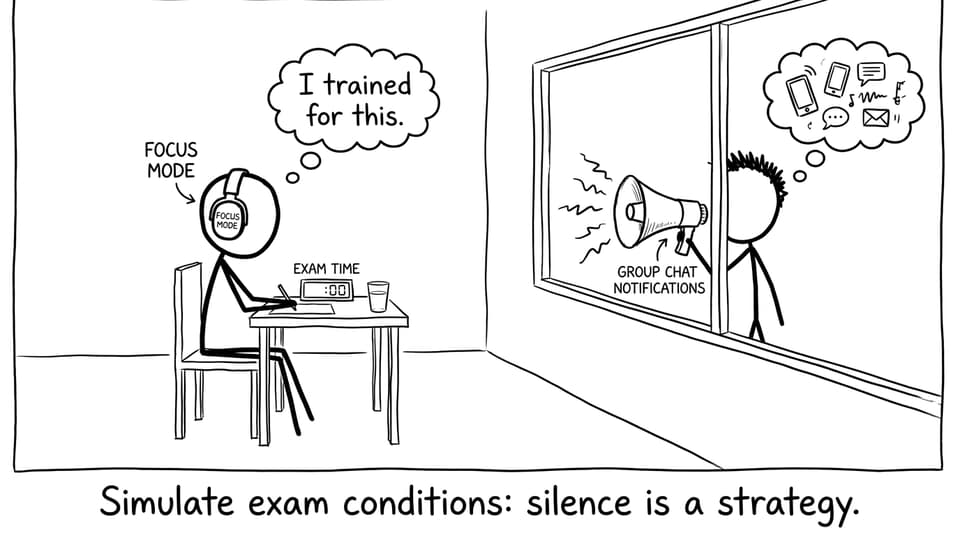
The cleanest IB mock exam strategies start with realism. If you always practice in “comfortable mode,” your first true timed sitting becomes a shock. Do the opposite: make your practice test feel like exam day.
Sit the paper timed, with only the resources allowed for that subject. Train your attention span, not just your knowledge. If you fade in the final third of the paper, that’s not a personality flaw; it’s a stamina gap you can train.
If you want a deeper routine for building timing without burning out, bookmark How to Study for IB Mocks (Without Burning Out).
Review like an examiner, not like a student
A score tells you where you are. Review tells you how to move.
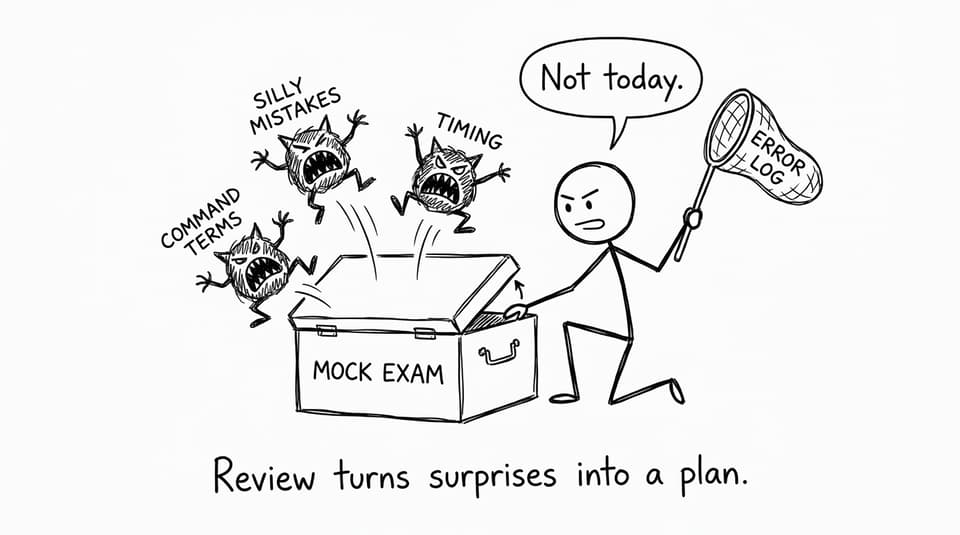
Use mark schemes (and your teacher’s expectations) to ask more precise questions:
-
Did I lose marks because I didn’t know content, or because I didn’t show it clearly?
-
Did command terms change what the question needed?
-
Did I write too much in low-mark sections and too little in high-mark ones?
Then rewrite just one weak response immediately. That single rewrite is where many IB students finally “get” what top-band answers look like.
To make this easier across subjects, pair your review with RevisionDojo’s analytics and practice loop from IB Question Analytics: Track Your Question Performance.
Use analytics to choose the next mock (not the next panic)
Strong IB mock exam strategies are data-driven. After each practice test, look for patterns:
-
Which topic types drop your accuracy fastest?
-
Where does your pacing collapse (early perfectionism vs late rushing)?
-
Which mistake type repeats: careless slips, misread questions, weak structure, or concept gaps?
Then build the next week around those patterns. This is where RevisionDojo’s ecosystem helps: use Study Notes to patch understanding, Flashcards to prevent repeat memory slips, and AI Chat to clear the “10-minute confusion” that can otherwise steal an hour.
A helpful next read is IB Test Builder: Create Custom Exams for Targeted Practice, especially if you want to turn one weak area into a targeted mini-mock.
Rotate by paper skill, not just by subject
Many IB students revise by subject blocks only. Better: rotate by paper skill.
One session might be “data-response accuracy.” Another might be “essay structure under time.” Another might be “short-answer precision.” This stops revision from becoming vague and forces your mock exams to train specific performance.
If you want an example of a paper-specific loop, see How to Use RevisionDojo to Prepare for IB Math Mock Exams.
FAQs about IB mock exam strategies
How many IB mocks should I take before exams?
Enough to build proof, not exhaustion. Early on, one IB mock per subject every few weeks can be plenty, because your biggest gains come from fixing fundamentals and learning the paper patterns. Closer to exams, increase frequency, but keep quality control: every mock must produce a clear error log and a targeted next-step plan. If you’re taking lots of practice tests and your weaknesses aren’t changing, you’re collecting scores rather than building skills. A good sign you’re doing it right is that each new IB mock feels slightly more familiar, even when the questions are new. If you need a realistic pacing plan, Is 1 Month Enough to Study for IB Exams? gives a practical weekly structure.
Should I review immediately after every IB mock?
Yes, and the timing matters. Same-day review is powerful because you still remember what you were thinking when you chose an answer or structured a paragraph. That makes your corrections more honest: you can see whether you misunderstood content, rushed the command term, or got trapped by timing. Start by reviewing your biggest mark losses first, not the first question you see. Then convert repeating mistakes into a short drill set in the Questionbank and a few Flashcards, so the same error doesn’t return next week. That review loop is the heart of effective IB mock exam strategies, because it turns effort into adaptation.
How do I avoid burnout while using IB mock exam strategies?
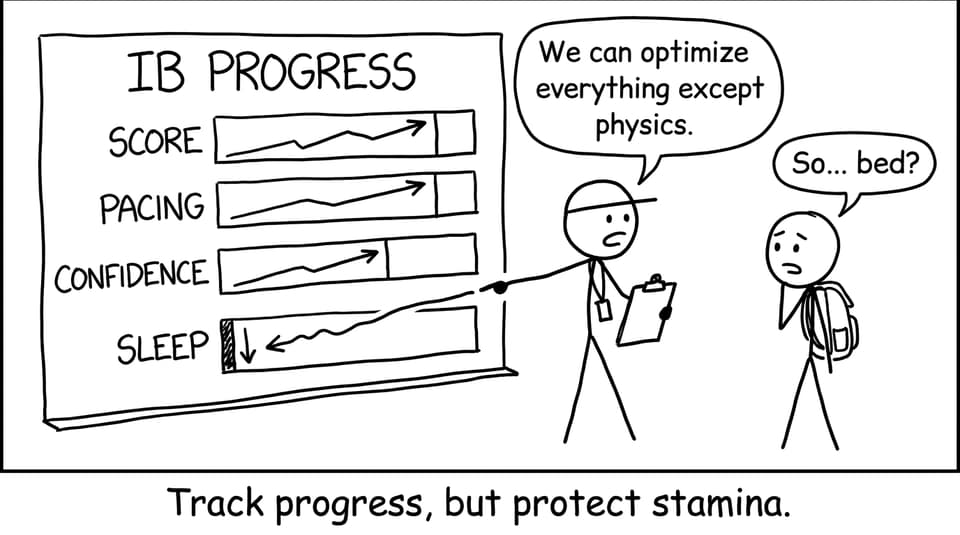
Treat mocks like weight training: progressive overload, planned rest, and good form. Rotate between full mocks and shorter timed sections so your week has intensity without constant maximum pressure. Use lighter days for Study Notes, Flashcards, and small Questionbank sets to keep momentum without draining willpower. Also protect sleep, because poor sleep creates “fake difficulty” that makes even easy IB questions feel hard. If you’re consistently dreading every session, that’s a signal to adjust volume, not to quit. For a calmer structure that still improves results, revisit RevisionDojo App: The Smarter Way to Prep for IB Exams.
Make your next IB mock count
The best IB mock exam strategies are simple: simulate, review, diagnose, target, repeat. When you run that loop inside RevisionDojo, using Mock Exams and Predicted Papers for realism, Grading tools and AI Chat for feedback, Study Notes and Flashcards for retention, and the Questionbank for targeted practice, each practice test stops being a stressful event and starts becoming a reliable system.
If you want your next IB mock to produce measurable improvement (not just a number), start with RevisionDojo’s IB mock exam strategies guide and build your next training loop from there.